

There's a moment most product orgs hit around 6–8 product managers where things quietly stop working. Not in a dramatic way. Roadmaps still ship. Standups still happen. But PMs start spending Tuesdays reconciling analytics discrepancies, Wednesdays chasing rollout approvals, and Thursdays cleaning up a botched flag config that nobody owned. The strategic work — the reason you hired them — keeps getting pushed to "next sprint."
Product Ops exists to absorb that operational tax. But most teams either don't formalize it, or they hire one "Product Operations" person and dump everything on them until they burn out. Neither works at scale.
What actually works is treating Product Ops like a service function with a defined menu, response commitments, and staffing ratios — the same way you'd think about IT support or a design system team. This post lays out that model concretely: what the service should offer, what SLAs are realistic, how many ops people you need per PM, and which KPIs tell you whether it's working.
Why PMs quietly become part-time operations staff
The core issue is that operational work is invisible until it fails. Nobody schedules "spend 4 hours validating that the new checkout event fires correctly across web and mobile." It just happens, reactively, usually the night before a launch review when someone notices the conversion numbers look wrong.
The same pattern keeps showing up across product teams of different sizes. As the number of surfaces, feature flags, experiments, and downstream data consumers grows, the coordination surface grows faster than headcount. A single PM at a 3-person startup can hold all of it in their head. That same PM at a 40-person product org is now coordinating with data engineering, legal, three squads, and a customer success team that files tickets in a tool they've never opened.
-
Analytics trust. Dashboards disagree. Someone spent a quarter optimizing against a metric that was double-counting.
-
Rollout coordination. A feature ships to 100% before support was trained, before the help doc existed, before sales knew.
-
Intake chaos. Feedback, bug reports, and feature requests arrive through six channels and none of them connect to the backlog.
None of these are strategy failures. They're operational failures. And when PMs personally patch them, you're paying senior-IC salaries to do work that a well-defined ops function could handle better and more consistently.
The Product Ops services menu
The mistake teams make is defining Product Ops by who it is instead of what it delivers. "Our Product Ops person handles… stuff." That's how you end up with a role that's impossible to scale, backfill, or measure.
Eliminate product chaos and align your team.
Itemyly helps you plan, prioritize, and track every product milestone seamlessly.
- Centralized roadmap management
- Stakeholder collaboration
- Release tracking & analytics
No credit card required
Define it instead as a menu of named services. Here's a starting menu covering the three highest-leverage areas — intake, analytics QA, and rollout support — plus the connective tissue that ties them to the roadmap.
| Service | What it delivers | Trigger | Typical turnaround |
|---|---|---|---|
| Feedback intake & triage | Deduped, tagged, routed feedback tied to backlog items | Continuous | Same-day acknowledgment, 3-day routing |
| Analytics QA | Event validation, dashboard sign-off, discrepancy investigation | Pre-launch + monthly audit | 2–4 business days |
| Rollout support | Rollout plan, comms checklist, staged release coordination | 2 weeks before GA | Plan drafted in 3 days |
| Experiment operations | Setup review, sample-size check, results readout template | Per experiment | 1–2 days for setup review |
| Release notes & internal comms | Changelog, sales/support briefs, help-doc handoff | Per release | 24–48 hrs before ship |
| Roadmap hygiene | Backlog grooming support, dependency flagging, status accuracy | Weekly | Ongoing |
| Reporting & metrics ops | KPI dashboards, portfolio status rollups, exec-ready summaries | Weekly/monthly | Scheduled |
The point of writing it out this way isn't bureaucracy. Once a service is named and has a turnaround expectation, PMs can rely on it. They stop doing it themselves because they know it'll get done. That reliability is the whole product.
Intake: the front door nobody guards
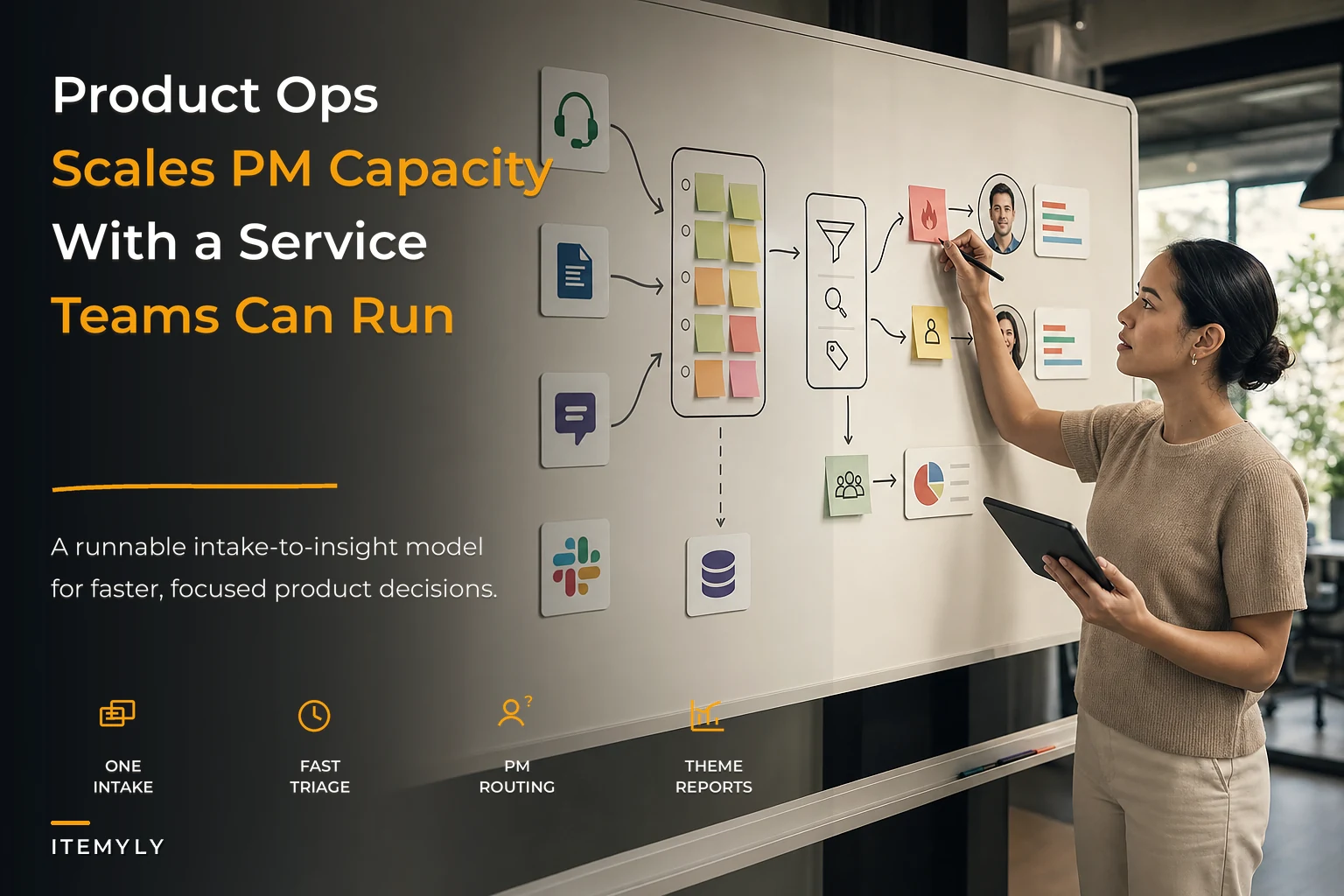
Intake is where most of the leverage hides. When feedback arrives across support tickets, sales calls, in-app surveys, and Slack DMs, it either disappears or lands on a PM's plate as raw noise. A good intake service does three things: captures everything in one place, dedupes and tags it, and routes it with enough context that a PM can make a decision in minutes instead of doing archaeology.
-
All channels funnel into a single intake queue — support tool, sales notes, and in-app feedback all pipe in.
-
Ops triages daily
deduping, tagging by theme and product area, attaching customer and revenue context.
-
Items above a severity or frequency threshold get routed to the owning PM with a short summary.
-
Everything else gets clustered into a monthly themes report so patterns surface even when individual items don't.
The teams that get this right treat intake as a filtering system, not a collection system. If you've already built a filtering rubric for noisy feedback, intake ops is what keeps it running so it doesn't decay after the first enthusiastic month.
Here's a visual of that workflow.
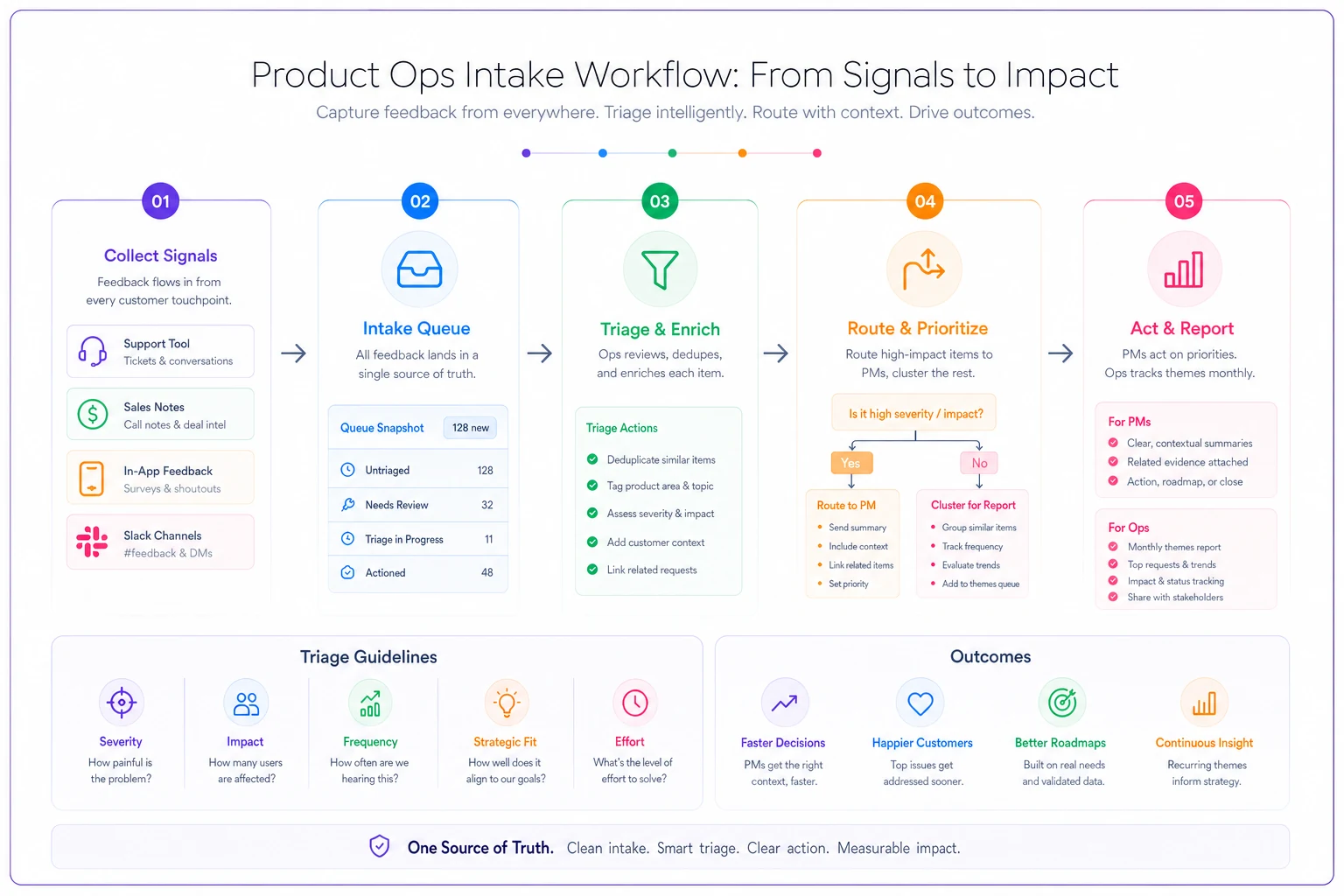
Treat intake as a filtering system, not a collection system — codify the filtering rubric so it doesn't decay after the first month.
Analytics QA: the service that saves you from optimizing the wrong thing
This is the one people underinvest in until it burns them. A typical failure: a squad ships a redesign, the "add to cart" event gets renamed during the refactor, and for three weeks the funnel dashboard shows a cliff that isn't real. The PM spends a week chasing a "conversion drop" that was a tracking bug the whole time.
-
Pre-launch verify new events fire correctly across platforms, confirm they map to the right dashboard, sign off before GA.
-
Monthly audit spot-check high-stakes metrics for drift, double-counting, and definition mismatches between teams.
-
Discrepancy investigation when two dashboards disagree, ops runs it down instead of the PM.
The KPI here is simple and brutal: how many launches shipped with instrumentation that had to be fixed post-launch? If that number is above zero with any regularity, your PMs are making decisions partially blind.
Rollout support: where cross-team coordination lives or dies
Rollouts fail on coordination, not code. The feature works fine; support wasn't briefed, the help center article doesn't exist, and sales promised the old behavior to a customer last week. Rollout ops owns the around-the-launch work so the PM can own the launch decision itself.
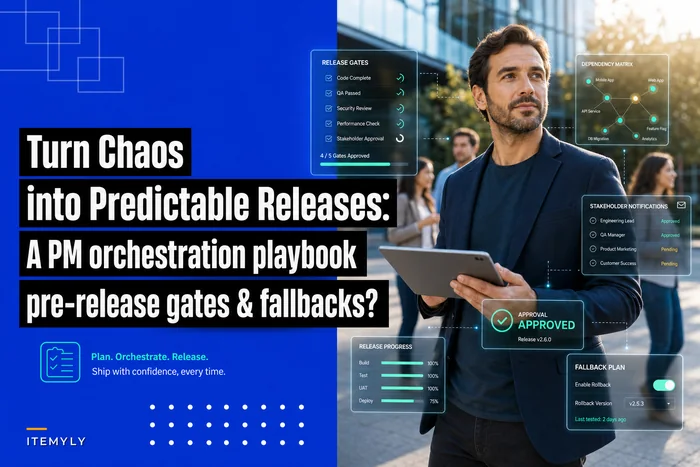
This overlaps heavily with cross-functional orchestration — if you've already got a solid PM orchestration playbook for cross-team launches, rollout ops is the standing function that executes it every release instead of reinventing the checklist each time. A staged rollout plan, a comms checklist for support and sales, a help-doc handoff, staged percentage releases with rollback criteria — all delivered on a predictable timeline before GA.
Example SLAs that are actually realistic
SLAs only work if they're honest about capacity. Promising same-day analytics QA when you have one ops person supporting eight PMs is how you get a service nobody trusts by month two.
| Service | Response SLA | Resolution SLA | Notes |
|---|---|---|---|
| Feedback intake acknowledgment | Same business day | Routed within 3 days | Automated ack, human routing |
| Analytics QA (pre-launch) | 1 business day | Sign-off within 4 days | Must be requested 1 week before GA |
| Analytics discrepancy | 1 business day | 3–5 days depending on depth | Complex ones get scoped separately |
| Rollout plan | 1 business day | Draft in 3 days | Requires 2-week lead time |
| Release comms | Same day | 24–48 hrs before ship | Blocked if scope changes late |
| Experiment setup review | 1 business day | 1–2 days | Before experiment starts |
Two things make SLAs survive contact with reality. First, lead-time requirements go both ways — the service commits to a turnaround if the request arrives with enough runway. A rollout plan requested 48 hours before GA gets best-effort, not the SLA. Second, exceptions are documented, not argued. When a PM needs to bypass the queue, there's a fast-track path with a named approver, so urgency doesn't quietly erode the whole system.
Staffing ratios: how many ops people per PM
This is the question everyone asks and few answer with real numbers. Honestly it depends on complexity, but here are ranges that hold up.
-
Early / low complexity (one product, few surfaces) 1 Product Ops person per 6–8 PMs. Mostly intake and reporting hygiene.
-
Scaling / moderate complexity (multiple squads, real analytics stack, regular experiments): 1 per 4–5 PMs. Analytics QA and rollout support start needing dedicated attention.
-
Complex / high compliance (multiple products, regulated surfaces, heavy experimentation): 1 per 3–4 PMs, often specialized — one person owns analytics ops, another owns rollout and comms.
The mistake is waiting until PMs are visibly drowning before adding the first ops hire. By then you've already lost months of strategic capacity and probably shipped a couple of instrumentation messes. A rough rule: when your PMs are collectively spending more than a day a week on operational reconciliation, you're past the point where one ops person pays for themselves.
A related mistake is over-hiring in the wrong direction — bringing on three ops generalists when what you actually needed was one person who deeply owns analytics QA. Staff to your biggest recurring failure, not to the org chart.
KPIs product managers can adopt immediately
Product Ops should be measured on whether it gives PMs their time and trust back. Vanity metrics like "tickets closed" miss the point entirely. These are the ones worth tracking:
-
PM operational load — hours PMs spend on ops work per week. This should trend down after the service launches. Sample a few PMs monthly if you can't measure it precisely.
-
Instrumentation defect rate — percent of launches that shipped with analytics needing post-launch fixes. Target: trending toward near-zero.
-
Intake cycle time — median time from feedback received to routed or clustered.
-
Rollout readiness score — percent of launches where support docs, comms, and staged plan were ready before GA.
-
Dashboard trust — qualitative but real
are PMs making decisions off dashboards, or rebuilding their own spreadsheets? If it's the latter, analytics QA isn't working.
-
Roadmap status accuracy — how often the reported status of an item matches reality when spot-checked.
These tie directly back to strategy execution. A Product Ops function that keeps status accurate and dashboards trusted is doing the plumbing that makes your operating model mapping objectives to roadmap to delivery actually reflect reality instead of drifting into fiction two weeks after planning.
A real scenario
A B2B SaaS company with four product squads and seven PMs was shipping fine but losing roughly a day per PM per week to operational cleanup — analytics reconciliation, chasing rollout approvals, and re-tagging feedback that arrived through support, sales, and an in-app widget nobody had connected to the backlog.
They formalized Product Ops with two people: one owning analytics QA and reporting, one owning intake and rollout support. Nothing fancy — just the menu and SLAs above.
Within about a quarter, a few things shifted. Launches shipping with broken instrumentation dropped from a near-monthly occurrence to essentially none, because pre-launch event validation became a required sign-off. Feedback routing time went from "whenever a PM got to it" — sometimes two or three weeks — to same-day acknowledgment with routing inside three days. PMs got back somewhere around 4–6 hours a week each, which went straight into discovery and stakeholder work.
The revenue impact was harder to pin down precisely, but the qualitative shift was obvious: PMs stopped being the last line of defense against operational messes and started spending their time on decisions only they could make.
When this makes sense — and when it doesn't
When it makes sense: You have more than five PMs, multiple product surfaces, a real analytics stack that people make decisions on, and recurring evidence that PMs are doing reconciliation work. If your governance is also shaky — decisions getting lost, status drifting — Product Ops pairs well with a stronger governance and escalation playbook, since ops maintains the accuracy those decisions depend on.
When it's a bad idea: You have two or three PMs and one product. At that scale, formal Product Ops is overhead. The founders or PMs can hold the whole picture, and adding a service layer just introduces handoffs where none were needed.
Who should NOT do this: Teams trying to use Product Ops to paper over a lack of prioritization discipline. If your real problem is that nobody can decide what to build, an ops function won't fix it — it'll just make the chaos more efficiently documented. Fix the decision-making first; Product Ops is for scaling execution, not compensating for the absence of strategy.
Where automation quietly helps
Once the menu and SLAs are in place, a lot of the repetitive parts — deduping intake, tagging feedback by theme, flagging analytics discrepancies, generating status rollups — are exactly the kind of work AI-assisted operational tooling handles well. Instead of an ops person hand-sorting 200 pieces of feedback a week, automation clusters and tags them, and the person spends their time on judgment calls and routing.
The value isn't replacing the ops function. It's raising the ratio — letting one ops person credibly support more PMs by removing the mechanical parts of intake and QA. But the automation only works if the underlying system is defined first. Automating a chaotic intake process just gives you faster chaos.
Closing thought
Product Ops isn't a job title to fill or a nice-to-have you get to eventually. It's the difference between PMs who spend their days on strategy and PMs who spend their days as unpaid operations staff. Define it as a service with a clear menu, honest SLAs, and staffing ratios that match your complexity — then measure it on whether your PMs are getting their time and their trust in the data back. Start with whichever service is causing the most pain right now, prove it works, and expand from there.
Ready to elevate your product management?
Join 2,000+ product teams using Itemyly to accelerate delivery, improve alignment, and build better products.