



The most expensive thing in roadmap work isn't the wrong bet. It's the decision that got made, then quietly un-made three weeks later because nobody could point to where it lived. Someone remembers agreeing to deprioritize the billing rework. Someone else remembers the opposite. The slide deck says one thing, the Slack thread says another, and by the time anyone digs it up, engineering has already burned two sprints on the wrong assumption.
That's not a communication problem. It's a governance vacuum. And it gets worse as you add teams, not better. This is the playbook for closing that gap: who owns what, when decisions get reviewed, how approvals actually flow, and what to say when something needs to jump the line.
Why decisions evaporate (and why meetings make it worse)
Meetings feel like where decisions happen. They're usually where decisions get discussed and then lost. The verbal "yeah, let's do that" carries zero weight a month later. Nobody wrote down the tradeoff, the owner, or the conditions under which you'd revisit it.
A pattern shows up constantly in teams between 20 and 80 people: the roadmap is technically documented, but the authority around it isn't. You can see what's planned. You cannot see who is allowed to change it, who needs to be consulted, or what triggers a reopen. Every ambiguous moment becomes a fresh negotiation.
Here's the mechanic that breaks things. When authority is fuzzy, people default to one of two behaviors:
-
Over-escalation — every small tradeoff gets pushed up to a director because nobody feels safe deciding.
-
Silent override — a team quietly changes course because asking permission feels slow, and now the roadmap and reality have drifted apart.
Both come from the same root: no explicit map of who decides what, at what altitude. A roadmap governance playbook exists to make that map boring and obvious, so 90% of decisions never need a meeting at all.
Role definitions: the part everyone skips
Most teams think they have roles defined because they have titles. Titles aren't decision rights. A "Product Owner" title tells you nothing about whether that person can unilaterally pull a committed item out of the quarter.
Eliminate product chaos and align your team.
Itemyly helps you plan, prioritize, and track every product milestone seamlessly.
- Centralized roadmap management
- Stakeholder collaboration
- Release tracking & analytics
No credit card required
The fix is to define roles by decision, not by job. Below is a lightweight model that works across most product orgs. Adapt the labels, keep the columns.
| Decision type | Decides | Consulted | Informed | Can escalate |
|---|---|---|---|---|
| Reprioritize within a team's own quarter | Product Owner | Tech Lead | PM lead | Tech Lead |
| Pull a committed cross-team item | PM lead | Affected team leads | Stakeholders, Eng director | Any affected team |
| Add net-new work mid-quarter | PM lead + Eng lead (joint) | Finance if >2 wks effort | Leadership | PO of displaced work |
| Change a public/customer-facing date | PM lead → Eng director sign-off | Support, Sales, CS | Whole org | Sales, CS |
| Kill an in-flight initiative | Product director | Sponsoring stakeholder | Team | Sponsor |
The single most useful column here is the last one. Most role docs define who decides but never define who is allowed to object and how. When you name the escalation path in advance, disagreement stops feeling like insubordination and starts feeling like process.
One mistake to avoid: don't put more than one name in the "Decides" column for routine work. Joint ownership sounds collaborative and works fine for big irreversible calls. For everyday tradeoffs, two deciders means zero deciders. Something sits until a meeting forces it, which is exactly the failure you're trying to fix.
When heavy role definition is a bad idea
If you're a team of six shipping one product, don't build this. You'll spend more time maintaining the RACI than making decisions. Governance overhead should scale with coordination cost. Below roughly 15 people on a single roadmap, a shared doc and a weekly 20-minute sync beats any formal structure.
The threshold where this starts paying off: when a decision made by one team routinely affects another team's committed work. That's when informal authority breaks.
Review cadences that actually get used
Cadences fail for a dull reason—teams schedule the meeting but never define what the meeting is for. A weekly review that re-discusses the whole roadmap is just a status meeting with a nicer name. Each cadence needs a different altitude and a different output.
Weekly (team-level, 20–30 min) Purpose: catch drift early. Not for strategy.
-
Anything slipping against its delivery band?
-
Any new urgent request that needs triage this week?
-
Any decision made this week that needs to be written down?
Output: an updated status and a list of items to escalate. That's it.
Monthly (cross-team, 45–60 min) Purpose: reconcile dependencies and confirm commitments still hold.
-
Which cross-team dependencies moved?
-
Any commitment now at risk?
-
Any accumulated small changes that add up to a scope shift?
Output: a short decision log entry per material change.
Quarterly (leadership + PM leads, half-day) Purpose: re-baseline. This is the only cadence where big bets get reopened.
-
What did we commit last quarter vs. what shipped?
-
Where did we consistently mis-forecast?
-
What's the next quarter's committed vs. exploratory split?
Output: a re-baselined roadmap and a written rationale for the top three tradeoffs.
The thing most teams miss: the quarterly review is where you audit your own decision quality, not just your delivery. Pull up the decisions you made last quarter and ask which ones you'd make again. Teams that do this get measurably better at estimating within a few quarters because the feedback loop finally closes. Teams that only review output keep making the same misjudgments.
A real example: a fintech product group of about 40 people was running one giant weekly "roadmap meeting" for everyone—close to 25 people, 90 minutes, every Tuesday. Roughly 20 of those people were passengers most weeks. They split it into team-weeklies plus a monthly cross-team sync and moved big reopens to quarterly. Total meeting time dropped from around 22 person-hours a week to somewhere in the 6–7 range, and—more importantly—decisions stopped getting relitigated in hallway conversations because there was now an obvious place for each type of change to live.
Here's a simple visualization of these cadences and where decisions and escalations flow.
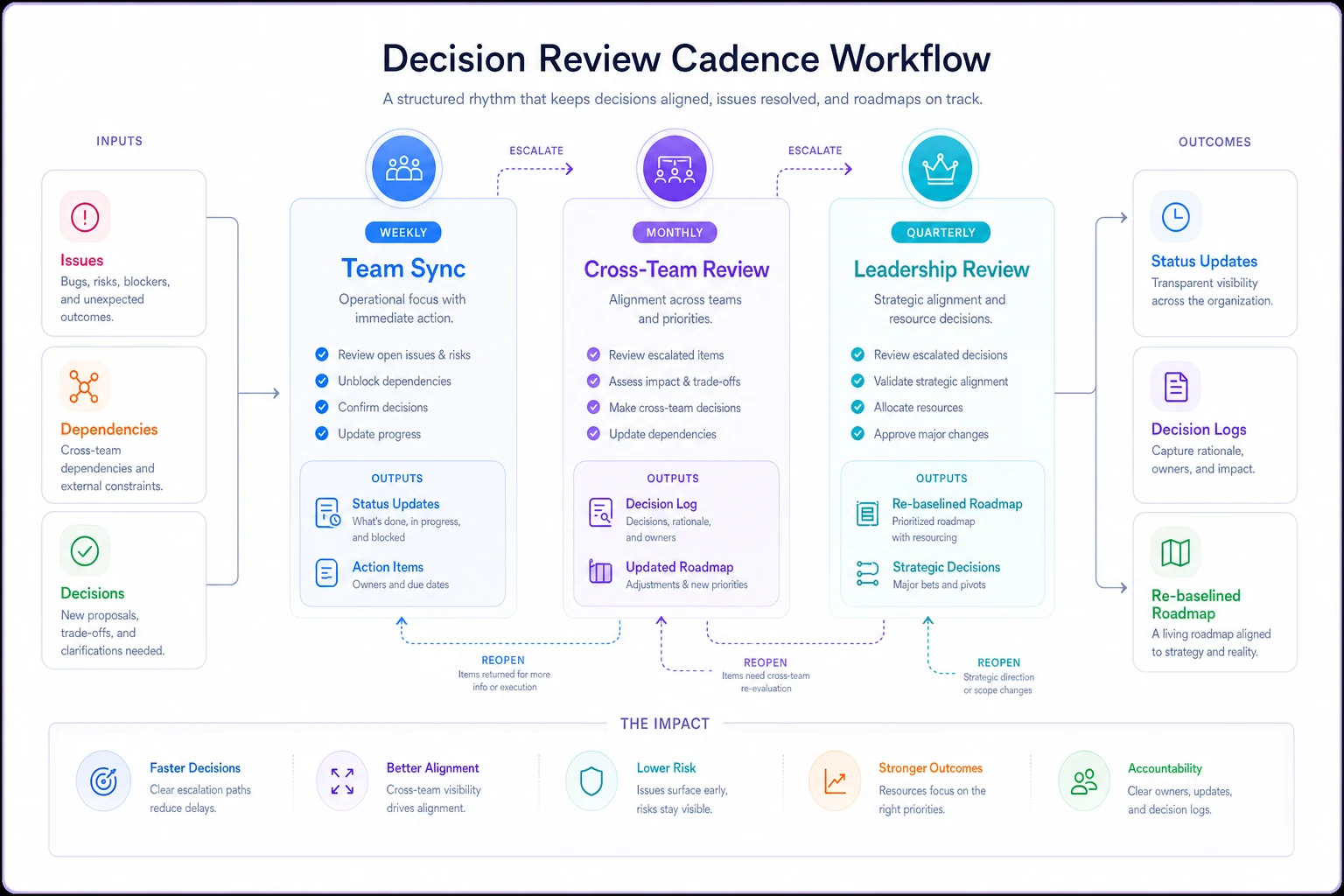
That visualization helps teams align on where each type of decision belongs so discussions don't keep showing up in the wrong meeting.
Approval flows: keep them lightweight or watch them get bypassed
The fastest way to guarantee people route around your process is to make approval feel like paperwork. Heavy approval flows don't create control—they create shadow decisions. Someone just does the thing and apologizes later.
Good approval flows follow one rule: the weight of the approval should match the cost of being wrong. Reversible, cheap changes need almost no approval. Irreversible or cross-team-expensive changes need a real gate.
A workable tiering:
-
Tier 0 — self-service. Reordering within your own team's backlog, small scope trims. No approval. Just log it.
-
Tier 1 — async sign-off. Changes affecting one other team. Post the change + rationale in a shared channel or ticket; the affected lead has 48 hours to object or it's approved by default. Silence = yes.
-
Tier 2 — explicit approval. Pulling committed work, changing effort by more than roughly two weeks, or touching a customer commitment. Named approver must actively say yes, in writing.
-
Tier 3 — leadership gate. Killing an initiative, changing a public date, reallocating budget. Goes to quarterly or an ad-hoc leadership decision.
That "silence = yes" default in Tier 1 is doing heavy lifting. Without it, async approvals stall for a week because everyone's busy. With a default and a clock, decisions keep moving and the burden is on the objector to speak up—which is where it belongs.
One caution: default-approve only works when the change is visible. If people post approvals into a channel nobody reads, "silence" doesn't mean consent—it means nobody saw it. The whole flow depends on the change landing somewhere the right person actually looks.
Escalation scripts: the part that saves relationships
Escalation gets emotional because people improvise it. Someone frustrated fires off a message that reads as an attack, the other lead gets defensive, and now it's a conflict instead of a decision. Scripts remove the improvisation.
The goal of a good escalation script is to make the escalation feel routine. You're not going over someone's head—you're following the documented path everyone agreed to.
Template for a peer-level escalation (blocked dependency):
> "Flagging a dependency risk per our escalation process. [Team X]'s work on [item] depends on [item] from [Team Y], which now shows slipping to [date]. This puts [committed outcome] at risk. I'd like a 15-min sync by [date] to either confirm a new date or agree on a mitigation. Looping in [PM lead] as informed per our roles doc."
Template for escalating up (need a decision above your authority):
> "Bringing this up because it's above team-level authority per our governance model. We have a conflict between [commitment A] and [new request B]—both can't fit this quarter. Here's the tradeoff [one sentence each side]. We need a decision by [date] to avoid wasted work. Recommending [option] and why. Happy to take it async if that's faster."
Two things make these work. First, they cite the process—"per our escalation path," "above team-level authority"—which depersonalizes the ask. Second, they always include a decision deadline and a recommendation. Escalating without a recommendation just dumps the problem upward and slows everything down. The people you escalate to will thank you for arriving with a proposed answer.
Worth naming: teams that write these scripts once and reuse them tend to escalate more, not less—and their leaders describe those escalations as helpful rather than annoying. When escalation is scripted and expected, it stops being a last resort and becomes a normal tool.
What to write down, and where it lives
None of this survives if the decisions don't have a home. The most common failure isn't bad decisions—it's decisions with no durable record. Six months later nobody can reconstruct why you killed the mobile push work, so someone proposes it again, and you re-litigate a solved problem.
Minimum viable decision record:
-
What was decided (one sentence)
-
Why (the tradeoff, not just the choice)
-
Who decided and who was consulted
-
Date and revisit trigger (what would make you reopen this)
-
Link to supporting context
The "revisit trigger" field is underrated. Most decisions aren't permanent—they're right given current conditions. Writing down what would change your mind means the next reopen is fast and evidence-based instead of a fresh argument. Example: "Deprioritized because it affects fewer than 3% of accounts. Revisit if that crosses 10% or a strategic customer requests it."
Make the revisit trigger specific and measurable so future reopens are based on clear evidence, not memory.
Where it lives matters as much as what's in it. Decision records buried in meeting notes are effectively gone. They need to be searchable, in one place, findable by anyone who joins the team next quarter. The test is simple: can a new PM find why a decision was made without asking anyone? If yes, your governance is working. If they have to DM three people, it isn't.
A realistic before/after
A B2B SaaS company, roughly 55 people across product and engineering split across four teams. The symptoms were textbook: decisions made in a leadership sync would get quietly reversed by teams who weren't in the room, cross-team commitments slipped without warning, and the same three arguments came back every planning cycle. They estimated somewhere around 3–4 engineering weeks per quarter lost to work started on decisions that later got reversed.
They didn't buy anything new. They built the map:
-
A one-page decision-rights table (like the one above)
-
Three cadences with defined outputs
-
The four-tier approval model with the 48-hour async default
-
A shared, searchable decision log with revisit triggers
After about two quarters, reversed-decision waste dropped to under a week per quarter. But the change people actually talked about was softer—planning meetings got shorter because half the "decisions" were already made and documented, and the recurring arguments stopped recurring because there was a record with a rationale to point at.
That's the real return. Not fewer decisions. Fewer decisions that leak, drift, or come back from the dead.
When to build this—and when not to
Build it when:
-
More than one team's work depends on decisions made elsewhere
-
You've caught yourself re-arguing something you thought was settled
-
Reorgs or leadership changes keep resetting your roadmap context
-
You can't answer "who's allowed to change this?" for a committed item
Skip it (for now) when:
-
You're small enough that everyone's in every conversation
-
Your roadmap changes so fast that documented decisions would be stale weekly
-
The overhead of maintaining it would exceed the cost of the occasional dropped decision
Governance is a tax you pay to reduce coordination chaos. Below a certain size, the chaos is cheaper than the tax. Above it, the tax is the bargain of the year.
The point
Roadmap decisions don't get lost because people are careless. They get lost because there's no system that says who decides, when it gets reviewed, how it gets approved, and where it's written down. Put those four things in place—roles, cadences, approvals, records—and the meeting stops being where decisions go to die.
Start with the decision-rights table. It's the piece that unlocks everything else, and you can draft a usable first version in an afternoon. The rest layers on top once people trust that authority is finally, boringly clear.
Ready to elevate your product management?
Join 2,000+ product teams using Itemyly to accelerate delivery, improve alignment, and build better products.