

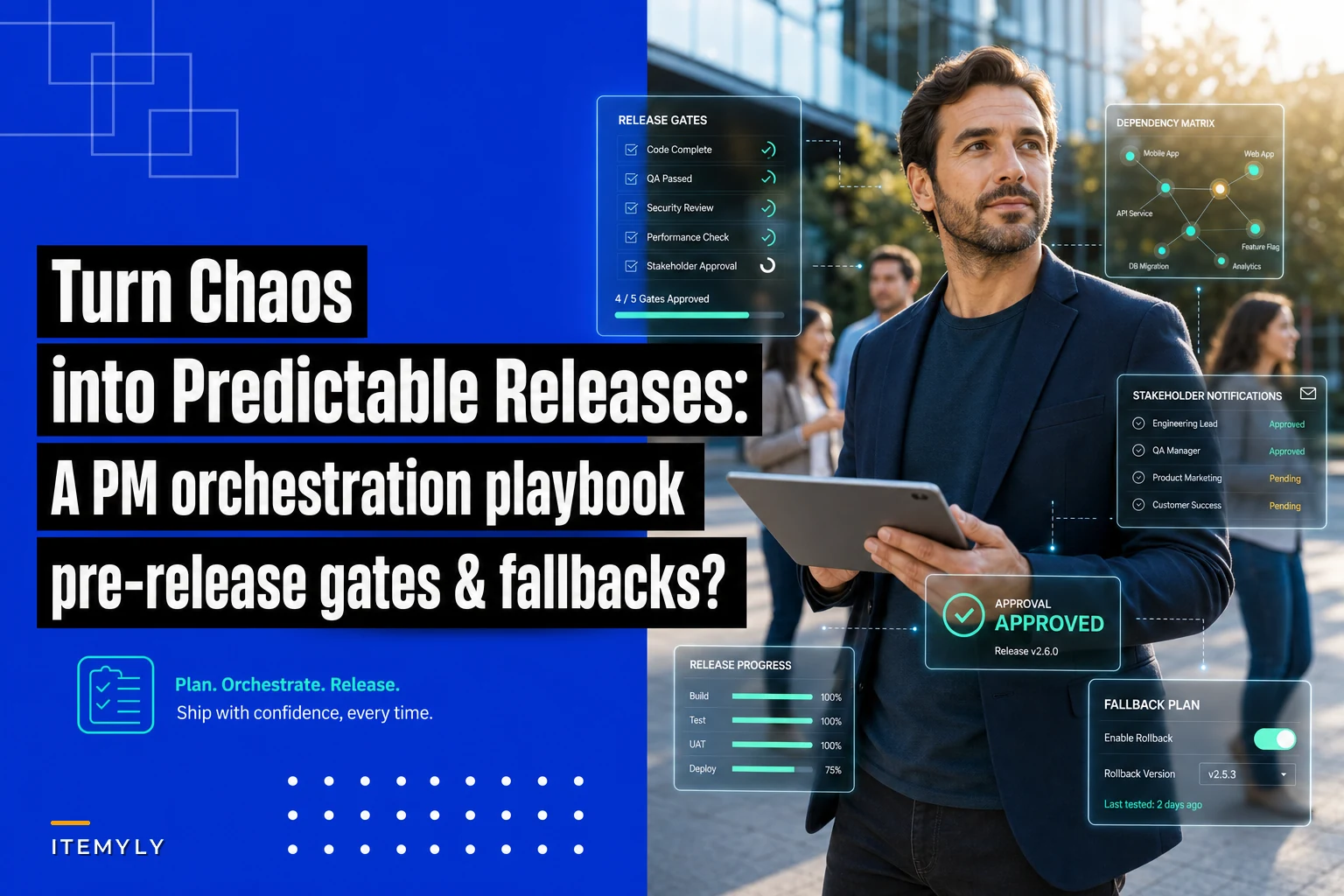

Most product managers track sprint velocity, feature completion, and release dates. What they don't track is the 15–20 hours per release spent in emergency coordination because marketing built campaigns for features engineering deprioritized or support learned about breaking changes via customer complaints.
The cost compounds fast. A fintech startup I worked with estimated they were burning about $42,000 per quarter on coordination overhead — PMs spending nearly a third of their time firefighting instead of planning. Their mobile team shipped a payment update that broke the web checkout because release coordination lived across 14 Slack threads.
Why traditional release planning breaks at scale
The standard approach looks simple: engineering owns the release calendar, product writes requirements, marketing gets a two-week heads-up, and support hears about changes during all-hands. That works with one product team and fortnightly releases but collapses once three or more teams ship continuously.
A typical week: Team A ships a backend API on Tuesday, Team B's mobile feature depends on it and ships Thursday, and Team C assumed the old API would remain live until month-end. Marketing scheduled webinars based on a misunderstood "end of month."
The breakdown accelerates when teams use different tools: engineering in Jira, product in ProductPlan, marketing in Monday.com, support notes in Notion. Each tool becomes its own isolated truth. I consulted for a marketplace that shipped 12 breaking changes in a quarter; partners only learned when angry emails arrived.
The compound effect of missing dependencies
Dependencies are rarely simple links on a Gantt chart. A single change often ripples through monitoring, billing, partner integrations, and support workflows — and teams rarely document all of those touches.
Eliminate product chaos and align your team.
Itemyly helps you plan, prioritize, and track every product milestone seamlessly.
- Centralized roadmap management
- Stakeholder collaboration
- Release tracking & analytics
No credit card required
-
Fraud team needs new rules for the payment provider's risk signals
-
Data team needs ETL updates for transaction reporting
-
Mobile team needs SDK updates pushed through app-store review
-
Accounting needs reconciliation logic adjusted
-
Customer support needs macros for payment failure scenarios
Miss any of these and you risk partial outages, data inconsistency, or support tickets no one can resolve. One B2B SaaS company pushed a pricing-tier update and missed a hardcoded onboarding flow; new trials failed for six hours. The fix took 20 minutes; rebuilding trust took months.
Building pre-release gates that actually prevent disasters
Approval workflows aren't the same as operational gates. Three people clicking "approve" in Jira won't stop bad releases. You need gates that verify readiness across every impacted system and require evidence, not checkboxes.
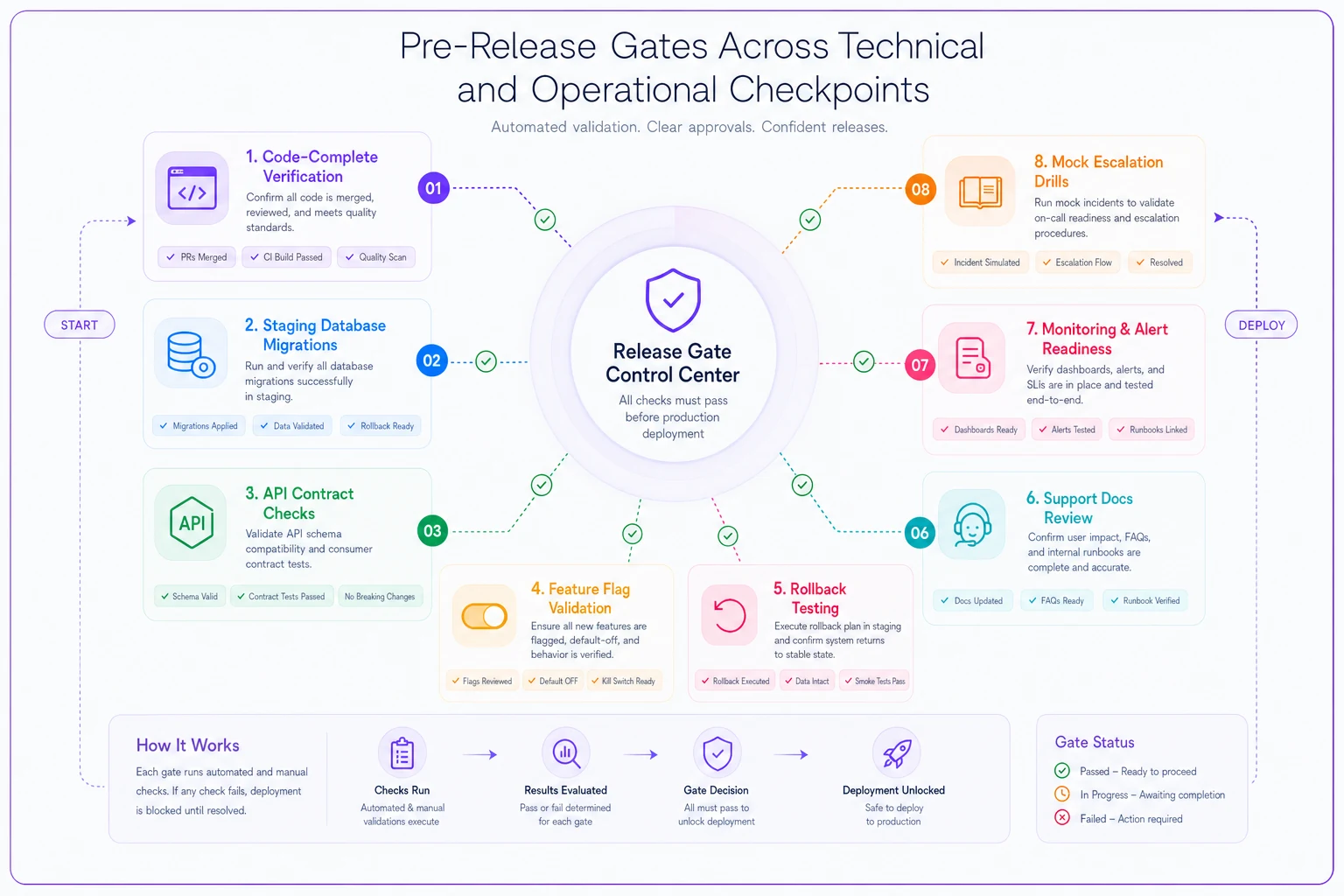
Start with technical readiness gates that verify more than "code complete."
-
Database migrations run successfully in staging with production-scale data
-
API contracts match what consuming teams actually use, not just docs
-
Feature flags work correctly across all environments
-
Rollback procedures have been tested with an actual rollback
-
Performance benchmarks hold under expected load
One platform engineering team enforced these gates in their pipeline so releases couldn't proceed until automated tests validated downstream services. Their breaking changes dropped from several per quarter to zero in six months.
Add operational readiness checkpoints: technical readiness means little if operations and support aren't prepared.
-
Support documentation exists and support can demonstrate handling a mock escalation
-
Customer communications are drafted and reviewed by responder teams
-
Internal training is complete for anyone touching the feature
-
Monitoring alerts are configured and tested in staging
-
Runbooks are updated with troubleshooting steps
The difference is evidence. Support must demonstrate handling a mock escalation with the new docs — not just check a box.
Stakeholder notification matrices that prevent surprises
Generic "email everyone" notifications get buried. Segment stakeholders by impact level and tailor timing and channel to prevent noise and ensure the right people are ready.
-
Critical stakeholders
synchronous communication, calendar invites, pre-release briefings, and war-room contacts
-
Affected stakeholders
detailed async updates, documentation 72 hours prior, recorded walkthroughs, and migration guides
-
Informed stakeholders
single summary post-release with links to detailed materials
A logistics software company adopted this and avoided 200+ warehouse managers being caught off guard. As Atlassian's guide shows, explicit checkpoints and clear responsibility reduce status-meeting clutter and keep teams synchronized: https://www.atlassian.comProduct Managers Guide Release Planning
| Timing | Sender Role | Impact Level & Recipients | Channel | Subject Line | Message Template |
|---|---|---|---|---|---|
| T-7 Days | Release Lead / PM | Critical & Affected: Engineering Leads, Support Ops, Integration Partners | Dedicated #release-readiness channel & Email | [UPCOMING RELEASE] {RELEASENAME} planned for {RELEASEDATE} | "Scope and contract freeze for {RELEASENAME} is active. Confirm all dependency sign-offs in {TICKETID} by {FREEZE_DEADLINE}. Action required: verify compatibility and flag any unscheduled migrations immediately." |
| T-3 Days | Product Operations Lead | Affected: Customer Support, Success, Account Managers | Email & #support-enablement | [ENABLEMENT] {RELEASE_NAME} customer impact FAQs and talk tracks | "Final enablement material for {RELEASENAME} is published at {DOCLINK}. Expected customer-facing changes: {SUMMARYCHANGES}. Tier 1 and 2 escalation coverage is confirmed under {ROSTERLINK}." |
| T-24 Hours | Technical Release Manager | Critical: Deployment Responders, Systems On-Call, Engineering Leads | Dedicated #release-war-room & Calendar invite | [GO/NO-GO] {RELEASENAME} cutover window confirmed for {STARTTIME} | "All technical and operational gates are green. Cutover window commences at {STARTTIME}. Deployment lead is {LEADNAME} and rollback authority is {ROLLBACKLEAD}. Review deployment sequence at {RUNBOOKLINK}." |
| T-15 Minutes | Deployment Engineer | Critical: Core Release Team & Primary On-Call | Synchronous Bridge & #release-war-room | [STARTING] {RELEASE_NAME} deployment initiating | "Initiating progressive deployment for {RELEASENAME}. Safety flags default to off ({FEATUREFLAGKEYS}). Bridge audio is open at {BRIDGEURL}. Next scheduled operational health check at {CHECK_TIME}." |
| T+2 Hours | Release Lead / PM | Informed: Executive Leadership, Broader Team | #company-announcements & Email digest | [COMPLETED] {RELEASE_NAME} live in production | "{RELEASENAME} cutover completed at {TIMESTAMP}. System telemetry and operational dashboards are healthy with zero abort thresholds reached. Review release recap at {REPORTLINK}; direct edge inquiries to {SUPPORT_QUEUE}." |
Support ticket volume dropped ~60% after implementing a clear notification cadence — not because releases magically improved, but because stakeholders knew what to expect.
Launch fallback decisions before you need them
Rollback procedures are common, but clear, measurable abort criteria are rare. Minutes wasted debating whether to rollback cost customers and revenue. Define thresholds that automatically trigger actions.
Define your abort criteria upfront and make them specific and measurable.
-
Error rates exceed 5% for more than 5 minutes
-
More than 3 P0 customer reports
-
Core business metrics drop more than 15% from baseline
-
Any data corruption detected
-
Payment processing failures exceed 1%
These should be automatic triggers: hit the threshold and execute the rollback. Debate the decision in the retrospective, not during the incident.
Create graduated response playbooks — not everything needs a full rollback.
-
Level 1 (Minor)
Toggle specific feature flags off; fix forward within 24 hours
-
Level 2 (Significant)
Partial rollback of affected services; communicate workarounds; fix within 4 hours
-
Level 3 (Critical)
Full rollback, all-hands response, executive communication, post-mortem within 48 hours
A subscription platform now automatically rolls back any billing failure over $10K. They learned the hard way: a three-hour rollback debate cost $400K in failed renewals.
Post-release measurement beyond vanity metrics
Deployment metrics (on-time, up/down, velocity) tell you little about release quality. Measure operational impact and coordination costs to find real improvement opportunities.
-
Cross-team coordination overhead
hours spent in emergency meetings and firefighting
-
Downstream impact time
how long before all affected teams adapt
-
Hidden failure costs
support tickets, churn, and partner integration failures
Measurement must trigger action. Dashboards without follow-up are decoration.
-
When support tickets exceed 20 per release → Mandatory support involvement in planning
-
When coordination overhead exceeds 20 hours → Release planning process review required
-
When rollback rate exceeds 10% → Expand automated testing for common failure points
-
When partner complaints exceed 3 → API versioning strategy review
Remediation patterns that prevent repeat failures
Post-mortems pile up unread and the same failures repeat. Effective remediation treats incidents as patterns across releases, not isolated events.
-
Timing misalignment
teams assumed simultaneous releases but shipped days apart
-
Configuration drift
staging didn't match production and hid issues until deploy
-
Communication gaps
critical info lived in team-specific channels inaccessible to cross-functional stakeholders
Instead of repeating "communicate better," build systematic fixes targeted at the root causes.
-
Timing
unified release calendar with automated notifications when dependencies shift
-
Configuration
configuration validation in CI/CD that blocks mismatched staging
-
Communication
single-source-of-truth release channels with required stakeholder participation
The operational cost of ad-hoc coordination
Ad-hoc coordination has predictable costs: PMs spend 8–12 hours per sprint on reactive coordination, engineering leads 5–6 hours weekly on cross-team debugging, and customer success handles 20–30% more tickets from preventable issues.
Marketing wastes $3K–8K monthly on campaigns for features that ship late or differently. Across a 50-person product org this often totals $300K–400K annually — two or three full-time salaries spent managing preventable chaos.
The solution isn't more meetings or thicker docs. It's systematic orchestration so coordination becomes automatic instead of reactive.
Making cross-team releases predictable
Teams that ship predictably don't necessarily have better engineers; they have systems that orchestrate releases across organizational boundaries. Build release coordination into your operational fabric.
Treat release planning with the same rigor as code review, automate dependency tracking like your deployment pipeline, and make stakeholder communication as consistent as sprint ceremonies.
A proper cross-team release plan focuses on checkpoints that catch misalignment before customer impact: clear dependencies, predictable notifications, explicit fallback criteria, and measurement that drives improvement. The difference between chaotic and consistent teams is systems, not heroics.
Make orchestration systematic: gates with evidence, segmented notifications, predefined abort criteria, and post-release measures tied to actions. When coordination is built into operations, releases stop being fire drills and become predictable.
Start small: enforce a technical gate and a notification cadence for your next release, measure coordination overhead, and iterate. Predictability compounds — a little structure prevents a lot of wasted hours and customer pain.
Ready to elevate your product management?
Join 2,000+ product teams using Itemyly to accelerate delivery, improve alignment, and build better products.