



Most product teams are stuck in one of two broken modes. Either they have beautiful OKRs that never translate into actual delivery, or they have efficient sprint machines shipping features that don't connect back to any strategic purpose. The real problem isn't strategy or execution—it's the connective tissue between them.
Teams that consistently ship meaningful products have figured out something specific: they've built an operating model that creates explicit contracts between every level of planning. Not vague alignment. Not quarterly check-ins. Actual operating contracts that define exactly how strategic objectives become themed initiatives, how those initiatives get sized and resourced, and how delivery commitments map back to measurable outcomes.
The broken middle layer everyone ignores
Here's what typically happens. Leadership sets annual objectives—let's say "expand into enterprise segment" with a target of 20% revenue from enterprise by year end. Product leadership translates this into quarterly themes like "enterprise authentication" and "admin controls." Teams pick up work that seems related. Three months later, you've shipped SAML SSO but enterprise revenue is at 2% because nobody built the audit logs enterprises actually needed to buy.
The disconnect lives in what I'd call the translation layer. Most organizations have strategy (where we're going) and execution (what we're building), but the middle layer connecting them is usually just meetings and spreadsheets nobody trusts.
A working operating model needs three explicit translation points:
Objectives → Themes: How strategic goals decompose into focused work streams with clear boundaries and success metrics
Themes → Initiative Sizing: How themed work gets broken into deliverable chunks with resource requirements and timelines
Sized Initiatives → Delivery Contracts: How teams commit to specific outputs with dependency management and progress tracking
Without these translation points, you get strategic objectives that sound important but never ship, or shipped features that don't move strategic metrics.
Building the objective-to-theme cascade
The first translation—objectives to themes—fails when teams try to map everything to everything. One objective spawns twelve themes. Five objectives all point to the same theme. Nobody knows what actually matters.
Eliminate product chaos and align your team.
Itemyly helps you plan, prioritize, and track every product milestone seamlessly.
- Centralized roadmap management
- Stakeholder collaboration
- Release tracking & analytics
No credit card required
The pattern that works: each objective gets 2-3 themes maximum, and each theme explicitly owns specific metrics from that objective.
Take the enterprise expansion objective. Instead of spawning themes for "enterprise features," "enterprise sales enablement," and "enterprise onboarding" (which overlap and confuse everyone), you create:
-
Authentication & Access Theme
Owns the metric "percentage of enterprise prospects who pass security review"
-
Administrative Control Theme
Owns "time to onboard 50+ seat accounts"
-
Compliance & Audit Theme
Owns "number of enterprise deals blocked by compliance"
Each theme gets a clear owner—usually a senior PM or product lead. That owner doesn't just coordinate work. They own the translation from objective to delivery. They define what ships when, what dependencies exist, and what tradeoffs get made.
This is where discovery boundaries become critical. Each theme needs contained discovery that doesn't sprawl into other themes' territory. The authentication theme can't suddenly decide to rebuild the entire permissions system because that would blow up the admin controls theme's roadmap.
Sizing initiatives without fake precision
The second translation point—themes to sized initiatives—is where most planning processes fall apart. Teams either do t-shirt sizing that's too vague ("this is a Large") or they do detailed estimation that's basically fiction.
What works is graduated sizing. Start coarse, get specific only when you're close to actually building:
Horizon 1 (next 4-6 weeks): Sized to the week. "This will take 2 weeks of full-team focus"
Horizon 2 (next quarter): Sized to the month. "This is a 1-month initiative"
Horizon 3 (next 6-12 months): Sized to the quarter. "This is a Q3 effort"
For each horizon, you contract different things:
| Horizon | What You Contract | What Stays Flexible | Review Cadence |
|---|---|---|---|
| Horizon 1 | Specific features, dependencies locked | Implementation approach | Weekly |
| Horizon 2 | Capability outcomes, resource needs | Feature specifics, sequencing | Biweekly |
| Horizon 3 | Strategic intent, rough capacity | Everything else | Monthly |
This graduated approach means you're not wasting time sizing work you might never do, but you're also not blindsided when something important suddenly needs six engineers for two months.
Only lock Horizon 1 features; keep Horizon 2 and 3 focused on outcomes and capacity rather than exact feature lists.
The table above matters more than most teams realize. The columns aren't just labels—they're the actual negotiating surface for each horizon. When you're in Horizon 2 and someone pushes to lock feature specifics, you now have a shared reference point to push back on.
The delivery contract that teams actually follow
Most "commitment" processes are theater. Teams commit to delivering a list of features, everyone privately knows the list will change, and we pretend it won't. Then come the uncomfortable conversations three months later about why nothing shipped as committed.
Real delivery contracts work differently. They explicitly separate what's fixed from what's flexible:
Fixed elements (the actual contract):
-
The business outcome we're driving
-
The metrics we'll move
-
The capacity we're allocating
-
The dependencies we need resolved
-
The deadline for measurable impact
Flexible elements (implementation details):
-
Specific features we build
-
Technical approach we take
-
Sequence of delivery
-
Internal milestones
Here's a real delivery contract from a roughly 40-person product team:
> Theme: Enterprise Authentication > > Fixed Contract: > - Outcome: Enable enterprise customers to use their own identity provider > - Metric: 80% of enterprise prospects pass security review without custom work > - Capacity: 3 engineers, 1 designer, 0.5 PM for 6 weeks > - Dependencies: Security team review by week 2, infrastructure team API by week 3 > - Deadline: March 15 customer-facing launch > > Flexible Scope: > - Starting with SAML vs OIDC (will validate in week 1) > - Building vs buying core components > - Which admin features to include in v1
This structure lets teams adapt to reality while still delivering what actually matters. The PM who owns the enterprise authentication theme knows exactly what success looks like, and the team knows exactly what they're accountable for.
Cadence templates that prevent surprise
The operating model only works if you have regular checkpoints that examine meaningful things. Not status updates—actual decision points where you adjust based on what you're learning.
For a 50-person product org, the cadence might look like:
-
Weekly Team Sync (30 min)
- Delivery contract progress: on track, at risk, or blocked - Dependencies needed this week - Decisions needed from theme owner
-
Biweekly Theme Review (45 min)
- Initiative sizing adjustments based on learnings - Dependency negotiations between themes - Metric progress and trajectory
-
Monthly Strategy Translation (2 hours)
- Theme performance against objective metrics - Resource reallocation decisions - Horizon 3 initiative prioritization
-
Quarterly Cascade Reset (full day)
- Objectives → Themes remapping based on results - Major pivots or new themes - Capacity planning for next quarter
Each meeting produces specific artifacts that feed the next level. The weekly sync updates a simple dashboard showing contract status. The biweekly theme review outputs updated initiative sizes and dependency maps. The monthly translation generates resource allocation decisions. The quarterly reset produces new theme charters.
Here's a visual of how those cadences connect the translation layers.
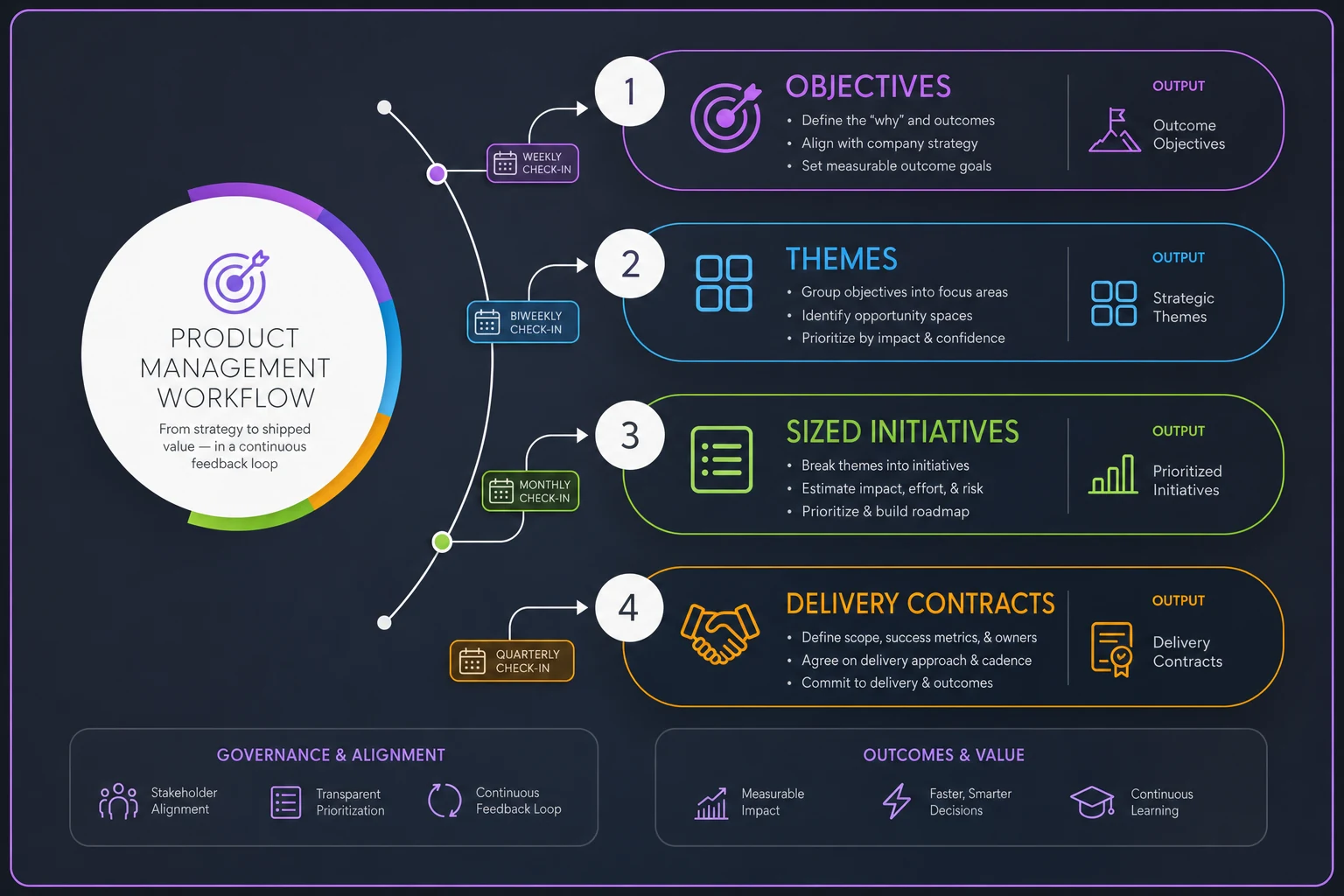
The weekly, biweekly, monthly, and quarterly checkpoints are the actual levers that keep the cascade aligned in practice.
Operating model variations by organization scale
The core cascade—objectives to themes to sized initiatives to delivery contracts—stays constant, but implementation changes a lot depending on scale.
10-person startup
At this scale, you probably have 2-3 objectives max, maybe 3-4 themes, and everyone already knows what everyone else is working on.
-
Objectives and themes are essentially the same thing
-
Initiative sizing happens in a weekly planning meeting
-
Delivery contracts are verbal agreements confirmed in Slack
-
The entire cascade fits on one page
A real example: a B2B SaaS with 8 people had one objective (get to 100 paying customers), two themes (core product stability and sales enablement), and delivery contracts that were literally sticky notes on a wall showing what would ship each week.
50-person product team
Now you need real structure. You've got 5-7 objectives, 10-15 themes, and people genuinely don't know what others are doing.
-
Theme owners who actually own metric-level accountability
-
Initiative sizing in a proper tool with resource management
-
Written delivery contracts with dependency tracking
The complexity here is that themes start interfering with each other. The authentication theme needs the same backend team as the API theme. The admin controls theme is blocked on the permissions rewrite. This is where you need actual program management, not just product management.
200-person product organization
The cascade becomes truly hierarchical. Objectives cascade to themes, themes cascade to sub-themes, and you need multiple layers of translation.
-
Portfolio-level views across all themes
-
Resource allocation models that handle shared platforms
-
Dependency management across completely separate teams
-
Quarterly planning cycles with monthly adjustments
-
Real governance around contract changes
This is also where operational software stops being optional. You literally cannot track all the dependencies, resource allocations, and contract adjustments in spreadsheets. The enterprise authentication theme alone might have 30 dependencies across 8 teams.
At this size, the operating model itself becomes a product you're maintaining. That's not a bad thing—it just means you need someone who genuinely owns it.
Common failure modes and recovery patterns
The operating model breaks in predictable ways:
The Objective Sprawl: Leadership creates 15 objectives because everything feels important. Fix: force rank and cut to 5 maximum. The ones that don't make the cut become "watch" items revisited quarterly.
Theme Bleeding: Themes start expanding scope because discovery keeps finding "related" problems. The authentication theme suddenly includes rebuilding the entire user model. Fix: theme charters with explicit boundaries and a formal change control process for scope expansion.
Sizing Theater: Teams spend days estimating work they'll never actually do. Fix: only size one horizon out in detail. Everything else gets rough magnitude sizing that's good enough for capacity planning.
Contract Amnesia: Teams commit to delivery contracts then immediately start working on other things. Fix: weekly contract review in every team sync. If you're not working on your contract, you need explicit permission to deviate.
Dependency Deadlock: Multiple themes block each other in a circular pattern. The API theme needs the auth theme's token system, auth needs the permissions theme's model, permissions needs the API theme's versioning. Fix: a quarterly dependency mapping session where you break cycles by forcing sequencing decisions.
The measurement system that tells you if it's working
You know the operating model works when you can answer these questions on the spot:
-
Pick any feature in development. Can you trace it back to a strategic objective?
-
Pick any objective. Can you list exactly which teams are working on it?
-
Pick any team. Can you state their current delivery contract?
-
Pick any dependency. Can you identify who owns resolving it?
Most organizations fail all four. The successful ones pass all four because the operating model makes these connections explicit, not assumed.
Strategy-to-Delivery Trace: Percentage of development work that maps to a current theme
Theme Health: Percentage of themes hitting their metric targets
Contract Reliability: Percentage of delivery contracts completed as committed
Dependency Resolution Rate: Percentage of identified dependencies resolved on time
When these metrics drop, you don't have an execution problem—you have an operating model problem. That distinction matters a lot, because most teams keep trying to fix the wrong layer.
Making the cascade stick
Building this operating model isn't the hard part. Making it stick is. Teams revert to old patterns the moment pressure increases.
Three things make it permanent:
First, tie compensation to theme metrics, not feature delivery. If you own the enterprise authentication theme, your bonus depends on enterprise security review pass rates—not whether you shipped SAML.
Second, make the artifacts visible. The objective-to-theme mapping should be on the wall. Delivery contracts should show up in every sprint planning session. The dependency map should be the first slide in every executive review.
Third, run the cadences consistently. The moment you skip the biweekly theme review because everyone's buried is the moment the model starts degrading. These meetings aren't overhead—they're the actual work of product operations.
The tools question nobody wants to discuss
You can run this operating model in spreadsheets for a team of around 20. Beyond that, you need actual tooling. Not because spreadsheets can't hold the data, but because the coordination overhead becomes unsustainable.
The authentication theme owner needs to see all their dependencies in one place. The resource manager needs to see capacity allocation across all themes. The executive team needs metric progression without having to ask for updates.
This is where AI-powered operational software makes a genuine difference—not by magically creating strategy, but by automating the translation layers. The right platform can track when delivery contracts deviate from theme objectives, flag when dependencies create cascading delays, and surface resource conflicts before they become crises.
The pattern that tends to work: start with the operating model on paper, prove it manually, then add operational software once you know what you're actually trying to automate. Teams that jump straight to tools without the operating model foundation just end up digitizing chaos.
One model, infinite variations
This operating model—objectives to themes to sized initiatives to delivery contracts—isn't prescriptive about your specific planning process. It's a skeleton you flesh out based on your context.
Maybe your themes run for six months. Maybe your delivery contracts are two-week sprints. Maybe you size initiatives in engineer-weeks or t-shirts. The specifics matter less than having explicit translation points between each layer.
What matters is that strategy becomes measurable, themes become bounded, initiatives become sized, and delivery becomes contracted. With those four elements in place, you can trace from your biggest strategic bet all the way down to a specific commit going into production tomorrow.
The organizations that build this stop having alignment problems, stop having priority conflicts, and stop getting blindsided by delays. Not because they plan better in some abstract sense, but because they've built an operating model that makes strategy executable by design.
Most teams spend years trying to fix execution problems that are actually operating model problems. They run retrospectives on why features were late instead of asking why nobody knew which features actually mattered. They optimize sprint velocity instead of questioning whether they're sprinting toward the right destination.
Build the cascade first. Make strategy measurable. Then watch how much easier execution becomes when everyone actually knows what success looks like.
Ready to elevate your product management?
Join 2,000+ product teams using Itemyly to accelerate delivery, improve alignment, and build better products.