


Most product teams hit a wall somewhere between 15 and 50 people. Not because they lack talent or process, but because they're trying to scale two opposing forces without understanding the trade-offs.
Discovery wants to explore broadly. Delivery needs to ship narrowly. As you add more teams, this tension doesn't just grow—it multiplies exponentially across every team boundary you create.
What starts as healthy creative tension becomes organizational chaos. Discovery teams generate insights faster than delivery can process them. Delivery teams build features nobody validated. Both sides blame the other for missed targets while the actual problem—unclear boundaries and handoff patterns—goes unaddressed.
The companies that scale successfully understand something critical: you can't optimize for both exploration and execution simultaneously without explicit rules about who owns what, when handoffs happen, and which team structure fits your current stage.
The three scaling patterns that determine everything else
After watching product organizations grow from startup to scale-up, the same three patterns emerge consistently. Not because someone planned them, but because organizational physics forces these choices.
Pattern 1: Centralized discovery, distributed delivery
One discovery team feeds multiple delivery teams. Works brilliantly up to about 20 people. Discovery maintains consistency across the product vision while delivery teams focus on specific product areas.
The breakdown happens around month six. Discovery becomes the bottleneck. Every delivery team waits for validation. Discovery can't keep up with demand. Teams start skipping discovery to hit deadlines. Quality drops. Rework increases.
Pattern 2: Embedded discovery within delivery teams
Each team handles both discovery and delivery. Seems perfect on paper—full ownership, no handoffs, complete autonomy. Reality looks different.
Without coordination, teams validate the same problems differently. One team discovers customers need better search. Another team discovers they need better filtering. Both build competing solutions because nobody connected the insights.
Pattern 3: Hub-and-spoke discovery coordination
Central discovery team sets direction, embedded researchers execute locally. Theoretically balances both approaches. Practically creates two layers of confusion—strategic discovery disagrees with tactical discovery, teams get conflicting signals.
The pattern you choose matters less than understanding when to switch patterns. Most organizations stick with their initial pattern too long, then overcorrect in the opposite direction.
When value stream teams actually work (and when they destroy productivity)
Value stream teams own the entire customer journey—from discovery through delivery. Marketing loves this structure because it sounds customer-centric. Leadership loves it because accountability seems clear.
Eliminate product chaos and align your team.
Itemyly helps you plan, prioritize, and track every product milestone seamlessly.
- Centralized roadmap management
- Stakeholder collaboration
- Release tracking & analytics
No credit card required
A fintech startup organized around value streams: onboarding, payments, and reporting. Each team had 8-12 people covering everything from user research to deployment. For the first year, velocity looked incredible. Each team moved fast, shipped features, gathered feedback.
Then the cracks appeared. The onboarding team built their own notification system. The payments team built a different one. The reporting team built a third. Three notification systems, zero consistency, confused customers.
-
Product boundaries naturally align with customer journeys
-
Teams rarely need to coordinate on shared components
-
Technical architecture supports independent deployment
-
Customer problems stay within clear boundaries
They fail spectacularly when:
-
Multiple teams touch the same customer touchpoint
-
Shared infrastructure requires constant coordination
-
Platform capabilities span multiple value streams
-
Technical debt accumulates in overlapping areas
The decision isn't permanent. A subscription management platform started with feature teams (authentication, billing, analytics). After reaching product-market fit, they reorganized into value streams (acquisition, activation, retention). Two years later, they added a platform team to handle shared services while keeping value streams for customer-facing work.
Value stream teams excel when:
The handoff problem that kills 40% of discovered opportunities
Discovery generates an insight. Delivery receives a specification. Somewhere between those two points, the original understanding disappears.
This isn't a documentation problem. It's a context transfer problem that gets worse as teams specialize.
Consider what happens during a typical handoff:
Discovery spends three weeks interviewing customers about invoice management pain points. They uncover that customers don't actually want faster invoice creation—they want to stop recreating the same invoice templates. The insight: automation matters more than speed.
The handoff document captures this perfectly. Screenshots, quotes, journey maps. Everything documented.
This diagram shows the handoff flow from discovery to delivery and where context often gets lost.
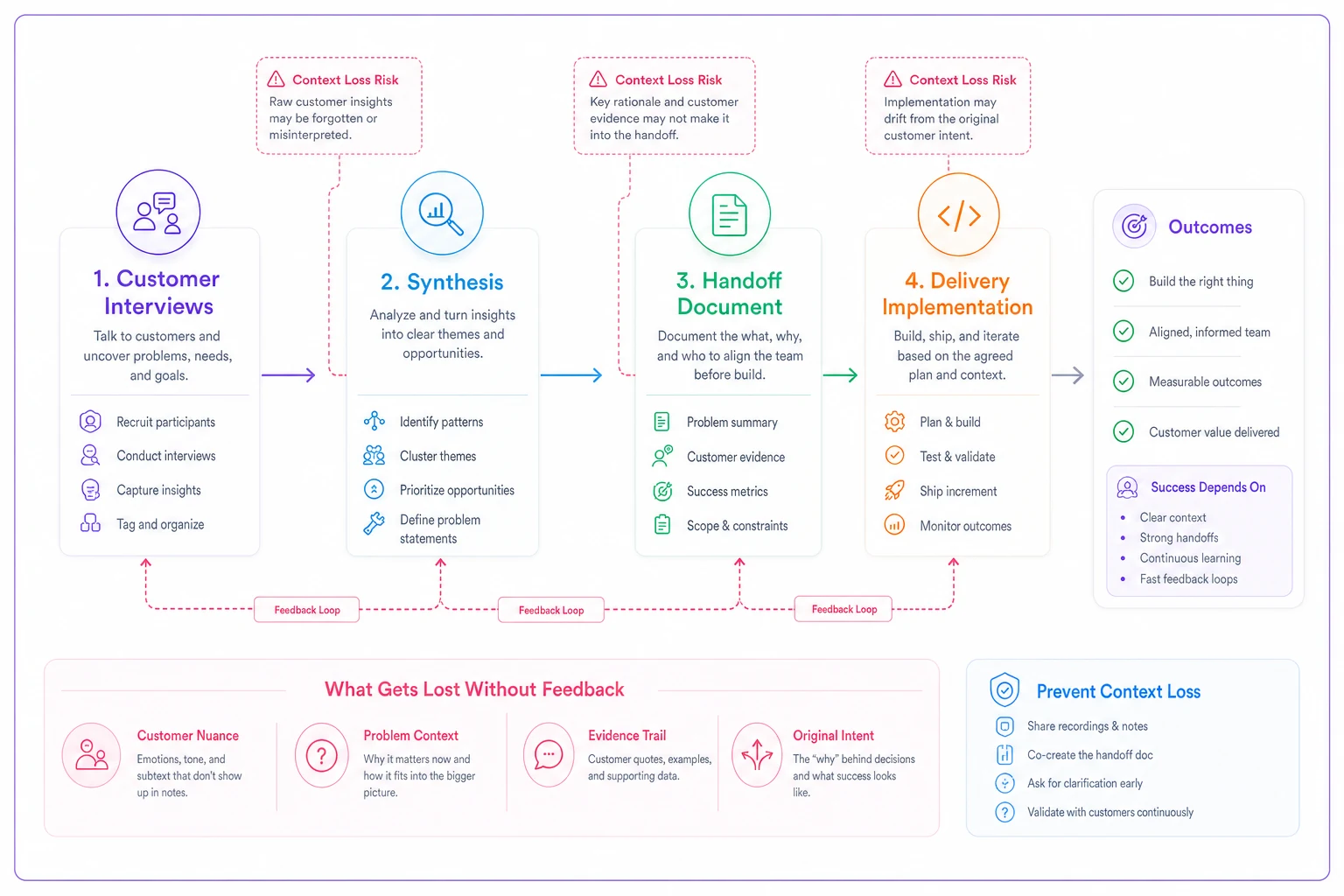
Delivery reads the document and builds a faster invoice creator with saved templates. Technically correct, completely missing the point. The automation insight got lost because delivery wasn't present during the discovery conversations where customers explained their workflow.
Operational software platforms help bridge this gap by capturing decision context automatically during handoffs. Instead of losing insights in translation, teams can track which customer insights led to which features, making it easier to course-correct when implementations miss the original intent.
Boundary rules that prevent territory wars
Clear boundaries prevent more problems than perfect processes. But most teams define boundaries around organizational structure instead of decision rights.
Effective boundary rules specify three things:
-
Who makes the decision
-
Who gets consulted
-
When the decision becomes final
A productivity software company with 35 people across four teams uses these boundary rules:
Discovery boundaries:
-
Customer problem identification
Discovery team decides, delivery consulted
-
Solution approach
Delivery team decides, discovery consulted
-
Priority ranking
Product leadership decides, both teams consulted
-
Technical feasibility
Delivery team decides, discovery informed
Delivery boundaries:
-
Implementation details
Delivery team decides autonomously
-
Scope adjustments
Delivery proposes, discovery approves if customer impact
-
Timeline changes
Delivery decides if under 2 weeks, escalate if over
-
Quality standards
Shared ownership with explicit review points
Cross-team boundaries:
-
Shared components
Platform team decides, feature teams consulted
-
Customer communication
Whoever's closer to customer decides
-
Technical standards
Architecture group decides, all teams consulted
-
Design patterns
Design system team decides, teams provide input
Record boundary rules with explicit examples so teams can apply them in gray areas without escalating.
Notice what's missing: endless meetings to align everyone on everything. Clear boundaries mean fewer meetings, not more.
The source-of-truth maze that nobody wants to maintain
Every growing product organization eventually has the same conversation: "Where's the actual source of truth for this decision?"
The research lives in Dovetail. The requirements live in Jira. The designs live in Figma. The discussions live in Slack. The decisions live in someone's head who left six months ago.
Small teams survive this chaos through proximity and communication. Scaled teams drown in it.
Level 1: Problem Definition
-
Source of truth
Opportunity Solution Trees in Miro
-
Owners
Discovery leads
-
Consumers
Everyone
-
Update cadence
Weekly during active discovery
Level 2: Solution Validation
-
Source of truth
Prototypes in Figma with research notes
-
Owners
Design and research
-
Consumers
Delivery and stakeholders
-
Update cadence
After each validation cycle
Level 3: Delivery Commitment
-
Source of truth
Epics in project management tool
-
Owners
Delivery leads
-
Consumers
Stakeholders and dependent teams
-
Update cadence
Sprint boundaries
Level 4: Implementation Details
-
Source of truth
Code repository and documentation
-
Owners
Development team
-
Consumers
Future development teams
-
Update cadence
Continuous
The magic isn't the tools—it's that everyone knows where to look for what type of information. No more searching through Slack to find a decision. No more conflicting documents with different versions of truth.
Modern workflow automation helps here by automatically updating multiple systems when decisions get made. Instead of manually keeping five different tools in sync, teams can focus on making good decisions while the software handles information flow between systems.
Rituals that bridge discovery and delivery (beyond the typical sprint review)
Standard agile ceremonies weren't designed for the discovery-delivery handoff. Sprint planning assumes you know what to build. Sprint reviews assume you built the right thing. Neither addresses the messy middle where discovery insights become delivery commitments.
Three rituals that work:
The Problem Pitch (not solution pitch)
Frequency: Every two weeks Duration: 90 minutes Attendees: Discovery, delivery, and product leadership Discovery presents problems, not solutions. Customer quotes, data, observed behaviors. Delivery asks clarifying questions about context, not implementation. No solutions discussed. No estimates given. Just problem understanding.
This prevents the common failure where delivery immediately jumps to technical solutions before understanding the problem space.
The Solution Workshop
Frequency: After each Problem Pitch Duration: 2-4 hours Attendees: Core discovery and delivery members Now solutions enter the conversation. Discovery shares what customers responded to. Delivery proposes technical approaches. Both groups sketch possibilities. Low-fidelity, high-speed ideation.
The output: 3-5 solution directions worth validating, not a final design.
The Commitment Checkpoint
Frequency: Before major build decisions Duration: 60 minutes Attendees: Whoever makes the go/no-go decision Review validation results. Discuss technical feasibility. Estimate roughly. Make explicit decision: build, iterate, or abandon.
Document the decision and reasoning. This becomes the reference point when questions arise later about why something was built a certain way.
How team size distorts everything
The uncomfortable truth about scaling product teams: every growth threshold breaks different things.
| Team size | Description |
|---|---|
| Under 10 people: | Everyone knows everything. Discovery and delivery blur naturally. Communication happens organically. Boundaries feel unnecessary. |
| 10-25 people: | First specialization appears. Usually a dedicated product manager or designer. Handoffs become necessary. Some documentation required. First complaints about "not being involved early enough." |
| 25-50 people: | Multiple teams form. Discovery and delivery separate. Coordination overhead spikes. Teams step on each other. Duplicate work appears. Politics begin. |
| 50-100 people: | Middle layer emerges. Team leads, principals, managers. Discovery and delivery might report to different leaders. Strategic vs tactical discovery splits. Platform vs feature teams debate starts. |
| 100+ people: | Full organizational design required. Multiple discovery teams. Multiple delivery teams. Explicit coordination roles. Governance processes. The machine becomes self-sustaining or breaks entirely. |
A marketplace platform learned this progression the hard way. At 15 people, they had one product manager doing discovery for two engineering teams. Worked fine. At 30 people, they added two more product managers without changing the structure. Chaos. The three product managers generated more ideas than five engineering teams could build. They had to create a quarterly planning process just to negotiate what got built.
At 60 people, they restructured into autonomous pods. Each pod had dedicated discovery and delivery. New problem: pods optimized locally but damaged the overall platform. The search pod made changes that broke the checkout pod's assumptions.
Finally at 100 people, they adopted a hybrid model. Platform teams owned shared services with their own discovery process. Feature teams owned customer experiences with embedded discovery. Quarterly alignment sessions connected both groups.
Structure must evolve with size, but not reactively. Plan the next structure before you need it.
Configuration examples from companies that got it right (eventually)
Real examples from companies that found their rhythm, after plenty of mistakes:
B2B SaaS (40 people, project management tool):
-
2 discovery leads covering the entire product
-
5 delivery teams organized by technical architecture
-
Weekly discovery share-outs to all delivery teams
-
Monthly rotation of engineers through discovery sessions
-
Source of truth
Notion for decisions, Linear for execution
-
Key learning
Rotating engineers through discovery eliminated most handoff problems
E-commerce platform (80 people):
-
4 value stream teams (browse, cart, checkout, fulfillment)
-
Each team has embedded researcher and designer
-
Central discovery team handles strategic initiatives
-
Quarterly big room planning to prevent overlap
-
Source of truth
Confluence for strategy, Jira for execution
-
Key learning
Value streams work until they share too much infrastructure
Developer tools company (25 people):
-
1 product manager handling all discovery
-
3 engineering teams with technical leads
-
Discovery sprints run 2 weeks ahead of delivery
-
Engineers join customer calls based on interest/availability
-
Source of truth
GitHub issues for everything
-
Key learning
Keep it simple until you absolutely can't
Healthcare startup (120 people):
-
Central discovery team of 8 researchers
-
12 delivery teams organized by feature area
-
Discovery embedded in critical teams, shared for others
-
Bi-weekly discovery readout to all teams
-
Source of truth
Productboard for discovery, Jira for delivery
-
Key learning
Not every team needs dedicated discovery
Notice how different their approaches are. No single right answer exists, just trade-offs that match their specific context.
The tool maze and why it matters less than you think
Teams obsess over tool selection. Should we use ProductBoard or Aha for roadmapping? Miro or Mural for workshops? Notion or Confluence for documentation?
The tools matter about 20% as much as the agreements around them.
A financial services team had perfect tool setup. Expensive research repository. Integrated project management. Automated handoffs between systems. Still failed because nobody agreed on what "ready for development" meant.
Meanwhile, a gaming studio runs discovery and delivery coordination through GitHub issues and a weekly Zoom call. Works flawlessly because everyone understands the process.
Under 25 people:
-
Whiteboard tool (Miro/Mural/FigJam)
-
Project tracker (Linear/GitHub/Trello)
-
Design tool (Figma)
-
Document store (Notion/Docs)
25-75 people:
-
Research repository (Dovetail/Condens)
-
Roadmap tool (ProductBoard/Aha)
-
Advanced project management (Jira/Monday)
-
Knowledge base (Confluence/Notion)
75+ people:
-
Discovery operations platform
-
Advanced analytics
-
Workflow automation
-
Integration platform
Fix the process first, then find tools that support it.
When to make the jump between team structures
The signals that indicate it's time to restructure usually appear three to six months before the restructure becomes critical. Most organizations wait until the pain becomes unbearable, then rush through a reorg that creates new problems.
Time to split discovery and delivery:
-
Product managers spending 60%+ time on delivery coordination
-
Engineers complaining about context switching
-
Discovery insights piling up without validation
-
Delivery teams making product decisions in isolation
Time to embed discovery in teams:
-
Central discovery becoming a bottleneck
-
Teams waiting weeks for research resources
-
Discovery disconnected from delivery reality
-
Same problems researched multiple times
Time to create platform teams:
-
Multiple teams building similar components
-
Shared services becoming unstable
-
Technical debt in common areas growing
-
Teams afraid to touch shared code
Time to form value stream teams:
-
Clear, stable customer journeys identified
-
Technical architecture supports independence
-
Teams frustrated by partial ownership
-
Customer problems span current team boundaries
Make changes when you see early signals, not when everything's on fire.
Why AI-powered operational platforms change the discovery-delivery equation
The traditional discovery-delivery pipeline assumes human bandwidth at every step. Researchers manually synthesizing interviews. Product managers manually writing specifications. Developers manually implementing features.
AI-enhanced operational platforms handle the repetitive parts differently. Instead of discovery finding that customers want better invoice templates and delivery building a template system, automated analysis identifies invoice patterns and suggests templates directly. The discovery-delivery cycle shifts from building features to configuring intelligence.
This fundamentally changes team structure needs. A logistics platform reduced their delivery team by 40% not by firing people but by shifting them to discovery and configuration roles. They went from discovering problems and building solutions to discovering patterns and training systems.
The boundary between discovery and delivery blurs when automated systems can implement certain changes autonomously. A customer complains about report formatting. Previously: discovery validates, delivery implements. Now: the system adjusts based on feedback patterns, teams review and approve.
Teams using these platforms report that coordination overhead drops because the software handles many of the handoff points that typically require human translation between discovery insights and delivery specifications.
The real coordination cost nobody calculates
Everyone understands that coordination has overhead. Few organizations calculate the actual cost.
-
15% of time in alignment meetings
-
10% documenting decisions for other teams
-
8% waiting for other teams' decisions
-
12% rework from misaligned assumptions
-
5% political navigation between teams
Half their capacity lost to coordination overhead. Not because they were inefficient, but because their structure created unnecessary dependencies.
The formula is roughly: coordination cost = (number of handoffs) × (ambiguity of boundaries) × (frequency of changes)
Reduce any variable and coordination cost drops. Most organizations try to reduce handoffs by combining teams. Sometimes works. Often just moves the coordination internal to the team.
Better approach: reduce ambiguity first. Clear boundaries and decision rights eliminate more coordination overhead than team restructuring.
Building your own scaling framework
Copy-pasting another company's structure rarely works. Context matters too much. But you can build your own framework by answering five questions:
-
1. What's your primary constraint? - Discovery bandwidth
Embed researchers in teams - Delivery capacity: Centralize discovery for efficiency - Coordination overhead: Create autonomous teams - Technical complexity: Organize around architecture
-
2. How stable are your team boundaries? - Stable
Optimize for team autonomy - Fluid: Optimize for resource flexibility - Unknown: Keep structure lightweight
-
3. Where does your value come from? - Feature breadth
Feature teams - Customer journey: Value stream teams - Technical platform: Platform/feature hybrid - Rapid experimentation: Small autonomous units
-
4. How do your customers experience your product? - Single journey:
4. How do your customers experience your product? - Single journey:
Make changes when you see early signals, not when everything's on fire.
Ready to elevate your product management?
Join 2,000+ product teams using Itemyly to accelerate delivery, improve alignment, and build better products.