
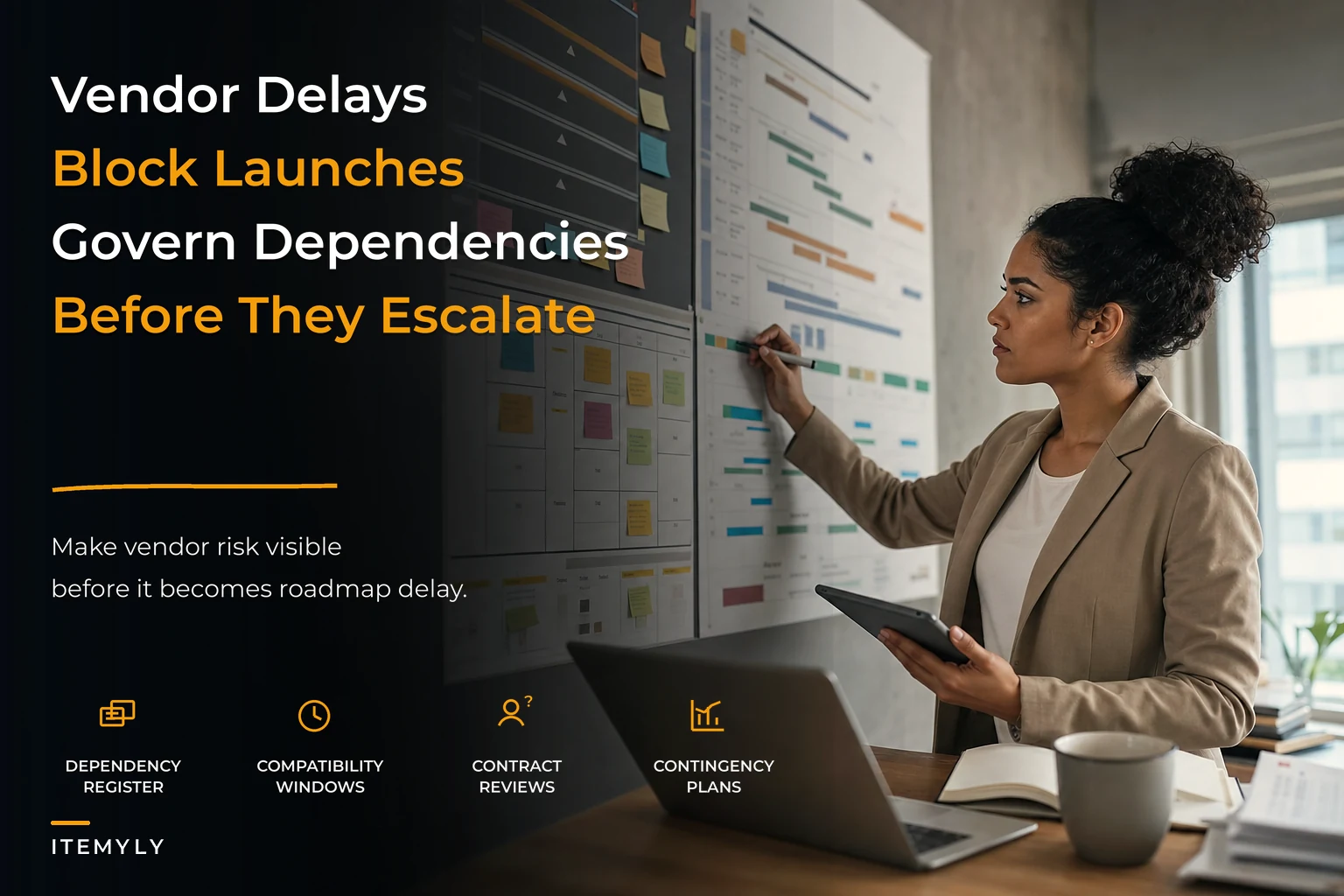

Look at the last three launches that slipped on your team. There's a decent chance at least one had nothing to do with your engineers, your QA, or scope creep—but because a vendor pushed a version, deprecated an endpoint, changed a pricing tier, or quietly moved a feature into a "future roadmap" bucket that never materialized.
That's the frustrating part about vendor dependency governance. You can run flawless sprints internally and still miss dates because a payments provider, an identity vendor, a maps API, or a data enrichment service decided their timeline mattered more than yours. Most product orgs don't treat that as a first-class risk. They treat it as a surprise.
This is a systems problem, not a "we picked a bad vendor" problem. The teams that ship predictably aren't the ones with perfect vendors—they're the ones who model vendor risk the same way they model engineering capacity. Explicitly, continuously, and with contingency already built in.
Why this breaks in almost every growing product org
Early on, vendor dependencies are invisible because they're small. You've got maybe three or four external services, one person remembers who owns each contract, and if something changes, someone catches the email. It works because everything fits in one person's head.
Then you scale, and a few things happen at once.
The number of vendors grows faster than anyone realizes. A mid-size product team can easily be sitting on 20–40 external services once you count auth, payments, analytics, comms, search, storage, feature flags, error tracking, and the handful of industry-specific APIs your product wraps around. Nobody decided to have 30 dependencies. It just accreted over time.
Ownership fragments at the same time. The engineer who integrated the SMS provider left. The contract auto-renews. The vendor emails their deprecation notice to a shared inbox nobody reads. And the person building your Q3 roadmap has no idea that the SMS provider is sunsetting the exact API your onboarding flow relies on—until onboarding breaks in staging two weeks before launch.
The failure usually isn't dramatic. There's no single catastrophic vendor. It's a slow accumulation of unmanaged edges. Each dependency is fine in isolation. The system as a whole has no owner, no register, no early-warning mechanism. So vendor risk shows up as launch risk, always at the worst possible time.
The four things that actually break
If you want to govern this, name the specific failure points instead of vaguely worrying about "vendor risk." In practice, delays cluster around four breakdowns:
Eliminate product chaos and align your team.
Itemyly helps you plan, prioritize, and track every product milestone seamlessly.
- Centralized roadmap management
- Stakeholder collaboration
- Release tracking & analytics
No credit card required
-
Discovery failure. You don't know a dependency exists until it breaks. Undocumented integrations that only surface during an incident.
-
Compatibility failure. A vendor ships a breaking change or deprecates a version inside your build window, and you find out too late to absorb it without slipping.
-
Contract failure. A renewal, price change, rate-limit change, or SLA downgrade lands mid-roadmap, and now you're re-architecting or renegotiating on their clock.
-
Contingency failure. Something goes down or gets discontinued and you have no fallback, no second source, and no documented plan—so the whole team improvises under pressure.
Most governance efforts fix one of these and ignore the other three. A dependency register with no compatibility tracking still gets blindsided by breaking changes. Compatibility tracking with no contract cadence still gets ambushed by a price hike that kills the ROI on the integration. You need the whole system. The good news is the pieces reinforce each other.
Start with a dependency register that's actually maintained
A dependency register sounds boring, and it is—right up until it saves a launch. The point isn't to have a document. It's to have a single, current source of truth for every external thing your product leans on, who owns it, and what happens if it moves.
The mistake most teams make is building the register as a one-time spreadsheet during a "let's get organized" week, then never touching it again. A register nobody updates is worse than no register because it creates false confidence. The fix is tying updates to events that already happen: a new vendor gets added when a contract is signed, an entry gets reviewed when an integration ships, and a named owner is required before anything goes to production.
Tie register updates to contract signings, ship dates, and incident reviews so entries stay current without manual audits.
Here's a workable structure for each entry:
| Field | What it captures | Why it matters |
|---|---|---|
| Vendor + service | The specific API/product, not just the company | One vendor can have five services with five different lifecycles |
| Internal owner | A named person, not a team | Teams don't read deprecation emails; people do |
| Criticality tier | Blocking / degradable / cosmetic | Decides how much contingency effort it earns |
| What breaks if it fails | The user-facing feature or flow | Turns abstract risk into launch risk |
| Version / API in use | Current version + latest available | Feeds your compatibility window tracking |
| Contract renewal date | Next renewal + auto-renew flag | Prevents surprise price/term changes |
| Fallback plan | Second source, cache, degrade path, or "none" | Exposes where you're truly exposed |
The criticality tier column is the one teams consistently underweight. Not every dependency deserves a contingency plan. A cosmetic analytics widget going dark for a day is annoying; a payments provider going down is revenue-stopping. Tiering lets you spend governance effort where it actually changes outcomes, instead of treating all 30 vendors as equally urgent.
Compatibility windows: know the change before it hits your build
This is where vendor governance connects directly to release planning. Every critical vendor has a rhythm—how often they ship breaking changes, how long they support old versions, how much deprecation notice they give. Your job is to know that rhythm and align your roadmap around it.
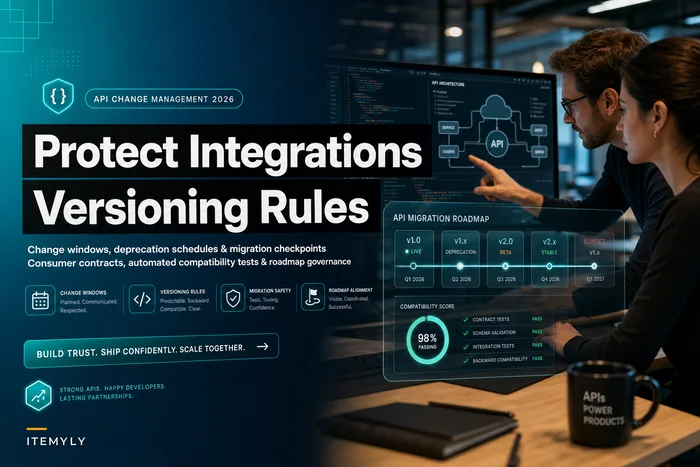
The concept mirrors what strong teams already do internally when they manage their own API change management, versioning windows, and roadmap coordination—except now you're on the receiving end of someone else's version policy, with far less control.
A practical compatibility window looks like this: for each blocking-tier vendor, track the version you're on, the latest supported version, and the announced end-of-life date for your version. Then translate that into roadmap language. If a vendor's v2 API sunsets in eight months, that migration isn't "someday"—it's a dated, sized item that competes for capacity like everything else.
A typical example of how this goes sideways: a team is on a data provider's legacy endpoint. The provider announces a 12-month deprecation window. Everyone nods in the meeting, nobody schedules the work, and the roadmap stays packed with feature development. Month 11 arrives. The migration turns out to be three weeks of work nobody has room for, and now a customer-facing launch gets bumped so the team can scramble to hit a hard cutoff. The change wasn't a surprise. The scheduling was.
The fix is unglamorous: pull every announced deprecation and version EOL into the same planning surface as your feature epics, with actual dates. If a vendor migration and a launch collide on the calendar, you want that fight to happen during planning, not during launch week.
Contract-review cadence: money and terms change quietly
Product teams tend to treat contracts as a procurement problem, not a roadmap problem. That's a mistake, because contract terms quietly constrain what you can build.
Rate limits cap how fast you can scale a feature. Pricing tiers determine whether an integration stays profitable as usage grows. SLA levels affect what reliability you can realistically promise your own customers. And renewal dates are decision points whether you treat them that way or not—auto-renew means the decision gets made for you.
A reasonable cadence: a quarterly pass over the register filtered to contracts renewing in the next two quarters, plus any vendor where usage or cost has moved sharply. In that review, you're asking a few specific questions:
-
Is this still the right vendor, or have we outgrown or underused it?
-
Are we approaching a pricing tier or rate limit that changes our unit economics?
-
Did the SLA or terms change at last renewal in a way that affects what we promise customers?
-
If we wanted to leave, how painful would it be—and is that lock-in growing?
-
Does anything in the next two quarters of roadmap depend on terms we haven't confirmed?
That last question is the bridge between contracts and roadmap. If Q3 includes a feature that will triple your calls to a metered API, the contract review is where you catch the cost before finance does—and before you've already shipped and can't easily walk it back.
Contingency playbooks: decide the fallback before you need it
This is where governance earns its keep, and it's also where most teams have nothing. Ask a team what happens if their email provider goes down for 24 hours and you'll usually get a shrug and "we'd figure it out." Figuring it out under pressure, at 2 a.m., during a launch, is the most expensive way to make that decision.
A contingency playbook doesn't have to be elaborate. For each blocking-tier vendor, you want a short, pre-agreed answer to three questions: how do we detect the problem, how do we degrade gracefully, and what's our escalation and fallback path. The value isn't in the document's polish—it's that the decision got made calmly, in advance, by people who actually understand the tradeoffs.
Contingency comes in tiers, and it's fine to pick the cheapest one that fits the criticality:
-
Graceful degradation. The feature fails soft. Search vendor down? Fall back to a simpler local query. Recommendations API down? Show a default set. Users notice something, but nothing hard-breaks.
-
Cached fallback. You serve recent cached data when the live source is unavailable. Works well for data that's fine being slightly stale.
-
Second source. A pre-integrated backup vendor you can flip to. Expensive to maintain—worth it only for truly revenue-critical paths like payments.
-
Manual bridge. A short-term human workaround for low-volume flows while the vendor recovers. Ugly, but keeps the business moving.
Contingency cost should scale with criticality, not anxiety. Teams either build nothing at all or over-engineer a hot-standby for a cosmetic feature. Match the fallback tier to the blast radius.
How the pieces work together as one workflow
None of these four components stands alone. The system works because information flows between them, and the register is the hub.
[New Integration Ships] ↓ [Register Entry Created — Owner + Criticality Tier Assigned] ↓ [Version Field → Compatibility Window Tracking] ↓ [Deprecation Announced → Dated Roadmap Item Created] ↓ [Renewal Date → Quarterly Contract Review] ↓ [Criticality Tier → Contingency Playbook Scoped] ↓ [Risk Visible in Planning — Not in Launch Week]
Walk through it. A new integration ships → it gets an entry in the register with an owner and a criticality tier. That entry's version field feeds the compatibility window tracking, so when the vendor announces a deprecation, it maps to a known dependency with a known owner. That owner sizes the migration and it enters roadmap planning as a dated item competing for capacity. Meanwhile the renewal date feeds the quarterly contract review, where you catch pricing and term changes before they hit the roadmap or the budget. And the criticality tier determines whether the entry needs a contingency playbook at all, and how heavy that playbook needs to be.
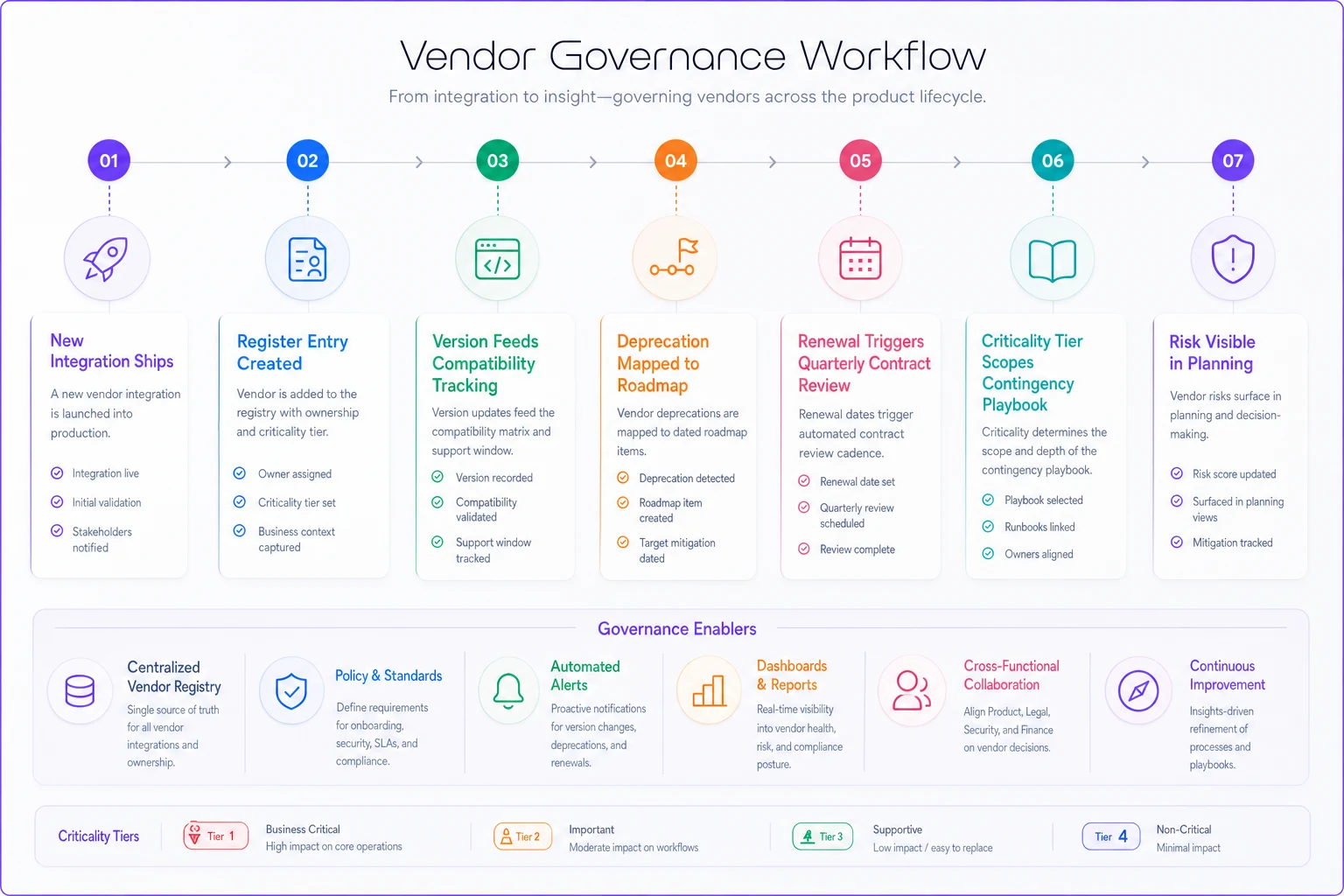
When this loop runs consistently, vendor risk stops being a surprise category and becomes a normal, visible input to planning—the same way you'd factor in engineering capacity or a known infra migration. Launches stop slipping for "external reasons" because the external reasons showed up on the roadmap months earlier, dated and owned.
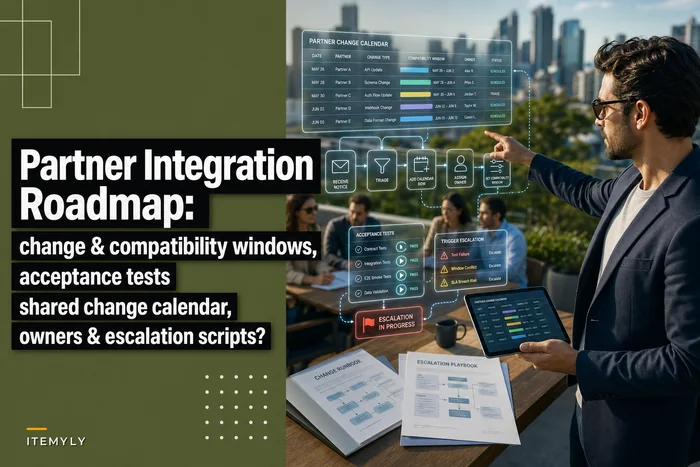
This is also why vendor governance and partner governance overlap so much. If your vendors are also integration partners you ship changes to, the inbound and outbound coordination should share a calendar—the same discipline behind a solid partner integration roadmap with change windows and a partner change calendar applies directly to the vendors you depend on.
A real scenario: the fintech onboarding flow
A small B2B fintech—payroll product, around 40 people, maybe 15 engineers—kept missing quarterly launch commitments. When they traced the slips, roughly half came back to external dependencies. An identity-verification vendor deprecated a version mid-quarter twice in one year. A bank-data aggregator changed rate limits right as they scaled a new employer segment, throttling onboarding at exactly the wrong moment.
They had no register. Ownership was scattered. The KYC integration was "owned" by whoever originally built it, who'd since moved teams. Contracts auto-renewed. No fallback existed for the aggregator, so when it throttled, onboarding queued up and support drowned.
The fix wasn't technically complicated. They built a register of about 22 external services, tiered them—four came out as genuinely blocking—assigned named owners, and pulled every announced deprecation and renewal date into their planning tool alongside feature epics. Lightweight contingency plans for the four blocking vendors: a cached fallback for the aggregator and a documented degrade path for identity verification.
Over the next couple of quarters, vendor-caused slips dropped from roughly half their misses to close to zero. Not because vendors behaved better—the identity vendor deprecated another version that same year—but because the deprecation showed up as a dated, owned, sized roadmap item three months out instead of a fire drill two weeks before launch. The aggregator throttling happened once more, but the cached fallback meant onboarding degraded quietly instead of collapsing. Their finance lead separately flagged that catching a pricing-tier jump in contract review saved something in the low five figures annually that would've otherwise been a surprise line item.
Nothing they built was technically hard. The whole thing was coordination and visibility. The risk was always there—they just started looking at it on purpose.
When this level of governance makes sense—and when it doesn't
Full vendor dependency governance is real overhead, and it's not always worth it.
When it makes sense: You've got more than a handful of external dependencies, at least a couple are revenue-critical, and vendor changes have already burned you at least once. If launches are slipping for "external reasons," you're past due. Regulated products—fintech, health, anything with compliance exposure—should be doing this regardless of size, because a vendor's SLA or data-handling change can become your compliance problem overnight.
When it's overkill: You're a small team with four or five stable vendors, no contract surprises, and a roadmap that isn't gated on external timelines. Building a formal register and quarterly cadence for that is bureaucracy for its own sake. A single well-maintained page listing your critical vendors and owners is plenty.
Who should be careful: Teams that will build the register once and abandon it. A stale register is actively harmful—it tells you you're covered when you're not. If you can't commit to keeping it current by tying updates to real events like contracts, ship dates, and incidents, start smaller. Track only your three or four blocking-tier vendors well rather than 30 vendors badly.
Where tooling helps—and where it doesn't
You don't need special software to start. A spreadsheet and a recurring calendar hold plenty of teams. What tooling actually buys you at scale is the thing spreadsheets can't do: keeping the register connected to your roadmap and surfacing changes before someone has to remember to check.
Product operations platforms that let you attach dependency and risk metadata directly to roadmap items help because the vendor deprecation and the feature epic live in the same view—so a collision is visible during planning instead of during a retro. Lightweight automation earns its place here too: watching for vendor changelog updates, flagging contracts approaching renewal, nudging the named owner when their dependency's version is nearing EOL. That's the difference between governance that depends on someone remembering and governance that mostly runs on its own.
But tooling won't decide your criticality tiers, write your contingency plans, or make the tradeoff between paying for a second source and accepting downtime. Those are judgment calls. Tools surface the risk on time; people still have to decide what to do about it.
The shift worth making
Vendor risk isn't a procurement footnote or an infrastructure concern that lives somewhere off your roadmap. It's a scheduling input, and treating it like anything else guarantees it keeps ambushing your launches.
The teams that ship predictably made one quiet mental shift: they stopped assuming their vendors would stay still, and started planning for the fact that they won't. A register that stays current, compatibility windows that feed planning, a contract cadence that catches term changes early, and contingency plans sized to blast radius—none of this is heavy process once it's wired into the work you already do. It just moves the fight from launch week, where you lose it, to planning, where you can actually win.
The teams that ship predictably made one quiet mental shift: they stopped assuming their vendors would stay still, and started planning for the fact that they won't. A register that stays current, compatibility windows that feed planning, a contract cadence that catches term changes early, and contingency plans sized to blast radius—none of this is heavy process once it's wired into the work you already do. It just moves the fight from launch week, where you lose it, to planning, where you can actually win.
Ready to elevate your product management?
Join 2,000+ product teams using Itemyly to accelerate delivery, improve alignment, and build better products.