
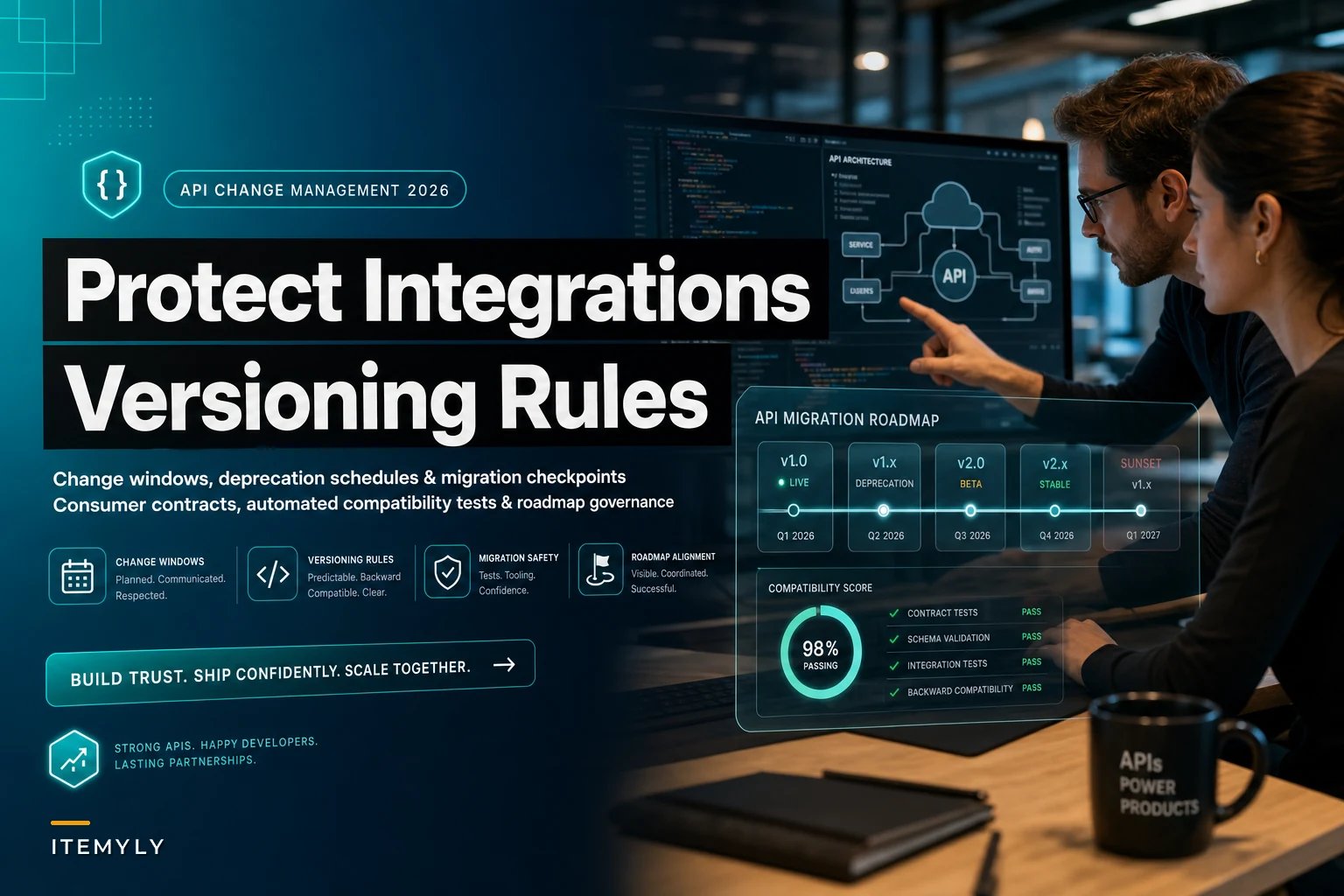

Every product team thinks they handle API changes well until a major integration partner calls at 8pm because their entire workflow broke. The worst part? Your changelog clearly stated the deprecation 90 days ago. They just never saw it. Or worse, they saw it but couldn't adapt in time because you deprecated three endpoints they depend on while their engineering team was mid-sprint on something else entirely.
API change management isn't just about semantic versioning or following REST principles. It's about understanding that every API change ripples through dozens of integration partners who each have their own release cycles, testing windows, and customer commitments. Most product teams learn this after breaking a key partner's integration during their busiest season.
The operational reality hits differently when you're coordinating changes across multiple consumer teams. A fintech platform ran into this when they modernized their payment processing API. They gave partners 60 days notice — seemed reasonable. Except one partner was a healthcare billing system that only deployed quarterly due to compliance requirements. Another was a retail POS system heading into Black Friday freeze. The "simple" API update turned into a six-month migration nightmare with different partners on different versions, requiring the team to maintain three API versions simultaneously.
Why traditional deprecation windows fail when partners have mismatched release cycles
The standard 30-60-90 day deprecation schedule breaks down when your API consumers operate on fundamentally different timelines. Enterprise clients might have quarterly release cycles. Startups might deploy daily but have no dedicated integration team. Government partners could have annual budget cycles that prevent mid-year technical changes.
Consider what happens at a typical API provider. A marketing automation platform launches v2 of their contact API and announces 90 days until v1 shuts down. Reasonable, right? Except their ecosystem includes:
-
E-commerce platforms on monthly release cycles
-
CRM systems with quarterly updates
-
Custom enterprise integrations maintained by consultants
-
Mobile apps with app store review delays
-
Legacy systems that haven't been touched in two years
Each consumer type needs different migration support. The e-commerce platforms can adapt quickly but need detailed migration guides. Enterprise systems need six months minimum but will actually follow through. Mobile apps need backwards compatibility during the transition since users don't update immediately. Legacy systems might need manual intervention or extended support contracts.
The practical breakdown usually follows this pattern. Product team announces deprecation based on their internal timeline. Early adopters migrate within weeks and report bugs. Mainstream partners start planning migration for their next sprint. Laggards don't even know about the change. Then as the deadline approaches, support tickets spike, partners request extensions, and product has to choose between breaking integrations or maintaining deprecated code longer than anyone wanted.
Creating overlapping support windows that accommodate different partner velocities
The solution isn't longer deprecation periods. It's overlapping support windows designed around partner segments. Here's the framework that actually works:
Eliminate product chaos and align your team.
Itemyly helps you plan, prioritize, and track every product milestone seamlessly.
- Centralized roadmap management
- Stakeholder collaboration
- Release tracking & analytics
No credit card required
Discovery Phase (Day 0-30)
-
Soft announcement to technical contacts
-
Migration guide drafts shared for feedback
-
Early access to new endpoints for testing
-
No public deprecation notice yet
Migration Phase (Day 31-180)
-
Public deprecation announcement
-
Both API versions fully supported
-
Automated compatibility reports for partners
-
Weekly migration metrics shared internally
Transition Phase (Day 181-270)
-
Old API marked deprecated but still functional
-
Warnings added to old endpoint responses
-
Progressive degradation (rate limits, feature restrictions)
-
Manual approval required for deadline extensions
Sunset Phase (Day 271+)
-
Old endpoints return errors with migration instructions
-
Case-by-case extended support for critical partners
-
Post-sunset monitoring for failed calls
This timeline assumes you've segmented partners correctly. A logistics platform found they had three distinct segments: real-time partners who needed immediate consistency, batch partners processing data overnight, and reporting partners pulling historical data weekly. Each segment needed a completely different migration strategy. Real-time partners got blue-green deployment options. Batch partners got dual-write capabilities. Reporting partners got data export tools.
The overlapping windows let different partners migrate at their natural velocity while giving you clear checkpoints. At day 90, you know which partners are engaged. At day 180, you can identify who needs intervention. At day 270, you make hard calls about extended support.
Here's how partner segments typically behave across the migration lifecycle:
| Partner Segment | Typical Migration Speed | Main Risk | Recommended Support |
|---|---|---|---|
| Startups / high-deploy teams | Fast (2-4 weeks) | Early bugs, fragile integrations | Detailed migration guides, sandbox access |
| Mid-market SaaS | Moderate (6-10 weeks) | Sprint conflicts, limited bandwidth | Compatibility reports, migration tooling |
| Enterprise / regulated | Slow (3-6 months) | Compliance reviews, quarterly release cycles | Dedicated support, custom timelines |
| Legacy / consultant-managed | Unpredictable | Unmaintained code, no clear owner | Extended support contracts, manual intervention |
| Mobile apps | Variable | App store review delays, user update lag | Long backwards compatibility windows |
The overlapping windows let different partners migrate at their natural velocity while giving you clear checkpoints. At day 90, you know which partners are engaged. At day 180, you can identify who needs intervention. At day 270, you make hard calls about extended support.
Prioritize partner segments by deployment cadence when scheduling overlapping windows to focus support where it's most needed.
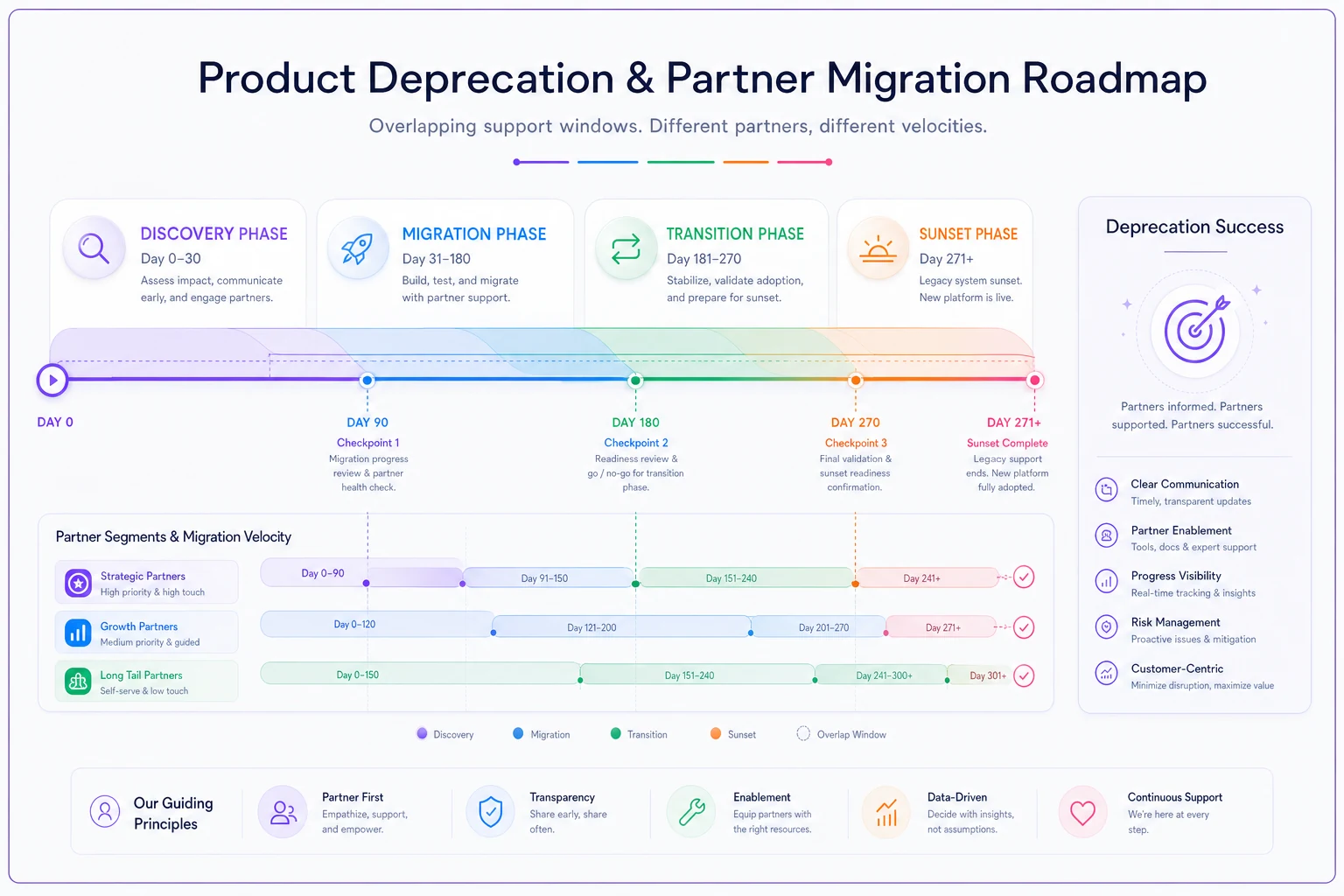
This flow shows the overlapping phases and checkpoints for partner migrations in a single view.
At day 90, you know which partners are engaged. At day 180, you can identify who needs intervention. At day 270, you make hard calls about extended support.
Automated testing patterns that catch breaking changes before partners do
The most embarrassing API failures happen when partners discover breaking changes before you do — not from announced deprecations, but from subtle behavior shifts that slip through regular testing. Response field ordering changes. Null values become empty strings. Timestamps shift timezone formats. These "non-breaking" changes absolutely break real integrations.
Building comprehensive contract testing requires understanding how partners actually use your API. Not how you designed it to be used — how it's actually called in production. A payments processor learned this after changing their error response format. Technically backwards compatible since they only added fields. Except several partners were using strict JSON schema validation that rejected the new fields. Integration broken, trust damaged.
Here's the testing matrix that catches real compatibility issues:
-
Schema validation (response structure, types, required fields)
-
Behavior validation (error codes, status flows, idempotency)
-
Performance validation (response times, payload sizes, rate limits)
-
Integration validation (actual partner code execution)
The fourth layer is where most teams fail. You need to run actual partner code against your changes — not just your interpretation of their integration. Their actual code. A marketplace platform implemented this by requesting integration test suites from their top 10 partners and running them against every release candidate. It catches roughly 3-4 breaking changes per quarter that would have slipped through normal testing.
For smaller partners who can't provide test suites, implement SDK monitoring. Track which SDK versions are calling your API and test against old versions explicitly. One analytics platform found that nearly a third of their traffic came from SDK versions over two years old. Their "backwards compatible" change broke every one of those integrations because the old SDK made assumptions about response parsing.
The automation setup looks like:
-
Partner test suites run on every commit to staging
-
SDK compatibility matrix tested nightly
-
Production traffic replay against release candidates
-
Automated alerts when deprecated endpoint usage spikes
The automation setup above helps catch changes before partners do and gives you a cadence of actionable alerts tied to real usage patterns.
Converting API lifecycle stages into roadmap items that executives actually understand
Product executives rarely grasp the true cost of API lifecycle management until something breaks. They see "deprecate old authentication endpoint" as a one-sprint task — not the six-month cross-functional effort it becomes when you factor in partner communication, migration support, documentation updates, and extended maintenance.
Turn cross-team launches from chaos into predictable releases: a PM orchestration playbook is directly relevant here. API changes are inherently cross-team efforts that need the same orchestration rigor as feature launches — often more so, since external partners can't attend your standups.
The roadmap translation problem comes from how teams present API work. Technical teams talk about "deprecating v1 endpoints" or "implementing OpenAPI 3.0." Leadership hears technical maintenance. They don't see the business impact: partner satisfaction, support cost reduction, platform stability, developer ecosystem growth.
Reframe API work as business outcomes:
Instead of: "Migrate authentication to OAuth 2.0" Position as: "Reduce partner integration time from 3 weeks to 3 days"
Instead of: "Deprecate legacy webhooks system" Position as: "Cut integration support tickets by 40%"
Instead of: "Implement versioned endpoints" Position as: "Enable quarterly feature releases without breaking partners"
Here's how API lifecycle stages map to roadmap items:
Quarter 1: Partner Discovery & Impact Analysis
-
Deliverable
Migration impact report for top 50 partners
-
Metric
Percentage of traffic analyzed
-
Risk
Identify breaking changes before commitment
Quarter 2: Migration Enablement
-
Deliverable
Self-service migration tools
-
Metric
Partner test coverage percentage
-
Risk
Reduce support burden during transition
Quarter 3: Progressive Migration
-
Deliverable
50% traffic on new version
-
Metric
Migration velocity by partner segment
-
Risk
Early identification of struggling partners
Quarter 4: Deprecation & Cleanup
-
Deliverable
Legacy system sunset
-
Metric
Support ticket reduction
-
Risk
Extended support contracts defined
This quarterly view helps executives understand the full lifecycle cost while giving product teams clear milestones to work toward.
Governance rituals that prevent surprise breaking changes
Most API breaking changes aren't intentional. They're side effects of seemingly unrelated changes. A database optimization changes response ordering. A security patch adds required headers. A performance improvement removes unused fields that partners secretly depended on.
Ignoring roadmap dependencies costs launches — practical mapping formats, mitigation patterns and prioritization rules applies directly here. Every API change has hidden dependencies that standard change review processes miss.
The governance structure that actually prevents surprises:
Weekly: API Change Review Board
-
30-minute standing meeting
-
Every code change that touches API paths gets flagged
-
Quick assessment
breaking, potentially breaking, or safe
-
Output
Testing requirements for that week's releases
Monthly: Partner Impact Assessment
-
Review usage analytics for all endpoints
-
Identify deprecated endpoints still receiving traffic
-
Alert partners showing unusual integration patterns
-
Output
Partner-specific migration recommendations
Quarterly: API Council Session
-
Cross-functional (product, engineering, support, partnerships)
-
Review all breaking changes from past quarter
-
Plan deprecation schedule for next two quarters
-
Output
Published deprecation calendar
The piece most teams miss is automatic change detection. You can't rely on developers remembering to flag API changes. A travel platform learned this after a "simple refactor" changed their date format from ISO 8601 to Unix timestamps in one obscure endpoint. Only three partners used that endpoint. All three were enterprise clients representing 30% of revenue.
Implement automated detection using this process:
-
Run API diff tools on every pull request to surface structural changes automatically
-
Require explicit approval for any OpenAPI spec changes before merge
-
Use a response recorder to compare production behavior against staging after each deploy
-
Gate merges on consumer contract test results so breakage is caught before it ships
One pattern worth calling out: shadow versioning. Every API change gets an internal version number, even non-breaking ones. Partners subscribe to version notifications at their desired sensitivity level. Some want to know about every field addition. Others only care about breaking changes. This granular communication prevents both over-alerting and under-communication.
Real-world example: How a mid-size logistics platform managed 47 partner migrations without a single breaking incident
A regional logistics platform with around 50 active API consumers needed to overhaul their shipment tracking API. The old version mixed concerns badly — tracking data, billing information, and customer details all bundled into one massive response object. The new version split these into separate, focused endpoints with better authorization controls.
The challenge: their partners included everything from e-commerce platforms to warehouse management systems to last-mile delivery apps. Each integrated differently. Some pulled full snapshots hourly. Others subscribed to webhooks. A few were scraping specific fields from responses they shouldn't have been parsing at all.
They started by instrumenting the old API to understand actual usage patterns. Turns out only 12 partners used more than 20% of the response fields. Most were suffering through massive payloads to extract three or four fields. That insight changed their migration strategy entirely.
Phase 1 (Months 1-2): Added new focused endpoints alongside the old omnibus endpoint. Partners could start using new endpoints immediately while old integrations kept working. Early adopters reported 60% reduction in response parsing time.
Phase 2 (Months 3-4): Implemented field-level deprecation warnings. When partners requested deprecated fields, the response included warnings about which new endpoint to use instead. Support tracked which partners saw warnings but hadn't started migration.
Phase 3 (Months 5-6): Launched partner-specific migration dashboards. Each partner could log in to see their deprecated field usage, suggested migration path, and estimated effort. Procrastinating partners had no excuse for surprise.
Phase 4 (Month 7): Started throttling requests to the old endpoint while maintaining full speed on new endpoints. This natural incentive pushed fence-sitters to finally migrate without completely breaking their integration.
Results after 8 months: 47 successful migrations, zero breaking incidents, support tickets actually decreased during migration, and partner satisfaction scores improved because the new endpoints were faster and more focused.
The key wasn't just the technical approach. They treated each partner segment differently. Enterprise customers got dedicated migration support and custom timelines. Small partners got self-service tools and clear documentation. Legacy integrations got extended support contracts with defined sunset dates.
Making API lifecycle work visible in existing ceremonies
API work often becomes invisible until something breaks because it doesn't fit neatly into feature-oriented ceremonies. Sprint planning focuses on user stories. Roadmap reviews showcase new capabilities. Architecture discussions stay high-level. Meanwhile, critical API changes slip through without proper attention.
The fix isn't adding new meetings. It's embedding API lifecycle checkpoints into existing ceremonies:
Sprint Planning: Add a standing question — does any work this sprint touch API contracts? If yes, which partners need notification? Create a specific story for partner communication, not just the technical change.
Daily Standups: Flag any discovered API behavior changes immediately. That "minor" fix to error handling might break someone's retry logic. Better to know early than discover it through support tickets.
Sprint Reviews: Demo API changes using actual partner integration code, not just Postman collections. Show how a real integration handles the change. This catches assumptions about backward compatibility.
Retrospectives: Track API-related incidents separately. Were partners surprised by changes? Did deprecation warnings work? Did anyone need emergency extensions? These patterns reveal governance gaps.
Roadmap Planning: Include API evolution as a workstream, not scattered tech debt tickets. Show the progression from current state to target state across multiple quarters. Make dependencies explicit.
A content management platform embedded these checkpoints after one too many surprise breaking changes. They added five minutes to sprint planning for API impact review — seemed like overhead at first. Then they caught a change that would have broken their biggest partner's mobile app right before a holiday campaign. Five minutes saved a relationship worth $2M annually.
The operational reality of maintaining multiple API versions
Every product team believes they'll maintain clean API versioning until they're actually supporting three versions simultaneously with different partners stuck on each one. The operational burden isn't just technical. It's the mental overhead of remembering which features exist in which version, which bugs are fixed where, and which security patches need backporting.
A subscription billing platform found this out the hard way. They maintained v1 (legacy), v2 (current), and v3 (beta). Sounds organized. Except v1 had three unofficial sub-versions based on hotfixes. V2 had feature flags that created eight different behavior combinations. V3 kept changing based on partner feedback. Their support team needed a decision tree just to figure out which documentation to share.
The sustainable approach requires clear version policies:
Maximum Versions: Never maintain more than two production versions plus one beta. If you need to add a new version, force migration from the oldest first.
Feature Freeze: Old versions get security patches only. No feature backports, no matter how simple they seem. Each exception creates version divergence that compounds over time.
Version Routing: Use header-based versioning, not URL paths. Makes it easier to route traffic and collect metrics, and prevents partners from accidentally bookmarking old versions.
Sunset Automation: Build forced migration into the platform. Old versions automatically get rate limited, then warning messages, then disabled. No manual intervention needed.
The hardest part is saying no to partner requests for extended support. One enterprise client paying $100k annually seems worth maintaining an old version for — until you factor in the engineering overhead, security risk, and opportunity cost. That same engineering effort could improve the current API for every partner.
Using AI-powered analysis to predict partner migration challenges
The most useful addition to API lifecycle management recently has been automated analysis of partner integration patterns. Instead of waiting for partners to report issues, AI-powered operational software can analyze API usage data and flag which migrations are likely to struggle before they even start.
The pattern recognition is genuinely useful even when it's straightforward. By analyzing how partners call your API — frequency, payload sizes, error rates, retry patterns — you can identify risk factors before migration begins. Partners with complex retry logic need more testing. Partners with consistently high error rates might have fragile integrations already. Partners calling deprecated endpoints in tight loops probably have their own technical debt to work through first.
This kind of operational intelligence changes how you plan migrations. Rather than treating all partners equally, you direct support where it's actually needed. One marketplace platform ran this analysis and found that partners with more than five API keys — indicating multiple environments — had roughly three times higher migration success rates. They started requiring development environments for new partners as a direct result, reducing future migration friction.
The automation extends beyond analysis too. AI-assisted tools can generate partner-specific migration guides based on actual API usage. If a partner only calls three endpoints, their guide covers those three. If they have unusual error handling, the guide addresses that specifically. Targeted support like this reduces the burden on your team while improving outcomes for partners who need it most.
Conclusion: API lifecycle management is about relationships, not just technical versioning
Strong API change management goes beyond versioning schemes and deprecation notices. It requires understanding that every API decision affects real businesses with their own constraints, timelines, and priorities. The teams that handle this well treat partners as stakeholders, not just consumers.
The patterns here — overlapping support windows, automated compatibility testing, governance rituals, roadmap translation — work because they acknowledge the operational reality of API ecosystems. Partners have different velocities. Changes have hidden dependencies. Communication needs to be proactive and specific.
More than anything, API lifecycle management needs to be visible work with clear business value, not hidden technical maintenance. When executives understand that good API governance reduces support costs, prevents partner churn, and enables faster feature delivery, it gets proper investment. When partners see consistent, predictable deprecation patterns with adequate migration support, they trust your platform with deeper integrations.
The shift from reactive API management to proactive lifecycle planning typically cuts breaking changes significantly while reducing migration support effort considerably. More importantly, it transforms partner relationships from fragile dependencies into stable foundations for growth. In an ecosystem where every integration adds network value, that stability becomes a real competitive advantage.
Ready to elevate your product management?
Join 2,000+ product teams using Itemyly to accelerate delivery, improve alignment, and build better products.