



Every product team that sells to businesses eventually hits the same wall: Sales and CS requests arrive wrapped in dollar signs, and almost none of them survive contact with the data. A rep says a feature "unlocks $400K ARR." A CSM swears a renewal "depends on this one integration." You build it. The deal closes anyway without it, or it doesn't close at all, and nobody circles back to say the number was made up.
The problem isn't that Sales and CS lie. It's that the intake process rewards confident numbers and punishes nobody for being wrong. If you want revenue-informed prioritization that actually holds up, you need two things working together: a ticket template that forces evidence, and governance rules that make gaming the system harder than just telling the truth.
This is a tight, specific build. Not a prioritization philosophy — an intake mechanism.
How the inflation actually happens
Walk through a real request lifecycle and you can see exactly where the numbers get soft.
A rep is working a $90K ARR opportunity. The prospect, during a demo, mentions they'd "love to see" bulk CSV export. The rep hears a buying signal. In the request ticket, bulk export becomes a deal blocker worth $90K — not "a feature mentioned by one of four stakeholders on one call," but the entire contract value attributed to a single feature, written as though the deal dies without it.
-
Full-contract attribution. The whole deal value gets stapled to one feature, even when the deal has ten moving parts.
-
No downside for being wrong. Nobody tracks whether the deal closed, whether the feature mattered, or whether the requester's prediction held up.
-
Urgency as a shortcut. "The customer needs this by end of quarter" skips the evidence step entirely because urgency feels like its own justification.
The result is that your highest-confidence-sounding tickets are often your least reliable, and the quiet, well-documented requests get buried under louder ones.
The intake ticket: what a real ARR request has to contain
A sales request intake template that works isn't longer than what people use now — it's structured so vague requests can't be completed. If a field can't be filled honestly, the ticket shouldn't move forward. That friction is the point.
Eliminate product chaos and align your team.
Itemyly helps you plan, prioritize, and track every product milestone seamlessly.
- Centralized roadmap management
- Stakeholder collaboration
- Release tracking & analytics
No credit card required
Here's the field set worth pushing every Sales/CS request through:
| Field | What it forces | Why it matters |
|---|---|---|
| Requested capability | A plain description of the actual behavior needed | Strips out solution-jargon; separates problem from proposed fix |
| Deal/account stage | Where this sits in the pipeline or renewal cycle | "Prospecting" vs "verbal commit" changes everything |
| ARR in question | The full contract value | The ceiling, not the claim |
| Attribution % | How much of that ARR this specific capability influences | Forces the requester to admit the feature isn't the whole deal |
| Adjusted ARR | ARR × attribution | This is the number that enters prioritization |
| Evidence attached | Links to call notes, emails, RFP line items | No evidence, no score |
| Blocker vs nice-to-have | Explicit classification with justification | Prevents everything becoming a blocker |
| Deadline + source | The date AND who set it | Separates real contractual dates from invented urgency |
| Alternative/workaround | What the customer does today without it | Often reveals the request is softer than claimed |
The two fields that do the heavy lifting are attribution % and evidence attached. Attribution kills full-contract inflation because the requester has to look at a $90K deal and write, honestly, "this feature influences maybe 20% of this decision." Suddenly that $90K blocker becomes an $18K adjusted bet, which sits very differently in the queue.
The evidence field handles the rest. A request that says "customer needs bulk export" with a pasted sentence from an actual email — "we can't adopt without a way to pull our records out monthly" — is categorically different from a rep's memory of a demo. When people know they have to attach a quote, the fabricated requests quietly stop getting submitted.
The required evidence checklist
Evidence isn't "the rep is pretty sure." Tie it to artifacts. Before a revenue-tagged request gets validated, it needs at least two of these:
-
A direct quote from the customer (email, call transcript, support ticket) describing the need in their own words
-
An RFP, security questionnaire, or procurement doc line item explicitly listing the requirement
-
A named stakeholder on the buying side who raised it, with their role
-
A lost-deal or churn note from a closed account citing the same gap
-
A written statement from the customer that a workaround is unacceptable, not just inconvenient
The "two of these" rule is deliberate. One data point is an anecdote. Two independent artifacts pointing the same direction is a pattern worth timeboxing. This is the same filtering discipline covered in our piece on fixing noisy customer feedback with a repeatable intake and filtering rubric — the difference here is that the revenue claim raises the evidence bar, because the dollar figure makes the request harder to say no to.
Timeboxed validation before anything hits the roadmap
Most teams go straight from "ticket submitted" to "build or reject." The missing middle is a short, bounded validation step that tests the ARR assumption cheaply before committing engineering weeks.
-
Reverse-ask the customer. Have the rep or CSM go back and ask directly: "If we delivered this in Q3 instead of now, does that change your decision?" The answer tells you whether it's a real blocker. Two-day turnaround, not a sprint.
-
Price-the-gap test. Offer the account a manual workaround or a services-led interim solution. If they accept, the feature wasn't blocking the deal — it was a preference. If they refuse the workaround flatly, you've confirmed the blocker.
-
Pattern check across accounts. Pull every open ticket referencing the same capability. If three accounts with similar profiles all cite it with evidence, the aggregate adjusted ARR might justify a real bet even if no single deal does on its own.
Each of these has a hard timebox — typically three to five business days. If validation can't complete in that window, the request waits in the backlog rather than jumping the queue on urgency alone. The timebox protects your roadmap from being hijacked by requests whose urgency evaporates the moment someone asks a clarifying question.
Here's a simple validation workflow.
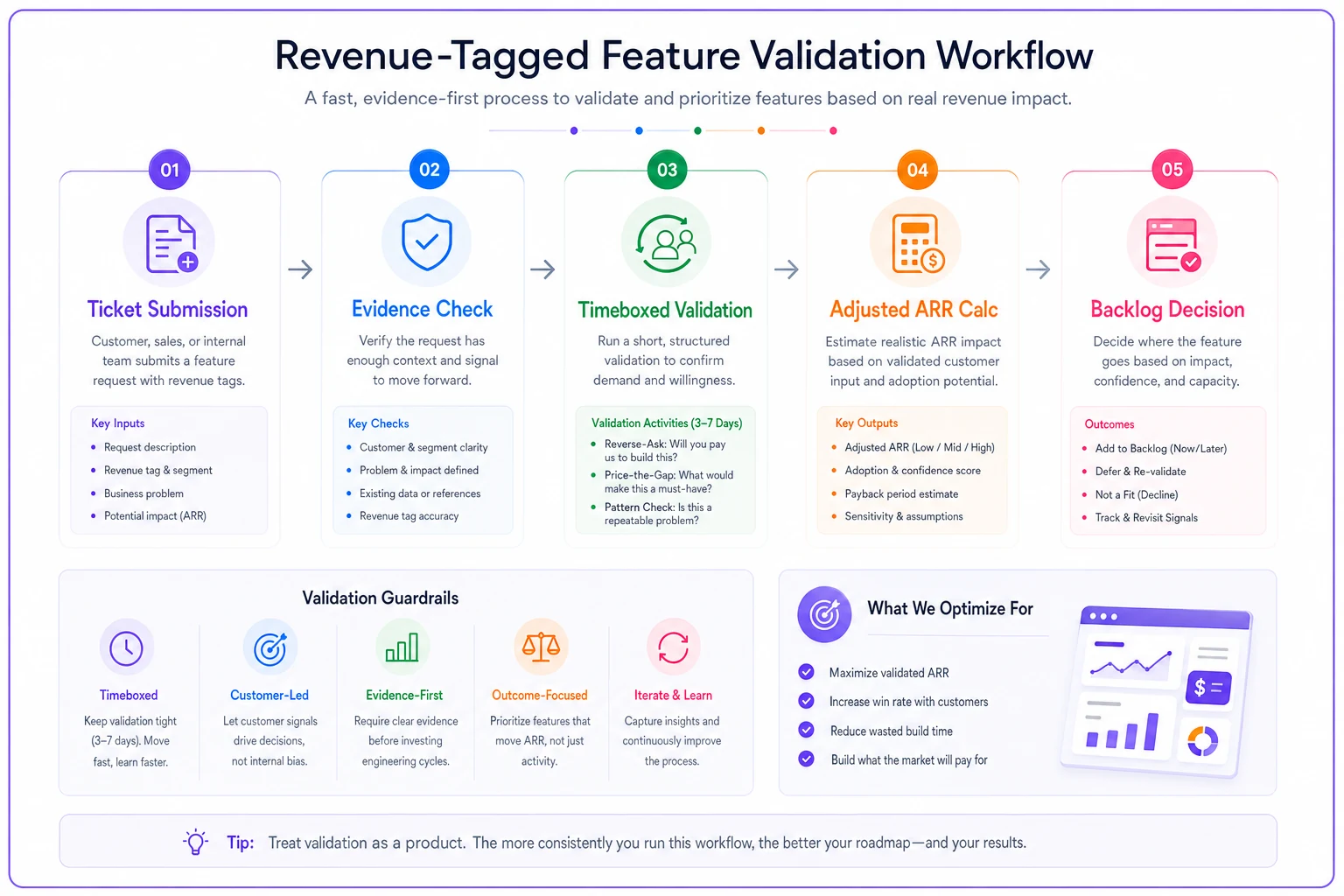
A realistic pattern: out of ten revenue-tagged requests that enter validation, roughly three survive as genuine blockers with confirmed adjusted ARR, four turn out to be preferences the customer will live without, and the rest collapse because the "deal" was earlier-stage than the ticket claimed.
Governance: fast-track rules vs rejection rules
This is the part that keeps the system honest. Evidence and attribution are only useful if there are explicit rules for what happens next. Ambiguity is where gaming lives.
Fast-track criteria (all must be true)
-
The account is at verbal commit or active renewal, not prospecting
-
Adjusted ARR (after attribution) clears a set threshold — pick a number that means something for your business, e.g. north of $50K
-
At least two evidence artifacts are attached
-
There's a contractual or procurement-driven date, with the source named — not a rep-invented deadline
Automatic rejection / park criteria
-
No evidence artifacts are attached after one follow-up
-
The deal is early-stage (prospecting/discovery) — revenue isn't real enough to prioritize against
-
Attribution is left at 100% with no justification (a tell for lazy inflation)
-
The same requester has a pattern of overturned claims (more on this below)
The accountability loop
This is the single most effective anti-gaming mechanism, and almost nobody runs it: close the loop on every revenue claim.
Keep a simple per-requester record of claim outcomes to calibrate evidence burdens and fast-track privileges over time.
After a deal closes or churns, go back to the ticket and record what actually happened. Did the deal close? Did the feature exist when it closed? Was the attribution accurate? Over a quarter or two, you build a quiet track record per requester. The rep whose claims consistently hold up gets their future tickets fast-tracked faster. The one whose "blockers" keep closing without the feature gets a higher evidence bar.
You don't need to publicly shame anyone. You just need the data to exist. Once people know claims get checked against outcomes, the inflation drops on its own — not because of a rule, but because the incentive to exaggerate disappears.
A real scenario
A mid-market B2B SaaS company, around 40 people, sold into operations teams. Their intake was a shared Slack channel and a Jira board where any rep could file a "revenue-critical" request. At one point the board had roughly 60 open revenue-tagged tickets, collectively claiming something like $2.1M in "at-risk ARR" — against a company doing a little over $600K ARR total. The number was nonsense and everyone shrugged at it.
They introduced the attribution field and the two-artifact evidence rule. Nothing else changed at first — same team, same deals. Within one intake cycle, about a third of the open tickets couldn't be completed because no one could attach evidence, and they got parked. Of the ones that survived, the adjusted ARR summed to somewhere around $180K–$220K — a number that was actually plausible and actually useful for sequencing work.
The more interesting shift came a quarter later, once they ran the close-the-loop step. They found two capabilities showing up repeatedly across accounts that actually churned, with real quotes attached. Those got built. Meanwhile, a long-standing "every deal needs this" integration request — which had sat near the top of the queue for months on reputation alone — turned out, under attribution, to influence maybe 15% of any given deal. It dropped down the list, and no deals were lost for it.
Engineering time didn't increase. The queue just started pointing at the right things, and the quarterly roadmap arguments got shorter because the numbers in the tickets were defensible.
When this is worth the friction — and when it isn't
This makes sense when you sell to businesses, deals carry meaningful ARR, and Sales or CS can file directly into your prioritization. The moment revenue claims influence what gets built, you need evidence discipline.
It's overkill when you're a small early-stage team talking to customers daily and the "intake process" is three people in a room. Formalizing attribution math for five requests a month is bureaucracy for its own sake.
One group that should not run this rigidly: teams where the real problem isn't inflated claims but missing high-value work — requests that never get surfaced at all. If your issue is blind spots rather than noise, the fix is upstream of intake. We worked through that separately in prioritization keeps missing high-impact work — an organizational system to surface the right bets. Intake guardrails filter what comes in; they don't generate signals that aren't being captured.
The point
Revenue-tagged requests feel authoritative because they come with a dollar figure, and dollar figures are hard to argue against in a planning meeting. The whole trick is forcing that figure to be honest before it earns a spot on the roadmap: attribution instead of full-contract claims, evidence instead of memory, a short validation window instead of reflexive urgency, and an accountability loop that keeps everyone truthful over time.
None of this is heavy. A handful of extra fields and two governance rules will strip most of the phantom ARR out of your queue within a cycle. What's left is a smaller, more trustworthy set of bets — and a Sales and CS team that gradually stops inflating numbers, because the system no longer rewards it.
Ready to elevate your product management?
Join 2,000+ product teams using Itemyly to accelerate delivery, improve alignment, and build better products.