



Most pricing work dies in a spreadsheet. Someone runs a smart analysis, finds that a $29 tier is leaving money on the table, writes up a recommendation, and then... nothing. Three months later the same deck gets re-presented with slightly newer numbers. The pricing idea never touched the roadmap, never got engineering capacity, and never turned into revenue.
That gap — between "we validated a pricing change" and "the change is live and compounding ARR" — is the actual problem. It's not that teams can't design pricing experiments. It's that pricing lives in a parallel universe from the roadmap governance that decides what actually gets built. One team runs experiments. A different team runs prioritization. They rarely share a pipeline, a scoring model, or even a vocabulary.
This article is about wiring those two systems together: a pricing experiments framework that produces evidence in a format your roadmap governance already understands, so a validated packaging change gets fast-tracked instead of re-litigated.
Why pricing and roadmap governance drift apart
The split usually isn't anyone's fault. It's structural.
Pricing tends to sit with finance, a growth PM, or the founder. Roadmap governance sits with product and engineering. Those groups measure success differently. Finance thinks in ARR, expansion, and net revenue retention. Product thinks in cycle time, delivery bands, and OKR progress. When a pricing insight shows up at a prioritization meeting, it arrives wearing the wrong clothes — a revenue argument in a room that's scoring engineering effort and risk.
So the pricing recommendation gets treated like a stakeholder request rather than a validated bet. It competes on vibes against features that already have user stories, estimates, and a sponsor. And it loses, because it has no effort estimate, no rollout plan, and no owner who sits inside the delivery process.
One thing worth noting: pricing changes often require less engineering than people assume. Changing a plan boundary, adding a usage meter, or gating a feature behind a tier is frequently a few weeks of work, not a quarter. But because the work was never scoped the way features get scoped, it gets perceived as risky and open-ended. The lack of a shared format makes small work look big.
This connects directly to the broader idea of a revenue-informed roadmap that runs on an ARR-backed decision pipeline. Pricing experiments are one of the highest-leverage inputs to that pipeline — but only if they emit evidence the pipeline can actually consume.
What breaks at scale
At 20 customers, pricing is a founder decision made over coffee. At 200 customers across three tiers, pricing becomes a system — and that's where the cracks show.
Eliminate product chaos and align your team.
Itemyly helps you plan, prioritize, and track every product milestone seamlessly.
- Centralized roadmap management
- Stakeholder collaboration
- Release tracking & analytics
No credit card required
-
Tier boundaries blur. You added a feature to Pro to close one enterprise deal, and now half your Starter customers want it. Nobody owns the question of which tier a feature belongs in.
-
Grandfathering debt piles up. Every experiment that touches price creates a cohort of legacy customers on old terms. Without governance, you end up with eleven effective price points and no one can model revenue.
-
Experiments contradict each other. Growth runs a trial-length test while sales runs a discount test on overlapping segments. The results interfere, and neither can be trusted.
-
Validated changes still don't ship. The experiment "won," but turning a win into a durable packaging change requires migration logic, billing updates, and comms — work that was never put on the roadmap.
The last one is the quiet killer. A pricing experiment that proves a $40 tier outperforms a $29 tier is worthless if the packaging change sits unbuilt for two quarters. The validation decays. Market conditions shift. The confidence you earned evaporates.
This is the same failure mode behind prioritization that keeps missing high-impact work — the highest-value bets don't fit the intake format, so they never surface in the ranking.
The ARR-uplift template that gives pricing a seat at the table
The fix starts with a shared artifact. Every pricing experiment that reaches a conclusion should produce a one-page ARR-uplift template — not a deck, a structured record that plugs directly into prioritization.
What belongs on it:
| Field | Example |
|---|---|
| Hypothesis | Moving the API-call limit from 50k to 20k on Starter pushes 15% of heavy Starter users to Pro |
| Segment affected | Starter accounts above 20k calls/mo (~140 accounts) |
| Measured lift | +$6k–$9k MRR observed in test cohort, extrapolated |
| Confidence | Medium — 6-week test, n=48, clean holdout |
| Engineering effort | ~2 weeks (meter change, upgrade prompt, billing update) |
| Migration cost | Grandfather existing accounts 90 days; comms sequence required |
| Reversibility | High — flag-controlled, can roll back limit |
| Risk flags | Possible Starter churn in price-sensitive cohort |
The point of this table isn't elegance. It's translation. It turns a revenue argument into something that carries both the ARR upside and the effort/risk fields your roadmap scoring already uses. Now a pricing bet can be ranked against a feature bet on the same axes instead of in a separate meeting with its own logic.
A detail people miss: the reversibility field matters as much as the lift. A high-lift, low-reversibility change — say, a hard contractual price increase — deserves far more scrutiny than a medium-lift, flag-controlled packaging tweak. Governance should fast-track the reversible ones aggressively, because the cost of being wrong is small.
Designing experiments that governance can trust
Pricing experiments break in ways feature experiments don't. You can't always A/B test price cleanly — charging two identical customers different amounts creates fairness and legal problems. So the designs have to be chosen deliberately.
-
Cohort-based price test — New signups only get the new price; existing customers untouched. Best for testing willingness-to-pay on acquisition. Clean, low legal risk, but slow to accumulate signal.
-
Packaging/gating test — Same prices, different feature bundles across cohorts. Best for finding which features actually drive upgrade decisions. Lower fairness risk because price doesn't vary.
-
Paywall/limit test — Adjust usage limits or feature gates and measure upgrade rate. Great for usage-based models. Watch for churn in the squeezed segment.
-
Discount/offer test — Vary promotional terms on new deals. Useful for sales-led motions, but results don't generalize to list price.
-
Survey + conjoint — No live money moves. Weaker evidence, but the only safe option for existing-customer price increases before committing.
Write the threshold decision rule on the ARR-uplift template before launching the test so the post-test path is unambiguous.
The mistake teams make is running a discount test and then treating the result as a willingness-to-pay finding. A customer who converts on a 30% discount tells you almost nothing about list-price elasticity. Match the design to the decision you're actually trying to make, and write that match down on the template so governance knows how much to trust the number.
Worth guarding against: letting pricing tests run without a pre-committed decision rule. Before launch, write the threshold — "if observed lift exceeds +$5k MRR with no statistically meaningful Starter churn increase, we ship." Without that, a win turns into a debate, and the debate reopens the same gap that killed the last pricing idea.
Packaging trade-off rules
Most pricing damage at scale comes from packaging drift, not price points. Features get stuffed into tiers reactively, boundaries lose meaning, and the whole lineup stops telling a coherent story.
-
One feature, one home. Every feature belongs to exactly one tier as its lowest availability. If you need it lower to close a deal, that's a signed exception, not a quiet change.
-
The good-better-best spread rule. Each step up should roughly double value perception, not price. If Pro costs 3x Starter but feels only 1.4x more valuable, the tier is mispriced or mis-packaged.
-
No naked price increases on reversible things. If you can test a packaging change instead of a raw price hike, do it — packaging moves are easier to roll back and less likely to trigger churn backlash.
-
Grandfather with an expiry. Every legacy cohort gets a defined sunset window. Open-ended grandfathering is how you end up with a pricing table no one can model.
These rules do something subtle: they turn pricing from a series of one-off decisions into a governed system where each change has to justify itself against the shape of the whole lineup.
Guardrails before you fast-track anything
Fast-tracking validated pricing changes only works if the guardrails are real. Otherwise "fast-track" becomes "skip the checks," and you ship a change that spikes churn.
-
Decision rule was written before the experiment ran, and the result cleared it
-
Affected customer segment is named and counted, not estimated loosely
-
Grandfathering and migration plan exists with a defined window
-
Billing and invoicing changes are scoped and owned
-
Customer comms sequence drafted (especially for anyone seeing a price change)
-
Rollback path confirmed — flag, limit, or config, not a code revert
-
Churn and downgrade monitoring in place for the 60 days after launch
-
Legal sign-off on any change touching existing contracts or published terms
If a pricing change clears this list and carries a strong ARR-uplift template, it should jump the normal intake queue. That's the whole payoff: validated, reversible, well-scoped commercial changes shouldn't wait behind feature work with weaker evidence.
When fast-tracking makes sense — and when it doesn't
When it makes sense: The change is reversible, affects a well-defined segment, and the experiment produced a clear decision-rule win. Packaging tweaks, usage-limit adjustments, and new-customer pricing almost always qualify. Speed compounds here — every month of delay is lost ARR you already proved was there.
When it's a bad idea: You're raising prices on existing customers based on a survey rather than live behavior. Or the "experiment" was really a discount test being misread as willingness-to-pay. Or reversibility is low and the blast radius is your whole base. In those cases, slow is correct. Fast-tracking an irreversible, poorly-validated price increase is how you manufacture a churn event.
Who should not run this system yet: Teams under roughly 30 customers. At that size you don't have the sample sizes for meaningful pricing experiments, and the overhead of templates and governance will slow you down more than it helps. Keep it founder-led and move fast until you have enough volume for real signal.
A real scenario
A B2B workflow SaaS, roughly 180 paying accounts, three tiers at $29 / $79 / $199. Expansion revenue had flatlined for two quarters. The growth PM suspected the Starter tier was too generous — heavy users had no real reason to upgrade.
They ran a paywall test: for new Starter signups, the automation-run limit dropped from 5,000 to 2,000 per month, with an in-app upgrade prompt when users hit 80% of the cap. Pre-committed decision rule: ship if upgrade rate improved by at least 8 points with no meaningful increase in first-90-day churn.
Over about seven weeks, the test cohort upgraded to the $79 tier at roughly 11 points higher than the control, and churn in the squeezed cohort moved only slightly — within noise. The ARR-uplift template estimated something like $7k–$10k in incremental MRR once rolled out to the full new-signup funnel, against roughly two weeks of engineering work (meter change, prompt, billing update) and a 90-day grandfather window for existing Starter customers.
Because the change was flag-controlled and reversible, and because the template carried both the lift and the effort on the same scorecard the roadmap already used, it cleared governance in one cycle instead of being re-presented for a quarter. It shipped the following sprint. The entire gap between "validated" and "live" closed to about three weeks — down from the previous pattern of pricing ideas simply never shipping.
The interesting part wasn't the lift number. It was that a pricing change finally moved through the same pipeline as a feature, scored on the same axes, with an owner inside delivery. That's the structural fix.
Making it a system, not a one-off
The win above only repeats if the connective tissue stays in place. That means pricing experiments feed a single intake, every conclusion emits an ARR-uplift template, and governance ranks commercial bets alongside feature bets using shared effort-and-risk fields. Experiment designs stay matched to the decisions they're meant to inform. The packaging rules keep the lineup coherent as features get added. The guardrails keep fast-tracking honest.
Here's a simple workflow to visualize how experiments should flow into governance.
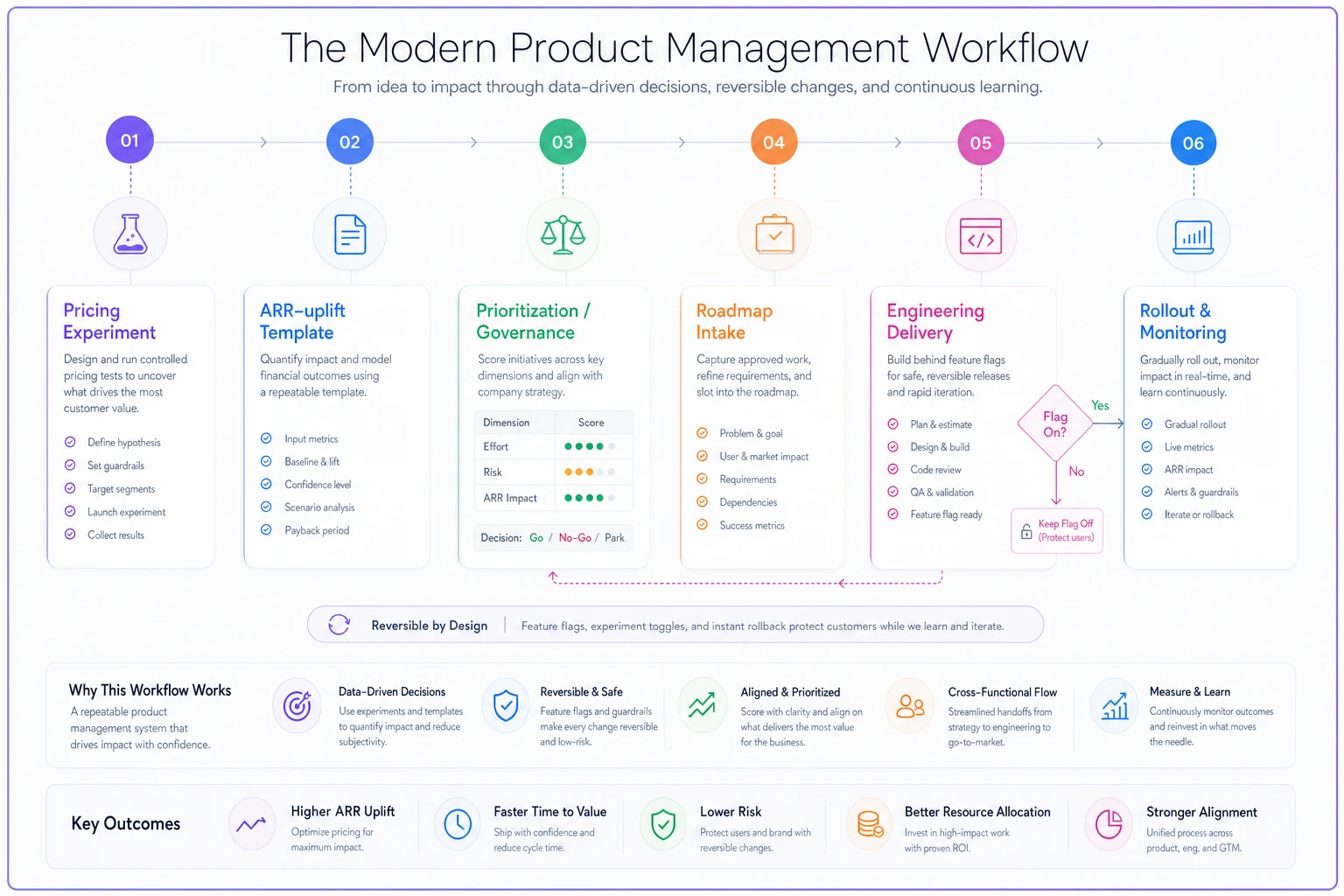
None of this requires heavy tooling. A shared template, a decision-rule habit, and a prioritization pipeline that accepts revenue bets in a format it understands will get you most of the way there. The teams that compound ARR aren't the ones running the cleverest pricing tests — they're the ones who closed the gap between validating a commercial change and actually shipping it, and then kept that gap closed every quarter.
None of this requires heavy tooling. A shared template, a decision-rule habit, and a prioritization pipeline that accepts revenue bets in a format it understands will get you most of the way there. The teams that compound ARR aren't the ones running the cleverest pricing tests — they're the ones who closed the gap between validating a commercial change and actually shipping it, and then kept that gap closed every quarter.
Ready to elevate your product management?
Join 2,000+ product teams using Itemyly to accelerate delivery, improve alignment, and build better products.