
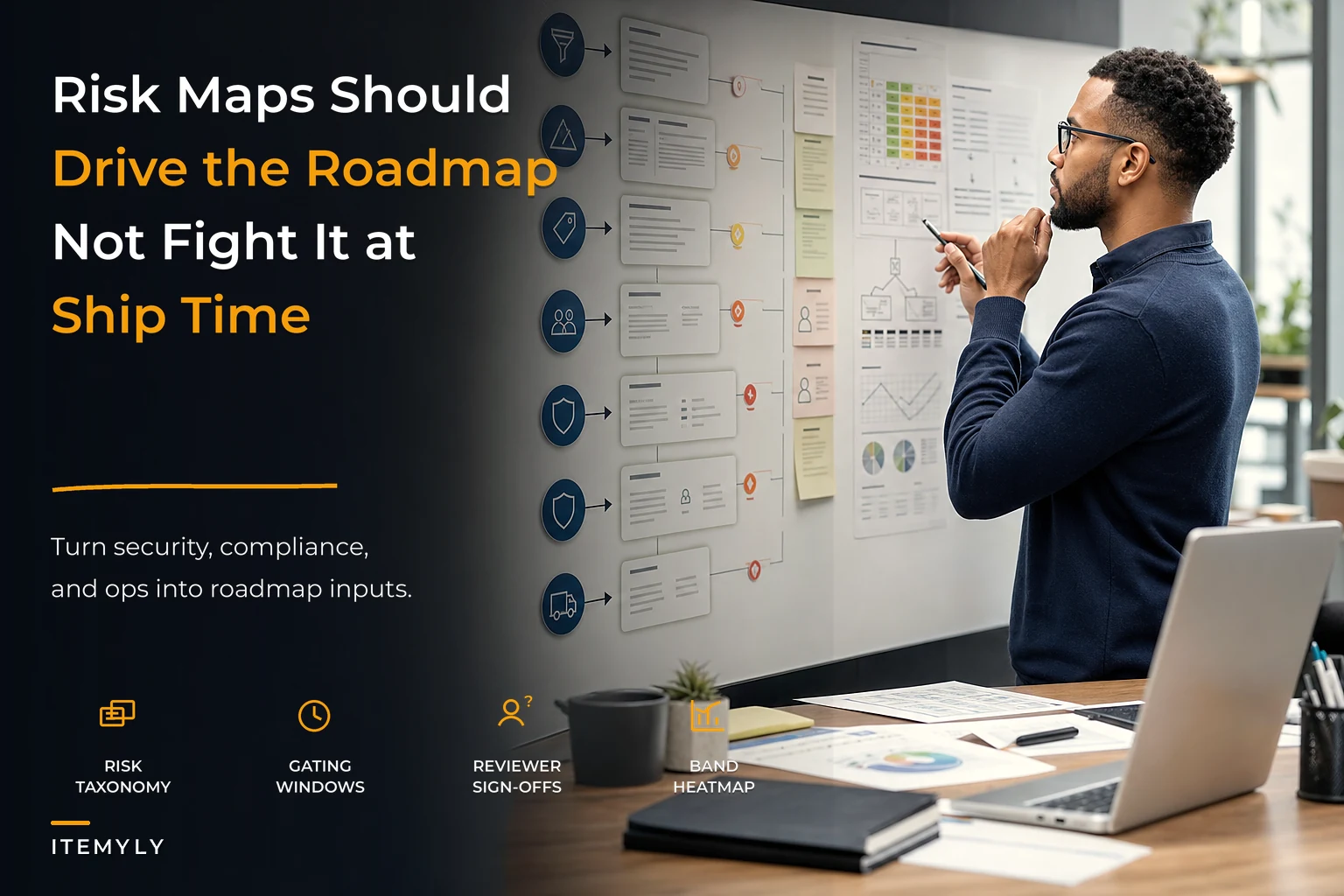

Most roadmaps treat risk the way people treat car maintenance — something you'll deal with when the weird noise gets loud enough. Security review happens two weeks before launch. Compliance shows up when someone in legal stumbles across the feature spec. Ops constraints surface when the on-call engineer files a complaint after the third 2am page.
The pattern is predictable: risk is invisible during prioritization, then suddenly non-negotiable at the worst possible moment. By then the team has already committed dates, sold the feature internally, and burned two sprints. The gate becomes a fight instead of a checkpoint.
Risk-aware roadmapping fixes the sequencing problem. Instead of bolting security and compliance onto the end, you quantify risk while you're deciding what to build, map it to a priority band, and attach gating rules that everyone agreed to before the pressure hit. This post covers the actual mechanics — the scoring templates, the taxonomy-to-band mapping, and the sign-off patterns that hold up when a VP wants to skip a step.
Why risk stays invisible until it's expensive
The core reason is structural, not lazy. Prioritization frameworks reward things that are easy to measure — revenue impact, effort estimates, customer request counts. Risk is diffuse. A data-exposure risk doesn't show up in a RICE score. A compliance obligation doesn't have a clean ARR number attached. So it gets left out of the math entirely, and anything left out of the math effectively scores zero during planning.
There's a second reason that becomes obvious as teams grow. Early on, one or two people hold the whole risk picture in their heads. The founder knows which customers signed data-processing agreements. The lead engineer knows which service has no rollback path. That informal knowledge works fine at 8 people. At 40 people across four squads, nobody holds the full picture anymore, and the tribal knowledge that used to catch problems just stops firing.
The transition point tends to be brutal precisely because nothing dramatic breaks at first. Things keep shipping. Then one launch triggers a data-residency violation, or a "small" auth change quietly exposes an endpoint, and suddenly leadership wants a process. The process gets built reactively, gets treated as bureaucratic overhead, and everyone resents it. Building it before the incident — as a planning input — changes how people relate to it entirely.
Quantifying risk so it competes fairly in prioritization
The trick is giving risk a number that lives in the same conversation as impact and effort. You don't need a sophisticated model. You need a repeatable score that two different people would land on within a point of each other.
Eliminate product chaos and align your team.
Itemyly helps you plan, prioritize, and track every product milestone seamlessly.
- Centralized roadmap management
- Stakeholder collaboration
- Release tracking & analytics
No credit card required
-
Likelihood — how probable is the bad outcome, given normal operating conditions (1–5)
-
Blast radius — how many users, records, or systems are affected if it goes wrong (1–5)
-
Reversibility — how hard is it to undo or contain (1–5, where 5 is "basically permanent")
Multiply likelihood by blast radius, then weight by reversibility. A feature flag change that affects everyone but rolls back instantly scores very differently from a database migration that touches a fraction of records but can't be reversed. That reversibility weight matters more than people expect — irreversible-but-small often deserves more scrutiny than reversible-but-huge.
Here's the part teams consistently skip: you have to score risk relative to a baseline, not in the abstract. "Does this change increase risk above what we already accept?" is answerable. "Is this risky?" is not. Anchor every score to the current state.
| Change type | Likelihood | Blast radius | Reversibility | Raw score | Band |
|---|---|---|---|---|---|
| Copy change on marketing page | 1 | 2 | 1 | 2 | Low |
| New third-party analytics SDK | 3 | 4 | 2 | 24 | Elevated |
| Auth/session logic refactor | 3 | 5 | 4 | 60 | High |
| Customer data export feature | 4 | 5 | 5 | 100 | Critical |
| Payment provider swap | 2 | 5 | 5 | 50 | High |
The numbers aren't sacred. The point is that "payment provider swap" and "auth refactor" both land in High and pull the same gating rules, even though a naive effort estimate might rank them completely differently.
Mapping taxonomies to prioritization bands
A raw score is useless until it maps to an action. This is where most homegrown risk systems fall apart — they generate a number and then nobody knows what to do with a 47.
The fix is a taxonomy that translates score ranges into bands, and bands into required behaviors. Four bands is usually enough. More than that and people stop remembering the distinctions.
-
Low (score 1–9) No gate. PM can ship on normal review. Logged for audit, nothing more.
-
Elevated (10–29) Requires a named reviewer sign-off (security or ops, depending on domain). Can proceed in parallel with development.
-
High (30–74) Requires a review artifact plus sign-off before the work enters a committed sprint — not before launch. The timing matters enormously.
-
Critical (75+) Requires a documented review, two sign-offs from different functions, and an explicit rollback plan attached to the roadmap item.
The single most important design decision here is when the gate fires. If your High band gate fires at launch, you've built the exact reactive system you were trying to escape. Make it fire at commitment — the moment the item moves from "maybe" to "we're building this." That's when changing course is cheap and nobody has sold the date yet.
One pattern worth stealing: attach the band to the roadmap item as a visible tag, the same way you'd tag effort or squad. When a Critical item sits in the backlog next to three Low ones, the planning conversation naturally accounts for the review overhead. It stops being a surprise cost.
Gating and sign-off patterns that actually hold
A gate is only real if it can't be quietly skipped. The failure mode isn't people maliciously ignoring rules — it's a Friday-afternoon deploy where the reviewer is on vacation, the deadline is Monday, and someone makes a judgment call. Multiply that across fifty deploys and your gate has holes.
-
The gate blocks a state transition, not a person. The item can't move from "committed" to "in progress" (for High) or "in progress" to "shippable" (for Critical) without the artifact and sign-off attached. This ties the gate to the workflow, not to someone remembering to ask.
-
Sign-off has a defined owner and a defined backup. Every gate names a primary and a secondary approver. No single point of failure means no "reviewer's on PTO" exception.
-
Exceptions are logged, not hidden. There will be legitimate emergencies. Build an exception path that requires a written reason and an expiry date, so the exception doesn't silently become the new normal.
-
The artifact is proportional to the band. A High item might need a half-page threat note. A Critical item needs a real review. Don't demand a 12-page document for an Elevated change — overly heavy artifacts train people to game the system.
The exception log deserves emphasis. Teams without a logged exception path don't have fewer exceptions — they just have invisible ones. Making the exception cheap-but-tracked is far safer than making it forbidden-but-inevitable.
A workflow that ties it together
[New roadmap candidate] ↓ [Refinement: 3-axis risk score assigned] ↓ [Score maps to band: Low / Elevated / High / Critical] ↓ [Low/Elevated → normal flow] [High/Critical → band tag + required-reviewer field populated] ↓ [Item enters committed cycle] ↓ [Gate: artifact present? Sign-off attached?] No → bounces to refinement with reason Yes → work proceeds ↓ [Critical only: second gate at shippable stage] → rollback plan present? → second sign-off from different function? ↓ [Ships. Everything logged against the item.]
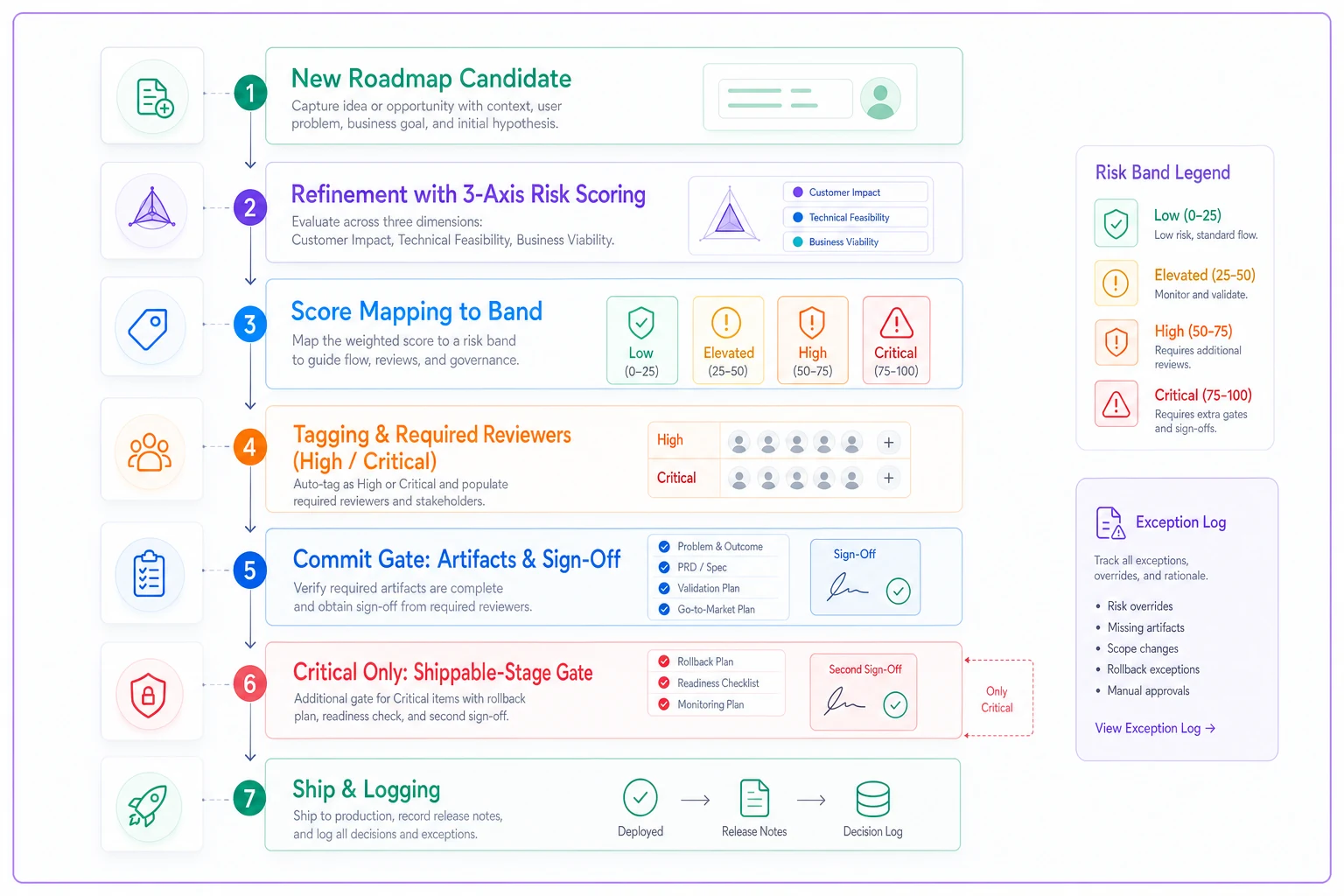
A new roadmap candidate comes in. During refinement, whoever owns it fills the three-axis score — takes about two minutes once people are used to it. The score maps to a band. Low and Elevated items flow normally. High and Critical items get a band tag and a required-reviewer field that must be populated before the item can be pulled into a committed cycle.
When the item enters the committed cycle, the gate checks for the artifact. Missing artifact means the item bounces back to refinement with a clear reason. Once sign-off is attached, work proceeds. For Critical items, a second gate at the shippable stage checks for the rollback plan and the second sign-off.
Everything gets logged against the item, so six months later when an auditor or a new PM asks why something shipped the way it did, the answer is one click away instead of a Slack archaeology expedition. This kind of decision traceability overlaps with what makes cross-team launches predictable instead of chaotic — attaching decisions to work items pays off in both contexts.
Where AI-assisted operational platforms genuinely help here is the boring middle: auto-scoring a first-draft risk level from the change description, flagging when an item's band doesn't match similar past items, and nudging owners when a High item is about to enter a sprint without its sign-off. Not making the risk decision — just making sure the human decision doesn't get skipped because someone was heads-down. That's the realistic role for automation in this workflow, and it's more valuable than it sounds.
A real scenario: a 30-person B2B SaaS team
A mid-stage B2B analytics company — around 30 people, five product squads — kept hitting the same wall. Security review fell to a single senior engineer who reviewed things when he had bandwidth, which meant reviews clustered right before launch. Two launches in one quarter slipped by roughly three weeks each because a security concern surfaced late and forced a redesign. One of those slips cost them a contract renewal window with an enterprise customer.
They introduced three-axis scoring during backlog refinement and mapped scores to four bands, with the High/Critical gate firing at sprint commitment instead of launch. Nothing complicated on the tooling side at first — a required field and a shared review queue.
Over the next two quarters, late-surfacing security issues dropped to almost none. The security engineer's review load didn't actually decrease much, but it spread out, so it stopped landing as a launch-week crisis. Launch slippage tied to risk fell from those two multi-week delays to a couple of one- or two-day adjustments. The renewal they'd nearly lost went through the following cycle. The engineer's own summary was pretty blunt: he was doing the same amount of work, just not all of it at 11pm on Thursdays.
The interesting part wasn't the metric. It was that the team stopped experiencing risk as an ambush.
When this makes sense, and when it doesn't
When it's worth building: You're handling regulated data, you've had at least one late-stage risk surprise, or you've crossed the point where no single person holds the full risk picture. Above roughly 20 people with multiple squads shipping independently, you almost certainly need something like this.
When it's overkill: A five-person team shipping an internal tool with no sensitive data doesn't need a four-band taxonomy and dual sign-offs. A lightweight "does this touch auth, payments, or customer data?" checklist is plenty at that size.
Who should not do this: Teams that will build the framework and never enforce the gates. An unenforced gate is worse than no gate — it creates a false sense of coverage while every actual decision routes around it. If leadership won't back the state-transition blocks, don't build them. Start with visibility (the band tags) and earn enforcement later.
One more honest caveat: this system competes with your other planning pressures, including technical debt work, which has its own claim on capacity. If you're already juggling maintenance-versus-features tradeoffs, it's worth reading how a scoring model and debt heatmap balance that load — risk gating and debt governance pull from the same capacity pool, and pretending otherwise is how both systems get starved.
Where teams get this wrong
The most common mistake is treating the score as the deliverable. The score is just a router — it sends items to the right level of scrutiny. Teams that obsess over calibrating the perfect formula miss that a rough-but-consistent score routes correctly far more often than it needs to be precise.
The second mistake is gating at the wrong moment. Gating at launch produces theater. Gating at commitment produces actual behavior change, because that's when the option to do something different still exists.
The third is letting the taxonomy sprawl. Someone always wants a fifth band, a sub-category, a special path for their edge case. Every addition dilutes the whole thing. Guard the simplicity — four bands, three axes, one exception path. If it can't fit on an index card, people won't use it under pressure, and under pressure is exactly when it matters.
Risk-aware roadmapping isn't about adding process for its own sake. It's about moving the risk conversation from the loudest, latest, most expensive moment to the quiet, early, cheap one — and making sure the move sticks even when someone senior wants to skip a step. Get the sequencing right and the rest is just plumbing.
Risk-aware roadmapping isn't about adding process for its own sake. It's about moving the risk conversation from the loudest, latest, most expensive moment to the quiet, early, cheap one — and making sure the move sticks even when someone senior wants to skip a step. Get the sequencing right and the rest is just plumbing.
Ready to elevate your product management?
Join 2,000+ product teams using Itemyly to accelerate delivery, improve alignment, and build better products.