



Most teams don't have a research problem. They have a research memory problem. Studies get run, insights get shared in a Slack thread, someone screenshots a quote into a deck, and six months later a new PM asks "have we ever talked to enterprise admins about bulk provisioning?" — and nobody can answer. The work happened. The knowledge evaporated.
That's the gap a real research ops playbook closes. Not more studies. Not fancier interview scripts. A system that takes discovery from a scattered set of activities and turns it into a repository your roadmap gates can pull from without a scavenger hunt.
This is about the plumbing. Where research goes in, how it gets structured, how it gets synthesized, and how that synthesis actually shows up when someone's deciding whether an epic makes the cut. Get the plumbing right and research stops being a bottleneck that PMs quietly route around.
Why research knowledge keeps disappearing
The failure mode is almost always structural, not about anyone being lazy or checked out.
Research gets treated as project output instead of organizational asset. A designer runs five interviews for a specific feature, writes up what's relevant to that feature, ships it, moves on. The other 80% of what those five people said — stuff that wasn't relevant to this project but would be useful for the next one — never gets captured in a way anyone can find.
Then the same customer segment gets re-interviewed three months later by a different team asking nearly identical questions. You're paying twice for the same insight and annoying your customers in the process. This almost always happens when there's no shared intake — every team keeps its own "research folder" in whatever drive they prefer, named however they felt that day.
The second driver is that synthesis is personal. One researcher's affinity map is another person's incomprehensible sticky-note wall. Without shared structure, the output of research is only readable by the person who made it. That kills reuse instantly.
And the third one — the quiet one — is that research almost never connects back to the decision that triggered it. A study answers a question, but the question, the decision it fed, and the outcome are stored in three different places. So you can't trace whether research actually changed anything, which makes it easy for leadership to quietly defund it.
This is the same class of problem as scaling discovery without clear boundaries — when discovery has no shape, it doesn't feed delivery, it just floods it.
The four layers that actually make research repeatable
Think of the system as four layers stacked on top of each other. Each one fails independently, and a weakness in any of them collapses the whole thing.
Eliminate product chaos and align your team.
Itemyly helps you plan, prioritize, and track every product milestone seamlessly.
- Centralized roadmap management
- Stakeholder collaboration
- Release tracking & analytics
No credit card required
| Layer | What it does | What breaks without it |
|---|---|---|
| Intake | Standardizes how a research request enters the system | Duplicate studies, vague asks, no way to prioritize |
| Artifact schema | Defines the shape of every research output | Insights nobody but the author can read or search |
| Synthesis templates | Converts raw notes into decision-ready findings | Synthesis quality depends entirely on who did it |
| Repository structure | Stores and links everything so it's findable | Knowledge evaporates; same questions re-asked forever |
Most teams have one of these — usually a repository tool they bought and half-populated. But a repository without intake standards is just a nicer graveyard. The layers only work together.
Layer 1: Intake standards that stop duplicate work
Intake is where research either becomes a system or stays a favor. Without a front door, requests come in as "hey can you talk to a few customers about X" and you have no idea if it's a two-hour job or a three-week study.
A workable intake form doesn't need to be heavy. It needs to force clarity on a few things before anyone touches a calendar:
-
The decision this feeds. Not the question — the decision. "Should we build tiered permissions in Q3?" is a decision. "Learn about permissions" is a wish.
-
The roadmap item or gate it's attached to. If it isn't attached to anything, that's worth surfacing — not necessarily a reason to say no.
-
What we already know. Forces the requester to check the repository first. This single field kills more duplicate studies than any policy you'll ever write.
-
Decision deadline. Separates "we need this to decide next sprint" from "someday curiosity."
-
Confidence needed. A directional read from five conversations is very different from statistically defensible sizing. Naming this upfront prevents scope arguments later.
Here's a pasteable intake template:
-
RESEARCH INTAKE
-
Requesting team / person
-
Decision this research feeds
-
Linked roadmap item or gate
-
What we already believe (and why)
-
What we've already looked at in the repo
-
Confidence level needed
[Directional / Confident / Defensible]
-
Decision deadline
-
Customer segments in scope
The teams that fill this out well aren't usually the most disciplined ones — they're the ones whose intake form makes the lazy path the correct path. When "check the repo first" is a required field, people check the repo. When it's a suggestion, they don't.
This connects directly to how you handle unstructured signal. If you've already built a repeatable intake and filtering rubric for noisy customer feedback, research intake is its more deliberate cousin — same principle, longer time horizon.
Layer 2: An artifact schema so insights are actually reusable
This is the layer teams skip, and it's the one that quietly determines whether your repository is worth anything in two years.
-
Study ID and date
-
Method (interview, survey, usability test, diary study, etc.)
-
Segment(s) studied
-
Decision it fed (linked back to intake)
-
Key findings — atomic, one insight per entry
-
Confidence tag on each finding
-
Supporting evidence — quote, clip timestamp, or data point
-
Related studies (links)
The critical move here is making findings atomic. One finding = one entry = one taggable, searchable, reusable unit. When you write findings as five-paragraph narratives, they can only be reused as a whole. When you write them as discrete statements — "Admins avoid bulk actions because they can't preview the change before applying it" — they can be pulled into any future study, roadmap doc, or exec narrative independently.
A mistake that shows up constantly: teams tag findings by feature ("permissions", "billing") instead of by segment and behavior. Feature tags rot the moment you rename or reorganize features. Behavioral and segment tags stay useful for years because customer behavior changes slower than your product taxonomy does.
Layer 3: Synthesis templates that produce decision-ready findings
Raw notes aren't research. Synthesis is where the value actually gets created, and it's also where quality varies most between people.
A synthesis template forces the same rigor regardless of who's driving. Here's a structure that holds up across methods:
-
SYNTHESIS
-
Question we set out to answer
-
What we did
[method, N, segments, dates]
-
Top findings (atomic, confidence-tagged)
-
What surprised us
-
What this means for the decision
-
Recommendation
[Build / Don't / Investigate further / Reframe]
-
Open questions / what we still don't know
-
[Finding] — [Confidence
High/Med/Low] — [evidence]
-
...
Two fields do most of the heavy lifting. "What surprised us" prevents confirmation bias — if nothing surprised you across a full study, you probably ran it to confirm a conclusion you'd already reached. And "what we still don't know" keeps people honest about confidence, which matters a lot at roadmap gates where overclaimed certainty leads to expensive bets.
The synthesis discipline that separates good teams from struggling ones: they synthesize against the decision, not against the data. A synthesis that ends with "here's everything we learned" is a report. A synthesis that ends with "and therefore we should / shouldn't do X" is research that can actually move a roadmap.
Layer 4: Repository structure that stays findable at scale
A repository breaks in a predictable way. It works fine for the first 30 or so studies because everyone remembers where things are. Around 80–100 studies, tribal memory fails, and if the structure relies on people remembering, everything past that point is effectively invisible.
The fix is organizing around entities that don't change, not projects that do. Structure the repo around:
-
Segments — the customer types you serve. These are stable.
-
Behaviors and jobs — what those customers are trying to do. Also stable.
-
Decisions — the roadmap questions research has fed over time.
-
Studies — the raw work, linked to all of the above.
Projects and features are the worst top-level organizing principle because they churn constantly. Segments and behaviors are the best because they outlast every reorg. A finding filed under "SMB admins → bulk operations" is findable in three years. The same finding filed under "Project Falcon Q2" is gone the moment Falcon ships and everyone forgets what it was.
The workflow, start to finish
Here's how a single research effort should move through the system, from trigger to traceable output: A PM hits a decision point — say, whether to invest in guided onboarding for a mid-market segment. They file intake, which forces them to state the decision and check what's already known. The repo returns two prior studies on adjacent behavior; that context reshapes the study before it even starts. A study runs against a defined confidence bar. Findings come out atomic and tagged against the artifact schema, filed under segment and behavior — not the onboarding project. Synthesis produces a confidence-tagged recommendation linked back to the original decision. That recommendation shows up at the roadmap gate as evidence, with a traceable line from decision to study to finding to recommendation. Six months later, a different team searching "mid-market onboarding" finds all of it instantly.
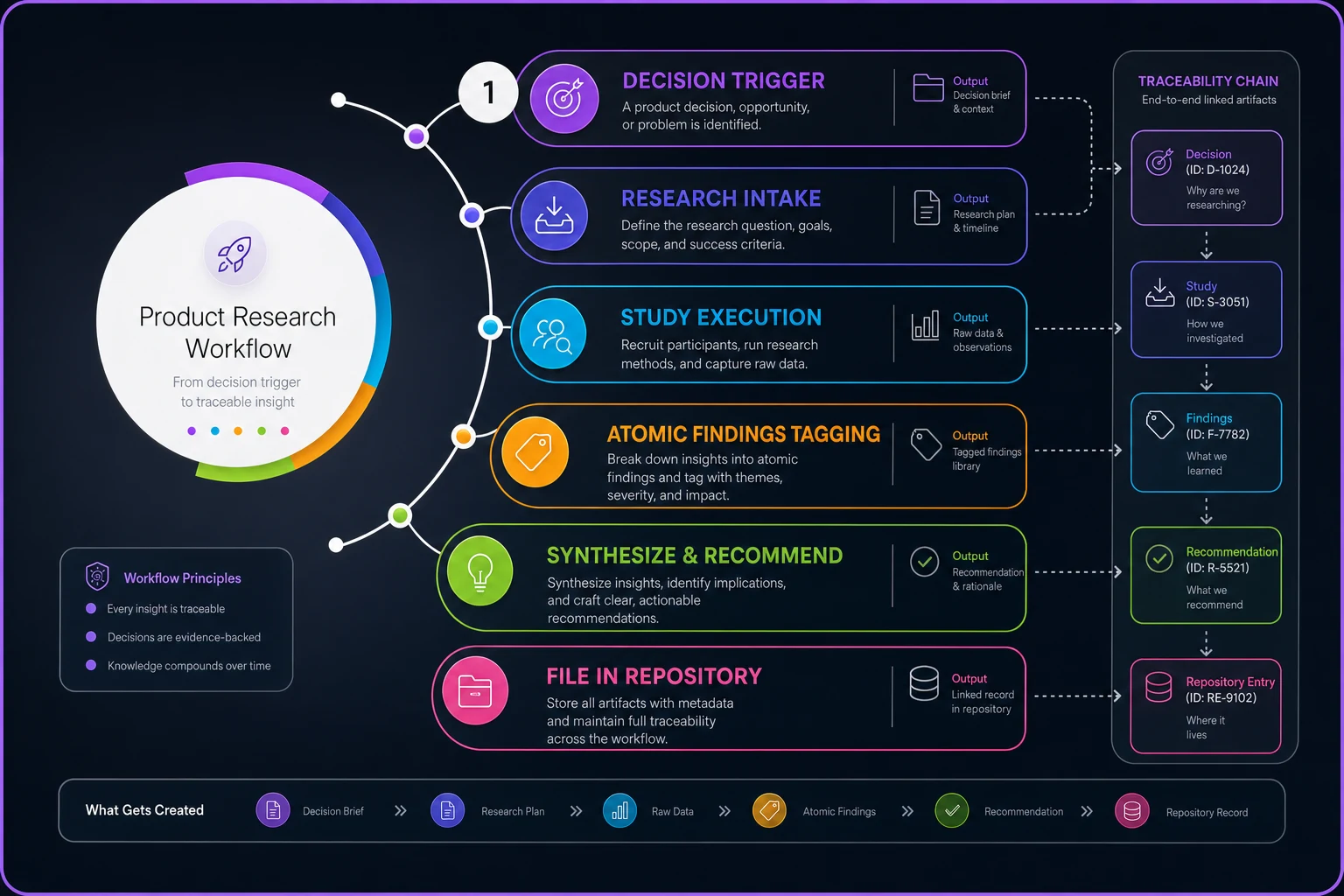
That last step is the whole point. The repository isn't an archive — it's the thing that makes the next study cheaper.
Feeding roadmap gates without turning research into a bottleneck
Research earns its keep when it changes a gate decision, so the connection has to be explicit. At each gate, the question isn't "did we do research?" It's "what does the evidence say, and how confident are we?"
| Gate | Evidence expectation | Confidence bar |
|---|---|---|
| Problem validation | Real signal a problem exists | Directional |
| Solution validation | Target users would use the solution | Confident |
| Build commitment | Enough certainty to spend the capacity | Defensible for large bets |
The mistake here is applying the same evidence bar to everything. A small experiment doesn't need defensible research; a nine-month platform bet absolutely does. Matching research depth to bet size is how you keep discovery from becoming the thing that slows delivery down.
A real scenario
A mid-sized B2B SaaS team — three PMs, two designers who also did research, no dedicated ResearchOps — was running somewhere around 15–20 studies a quarter with nothing shared between teams. Two of those PMs interviewed overlapping accounts about renewal friction within about six weeks of each other and didn't find out until a customer complained about being asked the same questions twice.
They built out the four layers over roughly a quarter. Intake form first, then a lightweight artifact schema, then synthesis templates, then restructured the repo around segments and behaviors. Nothing sophisticated — mostly a shared workspace and enforced templates.
The change that mattered wasn't a metric, it was behavior: PMs started searching the repo before scoping studies, and roughly a third of intake requests got answered without a new study at all because the answer already existed. Study volume actually dropped, but the number of decisions backed by evidence went up. Duplicate research effectively stopped. And when leadership questioned the research investment, they could point at specific gate decisions and trace them back to specific findings — which is the argument that keeps a research function funded.
When this level of structure makes sense — and when it doesn't
When it makes sense: you have more than a couple of people doing research, studies are being duplicated, or you can't answer "what do we already know about X?" in under ten minutes. If knowledge is walking out the door every time someone changes teams, you needed this yesterday.
When it's overkill: a two-person startup running its first handful of interviews doesn't need a four-layer schema. The overhead will slow you down more than the disorganization costs you. Build the intake habit early, add the rest as volume grows.
Who should be careful: teams that treat this as a tooling purchase. The repository software is the least important part. A well-run system in a shared doc beats an empty best-in-class research platform every time. The templates and the discipline to fill them out are what create the value — the tool just stores it.
Bringing it together
The reason research keeps failing to influence roadmaps isn't that teams don't do enough of it. It's that each study starts from zero, produces output only its author fully understands, and disappears the moment it ships. A research ops playbook fixes that by making research compound — every study makes the next one cheaper, faster, and better informed.
Standardize the front door so you stop paying for the same insight twice. Shape every artifact so it's reusable years later. Synthesize against decisions, not data. Organize the repository around things that don't change. Do those four things and research stops being a cost center you have to defend and becomes the thing your roadmap gates actually lean on.
Start with intake. It's the cheapest layer to add and it forces the discipline that makes every layer after it work.
Ready to elevate your product management?
Join 2,000+ product teams using Itemyly to accelerate delivery, improve alignment, and build better products.