



Most developer experience pitches die in the same place: someone stands up in planning, says the CI pipeline is slow and the local dev setup is painful, everyone nods, and then the work gets deprioritized behind the next feature ask. The reason isn't that leadership doesn't care about engineers. It's that "developer experience" sounds like an internal comfort project, and comfort projects lose to revenue every single time.
The fix isn't better complaining. It's converting saved engineering hours into a number that means something on the roadmap — delivery capacity — and then packaging the infra work so it reads like a customer-facing bet instead of a plumbing upgrade. If you can say "this frees roughly 3 engineer-weeks per quarter that we'll spend on the billing revamp customers keep asking for," you win the argument. If you say "our tests are flaky," you lose it.
This post walks through the actual ROI model, the packaging move, the governance patterns for scheduling infra windows without wrecking delivery, and the sell-in templates you can paste into your next planning doc.
Why the standard DX pitch fails
The typical developer experience request gets framed as cost reduction, and cost reduction is the weakest argument in product prioritization. Executives already assume engineering is a cost center. Telling them a cost will go down slightly doesn't move anyone.
There's also a measurement gap. When a PM says "the deploy process wastes time," the natural follow-up is "how much?" — and most teams can't answer with a number that survives scrutiny. They'll estimate 20 minutes per deploy, someone will argue it's actually 8, and now the conversation is about the estimate instead of the outcome.
The deeper issue is that saved time doesn't automatically become useful time. This is the part almost everyone skips. If you free up 200 engineering hours a quarter but those hours get absorbed into meetings, context-switching, and the next round of unplanned work, the business can't see any of it. The ROI model has to explicitly convert time-saved into committed roadmap capacity, or the whole thing evaporates.
Teams that get DX funded aren't usually the ones with the worst pain. They're the ones who translated their pain into the currency leadership already uses — shippable roadmap items.
The conversion model: time-saved to delivery capacity
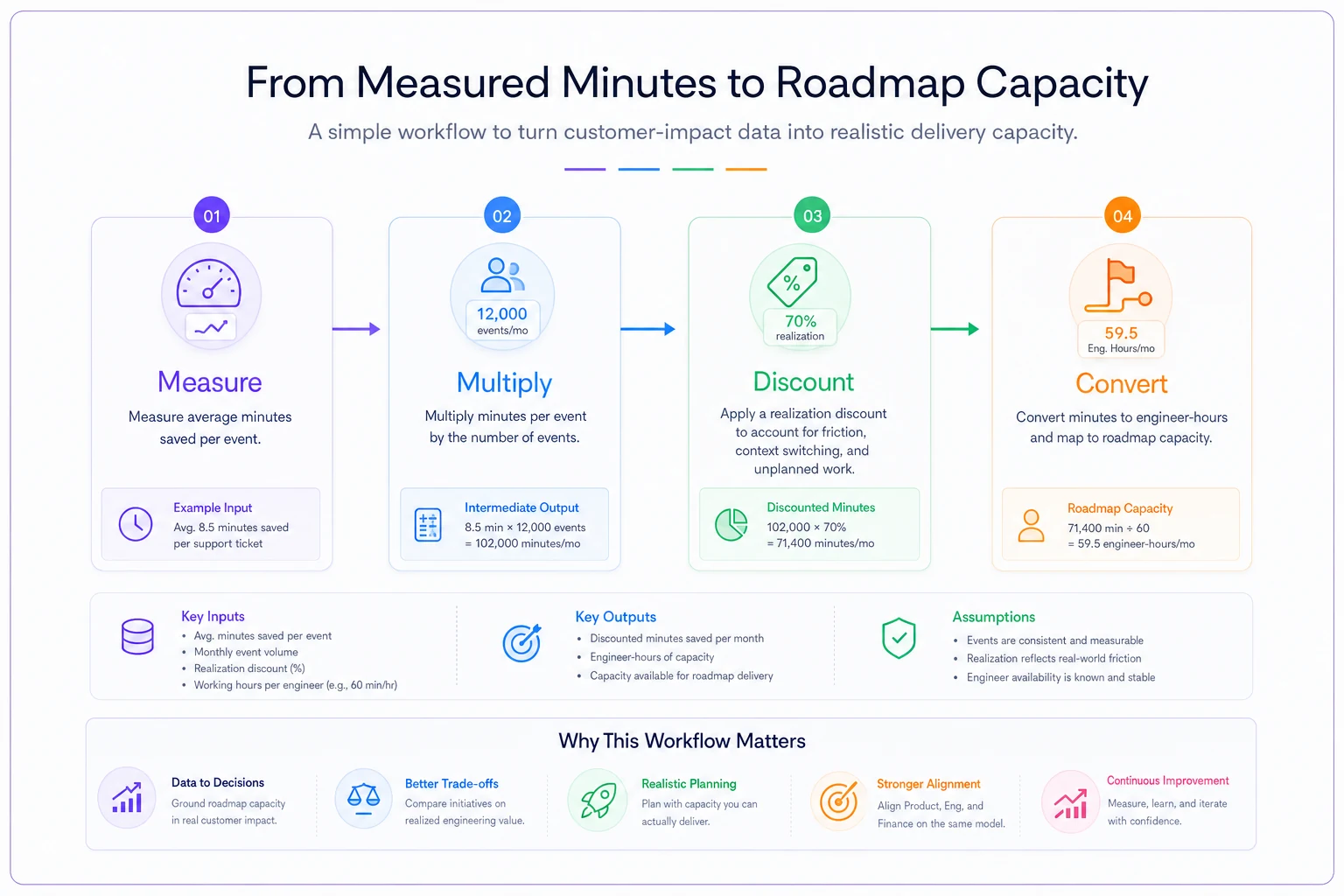
The model has four steps. The trick is that each step has to convert into the next unit until you land on something the roadmap understands.
Eliminate product chaos and align your team.
Itemyly helps you plan, prioritize, and track every product milestone seamlessly.
- Centralized roadmap management
- Stakeholder collaboration
- Release tracking & analytics
No credit card required
The graphic below shows the conversion flow.
-
Measure the recurring drain in minutes per event. Pick one concrete, repeated activity: local environment rebuilds, CI wait time, flaky-test reruns, manual release steps. Measure minutes per occurrence and occurrences per week. Don't estimate the whole "developer experience" — that's too vague to defend.
-
Multiply into engineer-hours per quarter. Minutes × frequency × number of affected engineers × 13 weeks. Now you have a raw hours number.
-
Apply a realization discount. This is the step nobody does, and it's why finance trusts almost no DX pitch. Not all saved time becomes productive time. Discount by 40–60%. If you free up 300 hours, plan to actually redeploy 120–180 of them. Being conservative here is what makes the model credible.
-
Convert realized hours into a roadmap item. Translate the discounted hours into a delivery band — "this covers roughly one medium epic" or "about 1.5 sprints of the payments work." That's the sentence that gets funded.
Here's a worked example. Say a 6-engineer team loses about 25 minutes per day each to slow local rebuilds and CI waits.
-
25 min × 5 days × 6 engineers = 750 minutes/week ≈ 12.5 hours/week
-
Over a quarter
≈ 162 hours
-
Apply a 50% realization discount
≈ 80–85 usable hours
-
That's roughly two engineer-weeks of reclaimed capacity per quarter
Two engineer-weeks isn't glamorous, but it's specific, and it maps directly to a backlog item you can name. Once you can point at the epic those hours will fund, the infra work stops being a comfort request.
Package infra work as a customer-facing initiative
Nobody funds "improve CI." Plenty of people fund "ship features 30% faster in the checkout area."
| Internal framing (loses) | Customer-facing framing (wins) |
|---|---|
| "Our CI pipeline is slow" | "Cut time-to-merge so the mobile team ships weekly instead of biweekly" |
| "Reduce flaky tests" | "Stop shipping delayed hotfixes to enterprise accounts" |
| "Modernize local dev setup" | "Onboard new hires to productive in 3 days instead of 3 weeks" |
| "Refactor the deploy scripts" | "Enable same-day rollback for high-risk releases" |
The right column never lies about what the work is — it just describes the result in language the business already measures. A slow onboarding pipeline genuinely does delay how fast new hires contribute, and if you're hiring four engineers this year, "productive in 3 days vs 3 weeks" is real recovered capacity you can quantify.
One caution worth taking seriously: don't overclaim. If you promise "features 30% faster" and only the build step got faster while code review is still the bottleneck, you'll get caught at the next review. Package honestly — tie the infra work to the specific customer-facing stream it actually accelerates, not to a vague speedup of everything.
This packaging also plays well with how technical debt gets scored and prioritized. If you already run a system for weighing maintenance against features — something like a debt scoring model and heatmap — DX infra items should enter the same pipeline with a delivery-capacity value attached, so they compete on equal footing instead of getting shoved into a separate "someday" bucket.
Governance for infra windows
Getting the work approved is half the battle. Actually doing it without infra quietly eating every sprint is the other half.
The failure mode is predictable: DX work has no natural deadline, so it expands to fill available time, and because it's "internal," it's the first thing interrupted when a customer escalation lands. You end up half-migrating the pipeline, living in a worse state than before, and burning credibility for the next infra ask.
-
Fixed windows, not open-ended allocation. Book infra work into defined windows — 15% of a quarter's capacity, expressed as specific sprints or day-blocks, not "whenever there's slack." Slack never comes.
-
A single owner per window. Infra windows with shared ownership drift. One person owns the outcome and the go/no-go.
-
Entry and exit criteria. Define done before you start. "Reduce median CI time below 6 minutes" is an exit condition. "Improve CI" is not.
-
A protected-but-bounded interrupt rule. Escalations can pause an infra window, but the paused hours get rescheduled, not deleted. Otherwise the window silently becomes zero.
-
A rollback plan for the infra change itself. Migrations to new build systems fail mid-flight more often than people expect. Have the "revert to the old pipeline" path documented before you touch anything.
The bounded-interrupt rule is the one most teams miss. Without it, every infra window becomes optional the moment something urgent appears — and something urgent always appears.
When you plan these windows, size them against real delivery bands rather than gut feel. A capacity-forecasting model that turns epics into reliable delivery bands gives you the vocabulary to say "this infra window costs one band and returns two over the next two quarters," which is exactly the trade governance forums need to see.
Stakeholder sell-in templates
Two templates you can adapt directly. Keep them short — the longer the DX pitch, the more it reads like special pleading.
One-paragraph exec sell-in:
> "We're spending roughly [X hours/quarter] on [specific repeated activity]. Fixing this reclaims about [discounted hours] of engineering capacity per quarter — enough to fund [named roadmap item] that [customer segment] has requested [N] times this year. The fix takes one infra window (~[Y] sprint), with a documented rollback. We'd like to book it in [quarter]."
Engineering-lead alignment note (for the people whose sprint gets touched):
> "Infra window planned for [dates]. Owner: [name]. Exit criteria: [measurable target]. Escalations can pause the window; paused hours reschedule to [dates]. Expected reclaimed capacity: [hours], redirected to [epic]. Flag concerns by [date]."
The exec version leads with capacity and customer demand. The engineering version leads with scope, ownership, and protection from interruption. Same initiative, two audiences, two currencies.
When this makes sense — and when it doesn't
This approach works best when you have a recurring, measurable drain and a specific roadmap item waiting for the freed capacity. Both halves matter.
When it makes sense:
-
The pain is a repeated activity you can actually time (builds, deploys, test reruns, onboarding).
-
You have a named backlog item that the reclaimed hours will fund.
-
Delivery predictability is suffering in a way stakeholders already feel.
When it's a bad idea:
-
The pain is real but hard to measure, and you'd be inventing numbers to justify it. Fabricated ROI models get you funded once and distrusted forever.
-
The "saved time" would just get reabsorbed because the team's real bottleneck is elsewhere — usually review, decision latency, or unclear requirements.
-
You're using DX as cover for a rewrite you want to do for its own sake. Leadership can smell this.
Who should probably not run this play: teams whose delivery is already unpredictable for reasons unrelated to tooling. If sprints keep missing because scope changes mid-flight, faster CI won't save you — and pitching it as capacity recovery will just surface that the real problem is planning.
A real scenario
A roughly 35-person B2B SaaS company had a release process that required several manual steps — tag the release, run a checklist, babysit the deploy, verify by hand. It ate around 3–4 hours of a senior engineer's time every release, and they released about twice a week. Nobody could get it prioritized because "the deploy is annoying" never beat customer features.
The PM reframed it. They measured: about 7 hours per week across releases, around 90 hours per quarter, discounted by half for realization — roughly 45 usable hours per quarter. They tied those hours to a specific customer ask: a self-serve seat-management feature that the sales team had lost two renewals over. The pitch became "automate the release path, reclaim about a sprint's worth of senior capacity per quarter, and put it toward the seat-management feature two enterprise accounts are waiting on."
That version got approved in one meeting. They booked a single infra window with a clear exit criterion (deploy fully scripted, one-command rollback), an owner, and a reschedule rule for interruptions. It slipped once when a customer incident paused it, but the reschedule rule meant the hours came back instead of disappearing.
The outcome wasn't dramatic in a headline sense — releases dropped to near-zero manual effort, and the reclaimed time went where it was promised. But the more important result was credibility: the next infra ask got a much faster yes, because the first one delivered exactly the capacity it claimed.
The takeaway
Developer experience ROI isn't about proving engineers are unhappy. It's about doing the one conversion almost nobody does — turning measured, discounted time-saved into named roadmap capacity, then packaging the underlying infra work as the customer outcome it genuinely unlocks. Add governance that protects the infra window from silent erosion, hand your stakeholders a sell-in they can approve in a paragraph, and the work stops living in the "someday" pile.
The teams that get this consistently funded aren't better at building pipelines. They're better at translating internal friction into the only language prioritization respects: what ships, for whom, and how much sooner.
Ready to elevate your product management?
Join 2,000+ product teams using Itemyly to accelerate delivery, improve alignment, and build better products.