

Feature flags start as temporary switches. Six months later, you're debugging production because someone toggled a flag that controls logic nobody remembers writing. The payment flow breaks. Onboarding redirects to a deprecated page. Monitoring alerts fire for code paths that shouldn't exist anymore.
The hidden operational debt quietly breaking your releases
This isn't an engineering discipline problem. It's a product team problem — specifically, the complete absence of operational governance for what happens to flags after launch. Most teams have roadmap processes and release processes. Almost none have a process for managing flag lifecycles.
Flag debt compounds silently. Unlike bugs that generate tickets or tech debt that slows velocity, stale flags just sit there. Until they don't. By then, the PM who created them has moved teams, the context is gone, and you're reverse-engineering business logic from code comments written in 2022.
Why product teams lose control of their flag inventory
Feature flags multiply faster than anyone tracks them. Every A/B test leaves one behind. Every gradual rollout creates one. Kill switches for risky features. Operational toggles for third-party integrations. Beta access gates. Regional compliance switches.
Eliminate product chaos and align your team.
Itemyly helps you plan, prioritize, and track every product milestone seamlessly.
- Centralized roadmap management
- Stakeholder collaboration
- Release tracking & analytics
No credit card required
A typical mid-sized product team running continuous delivery accumulates 15–20 new flags per month. After a year, you're sitting on 200+ flags. Maybe 30 are actually needed. The rest are zombies waiting to cause problems.
The proliferation happens because flags solve immediate problems really well. PM needs to test a checkout flow? Flag it. Engineering wants safer deployments? Flag it. Support needs to kill a problematic feature? Flag it. Sales wants enterprise-only functionality? Flag it.
But nobody plans for what comes after. Flag ownership degrades over time. The PM who requested that experiment flag gets promoted. The engineer who built it switches teams. Six months later, nobody knows whether enablev2search_algorithm is safe to remove. So it stays. Forever.
-
Around 40% of flags hadn't been modified in 6+ months
-
65% had no documented owner
-
80% lacked any removal criteria
-
About a quarter controlled code that had already been deleted
The scariest finding wasn't the orphaned flags. It was that production configurations were referencing flags that no longer existed in the codebase. Applications kept running because the flag service returned defaults — but any configuration change would break those flows instantly.
The cascading failures of ungoverned feature flags
Flag rot creates three categories of operational failure that compound over time. Each gets harder to fix the longer flags stay ungoverned.
Configuration drift happens when flag states diverge across environments. Staging has newpricingmodel enabled. Production has it disabled. QA has it enabled for some users via targeting rules nobody documented. Every deployment behaves differently depending on which environment you're comparing against.
A marketplace platform traced this exact problem when their seller dashboard worked fine in staging but showed blank pages for roughly 30% of production users. Root cause: a flag controlling API response formats had different values across environments. It was supposed to be temporary during a migration three months earlier. Nobody removed it because nobody owned it.
Decision paralysis kicks in when teams can't figure out what changes are safe. You need to modify checkout logic but seventeen flags affect that flow. Which combinations have been tested? Which are mutually exclusive? Which ones do customers actually depend on? The only safe choice becomes touching nothing.
Operational blindness develops as monitoring loses meaning. Your dashboards track metrics for code paths controlled by flags — but half those flags are permanently disabled. Are those metrics relevant? Should those alerts fire? Is that error rate real or just noise from deprecated flows?
The compound effect is rough. Each stale flag makes the next release riskier. Each undocumented toggle makes debugging harder. Eventually teams stop using flags altogether because the operational overhead has eaten the deployment benefits.
Building feature flag lifecycle governance that actually works
Product teams need to own flag lifecycles the same way they own roadmap items. Not engineering ownership of the implementation — product ownership of the business logic and the lifecycle decision.
Start with ownership matrices that map every flag to a responsible PM and an expiration policy:
| Flag Category | Owner Role | Default TTL | Removal Trigger |
|---|---|---|---|
| Experiment flags | Experiment PM | 30 days | Experiment conclusion |
| Release toggles | Feature PM | 14 days | 100% rollout |
| Ops switches | Platform PM | No TTL | Quarterly review |
| Kill switches | On-call PM | No TTL | Incident resolution + 7 days |
| Beta gates | Beta program owner | 90 days | GA launch |
The ownership model needs teeth. When a flag approaches TTL, the owner gets notified. If they don't extend or remove it, the flag automatically defaults to its safe state. No orphaned flags. No forgotten toggles.
TTL enforcement requires tooling most flag services don't provide natively. You need:
-
Automated expiration dates set at flag creation
-
Progressive warnings as expiration approaches (30 days, 14 days, 7 days, 1 day)
-
Automatic safe-state defaulting when TTL expires
-
Audit logs of all TTL extensions with documented justification
Make safe-state defaults explicit in the ownership matrix so automation can revert flags predictably when TTLs expire.
One product team implemented this using their existing flag service's API plus a lightweight automation layer. Every flag creation required an expiration date. A daily job checked approaching expirations and posted to Slack. Expired flags automatically reverted to their documented safe state. Flag count dropped roughly 60% in the first quarter.
Monitoring rules tie flag states to operational metrics:
``
IF flag 'paymentproviderswitch' = enabled
  THEN monitor paymentsuccessrate > 95%
  ELSE monitor legacypaymenthealth = normal

IF flag 'newuseronboarding' targets > 1000 users
  THEN alert on onboarding_completion < 70%
``
These rules make flag impacts visible. You can't easily ignore a stale flag when your dashboards are showing its effect on real conversion numbers. Product teams start caring about flag hygiene pretty quickly once business metrics are attached to it.
The flag lifecycle in practice
Before getting into removal steps and automation, it helps to see how a flag actually moves from creation to retirement. Most teams treat this as informal — flag gets created, flag gets forgotten. A cleaner model looks like this:
``
[Flag Proposed] → [Created with TTL + Owner] → [In Development]
        ↓
[Staged Rollout] → [Monitoring Period] → [Full Rollout or Kill]
        ↓
[Scheduled for Removal] → [Code Removal] → [Definition Archived]
``
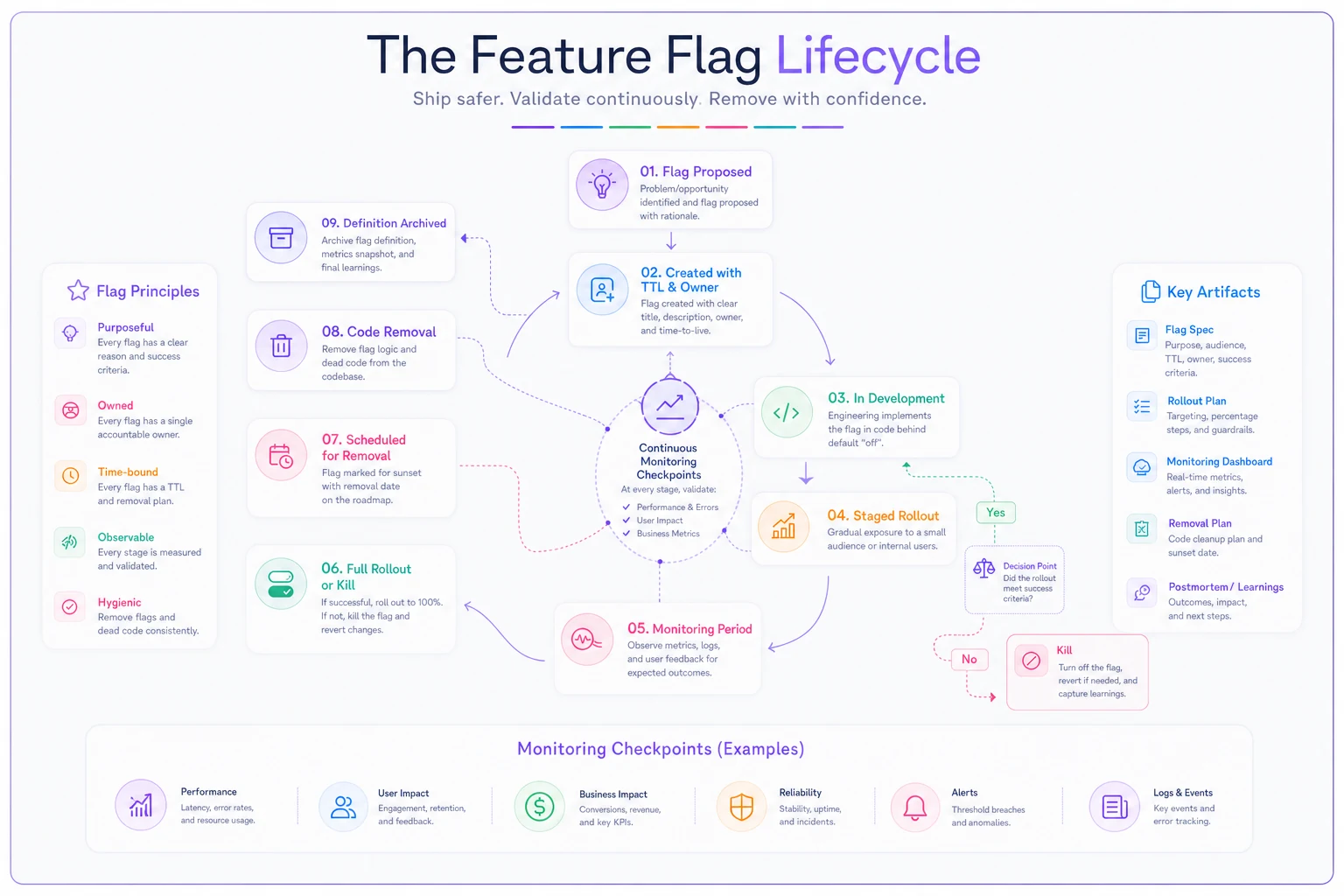
Each transition should be an explicit decision, not just something that happens by default. The monitoring period is where most flags get stuck — teams roll out to 100% and then forget to close the loop. Building the "Scheduled for Removal" stage into your board forces that closure.
It's a simple model, but having it written down somewhere visible changes team behavior more than you'd expect. Without it, flags exist in a kind of operational limbo where nobody feels responsible for the final step.
The practical removal process most teams miss
Removing flags requires more than deleting code. There's a systematic process that validates safety at each step.
Pre-removal validation:
-
Check current flag state across all environments
-
Identify all code paths affected by the flag
-
Verify monitoring coverage for those paths
-
Document expected behavior after removal
-
Confirm with the flag owner that removal is safe
Staged removal sequence:
-
Set flag to its final state in all environments
-
Wait one full release cycle (verify behavior)
-
Remove flag checks from code (keep flag definition)
-
Wait one more release cycle
-
Remove flag definition from configuration
-
Archive flag documentation
A fintech product team learned this the hard way. They removed a flag controlling transaction fee calculations in a single step. It defaulted differently than expected. Three hours of transactions processed with incorrect fees before anyone caught it. Now they use staged removal with validation between each step.
The removal checklist:
-
Flag has been in final state for 14+ days
-
No incidents related to this flag in past 30 days
-
Owner has approved removal in writing
-
All targeting rules have been removed
-
Flag metrics show consistent behavior
-
Rollback plan documented if removal causes issues
-
Communication sent to stakeholders
This process feels like overhead until your first flag-related production incident. After that it's non-negotiable.
Automation recipes that detect stale flags before they break things
Manual flag governance fails at scale. You need automation that continuously identifies and surfaces problematic flags.
Staleness detection runs daily to find:
-
Flags unmodified for X days (configurable by category)
-
Flags with 0% or 100% rollout for extended periods
-
Flags with no recent evaluation calls
-
Flags missing ownership information
-
Flags past their TTL
The automation posts a weekly report to your product channel. Each flag gets a staleness score. Anything above threshold requires immediate owner attention or gets automatically scheduled for removal.
``
Flag A = enabled AND Flag B = enabled → WARNING
Flag C targets user segment X AND Flag D targets segment Y → CONFLICT
Flag E modifies same code path as Flag F → REVIEW REQUIRED
``
These rules catch problems before they hit production. A travel booking platform found three flags that each modified the same pricing logic. Each worked fine individually. Together, they double-discounted inventory. Conflict detection caught it during staging deployment.
Usage analytics tracks flag evaluation patterns:
-
Which flags get evaluated most frequently?
-
Which flags have declining usage?
-
Which user segments hit which flags?
-
What's the performance impact of flag evaluation?
Low-usage flags are prime removal candidates. High-usage flags might need optimization. Segment-specific flags could indicate incomplete rollouts.
JIRA and board templates for flag lifecycle tracking
Feature flags need the same operational rigor as feature development — boards, tickets, and workflows.
The flag lifecycle board:
| Proposed | In Development | Testing | Rolled Out | Monitoring | Scheduled Removal |
|---|---|---|---|---|---|
| New A/B test flag | Payment flag impl | Search flag QA | Pricing flag 50% | Dashboard flag stable | Old nav flag |
| Regional flag | Auth flag setup | Mobile flag staging | Onboarding 100% | API flag watching | Legacy API flag |
Each flag moves through stages like any feature. "Scheduled Removal" is the critical column — it forces explicit decisions about flag retirement instead of letting flags drift indefinitely.
Flag ticket template:
``
Flag Name: [descriptiveflagname]
Owner: [PM name]
Engineering Lead: [Eng name]
Purpose: [Why this flag exists]
Success Criteria: [When to remove]
TTL: [Expiration date]
Safe State: [Default if expired]
Rollout Plan: [Percentage/timeline]
Monitoring: [Key metrics to watch]
Removal Trigger: [Specific condition]
Dependencies: [Related flags/features]
``
The quarterly flag review ritual:
-
List every active flag
-
Owner presents status and plan
-
Team votes
Keep, Remove, or Extend
-
Create removal tickets for Remove votes
-
Update TTLs for Extend votes
-
Document decisions
One product team folded this into their PI planning cycle. They found 40+ flags nobody could explain. Removing them freed up meaningful complexity budget for new features — not a small thing.
When PMs should override engineering preferences on flags
Product owns the business logic. Engineering owns the implementation. That distinction matters more than most teams realize.
PMs should push back when:
Flags affect user experience directly. That checkout A/B test is a product decision. The feature impacts conversion, user flow, and business metrics. Engineering might prefer keeping it for "flexibility," but product owns the customer experience.
Business logic gets embedded in flags. Pricing rules, tier limitations, regional restrictions — these are product decisions. Engineering shouldn't maintain flags encoding business rules without product oversight.
Flags outlive their purpose. Engineers often keep flags "just in case." If the feature launched, the experiment concluded, or the migration is done, the flag goes. Product makes that call.
Technical flags affect product metrics. That database migration flag seems purely technical. But if it's impacting page load time, it's affecting user experience. Product has a vote.
The balance is roughly this: engineering owns operational flags (circuit breakers, load shedding). Product owns feature flags (experiments, rollouts, user-facing changes). Shared ownership for anything in between, with product having veto power on removal timing.
Converting flag chaos into predictable operations
The path from flag chaos to predictable operations isn't complicated. It just requires consistent application of simple rules.
A SaaS platform with 400+ accumulated flags implemented this governance model. Within six months, active flag count dropped to 87. Production incidents from stale flags hit zero. Average flag lifespan went from effectively forever to around 34 days. The technical debt scoring model they already used helped them prioritize which flags to tackle first.
The automation came next. Daily staleness reports. Weekly conflict detection. Monthly usage analytics. All of it feeding into their standard cross-team launch coordination process. Flags went from hidden technical details to visible operational assets.
The behavioral shift was noticeable. PMs started asking "when does this flag get removed?" during planning. Engineers started documenting flag purposes. The quarterly review stopped feeling like a chore and started feeling like normal operational hygiene.
The operational reality of sustained flag governance
Feature flag lifecycle governance isn't about perfection. It's about preventing the slow accumulation of operational debt that eventually makes your system fragile to release.
Teams that do this well treat flags like inventory — valuable when needed, expensive when hoarded. They build lightweight processes that make the right thing (removing flags) easier than the wrong thing (keeping them indefinitely).
Your existing operations already handle features, bugs, and tech debt. Feature flags are just another asset class that needs the same treatment. The operational discipline, ownership models, and automation that manage your roadmap can manage your flags.
Start with ownership. Add TTLs. Automate detection. Build removal processes. Make it visible. Most of the governance takes care of itself once those foundations are in place.
Ready to elevate your product management?
Join 2,000+ product teams using Itemyly to accelerate delivery, improve alignment, and build better products.