


The platform vs product roadmap debate destroys more quarterly planning sessions than any other topic. Engineers push for platform investments, product screams about feature velocity, leadership wants both, and nobody has a framework that actually settles it.
There's a clear pattern to which platform investments deliver returns versus which ones become multi-quarter sinkholes. The teams that get this right use valuation models and SLAs to make these calls—not gut feelings about "technical excellence."
The real cost structure nobody calculates
Platform work carries three cost categories that most roadmap discussions ignore. Direct engineering time is obvious. What kills teams is the hidden multiplication effect.
Platform changes create migration overhead for every team touching the system. A two-sprint platform project becomes eight sprints of migration work spread across four teams. Then there's the coordination tax—every standup, planning session, and architecture review now includes platform migration discussions. And platform work blocks feature delivery in ways that compound. Teams can't start features until migrations complete. Features get half-built, then paused for platform cutover windows.
One fintech product team tracked their actual platform costs over six months. Their "four-week authentication service rebuild" consumed 340 engineering hours directly. Migration and coordination overhead? Another 890 hours across eight teams. Feature velocity dropped 40% for two quarters.
The opportunity cost hits harder than the direct cost. While your engineers rebuild the authentication layer, competitors ship three new features customers actually asked for. Platform work needs to clear a much higher ROI bar than feature work because the true cost runs 3-4x what shows up in sprint planning.
Time-saved valuation models that actually work
The platform investments that consistently pay off follow a simple formula: developer hours saved per month, times team size, times hourly rate. Sounds basic, but most teams skip the math entirely.
Eliminate product chaos and align your team.
Itemyly helps you plan, prioritize, and track every product milestone seamlessly.
- Centralized roadmap management
- Stakeholder collaboration
- Release tracking & analytics
No credit card required
Here's the calculation framework:
Monthly Time Savings = (Current task time × Monthly frequency × Number of developers) - (New task time × Monthly frequency × Number of developers)
Payback Period = Total platform investment hours / Monthly time savings
A platform team at a marketplace startup used this to evaluate their service mesh proposal. Current deployment process: 45 minutes per deployment, 3 deployments per developer per week, 24 developers. Proposed platform: 10 minutes per deployment.
Monthly savings: ((45 min × 12 deployments × 24 devs) - (10 min × 12 deployments × 24 devs)) / 60 = 168 hours per month
At $150/hour fully loaded cost, that's $25,200 in monthly savings. Their 800-hour platform investment pays back in 5 months. Clear win.
But most teams miss this—time savings degrade. That 35-minute reduction becomes closer to 25 minutes after six months as complexity creeps back in. The new platform needs maintenance. Edge cases emerge. Build your model with a 30% degradation factor or you'll overstate returns every single time.
Investment bands and the platform ladder
Platform investments fall into clear bands that determine approval paths and success criteria:
| Investment Band | Engineering Hours | Payback Required | Approval Level | Success Metrics |
|---|---|---|---|---|
| Tactical (<200 hrs) | Under 5 weeks | 3 months | Tech Lead | Time saved, defect reduction |
| Strategic (200-800 hrs) | 5-20 weeks | 6 months | Product Director | Velocity improvement, operational metrics |
| Foundational (800+ hrs) | 20+ weeks | 12 months | C-level | Business outcomes, market position |
Tactical platform work gets approved at the team level—upgrading test frameworks, improving build pipelines, standardizing logging. These need simple time-saved calculations.
Strategic platform work requires product leadership buy-in—new API gateways, service extraction, database migrations. These need both time-saved metrics and velocity improvement projections.
Foundational platform work only makes sense with executive sponsorship—full re-architectures, new technology stacks, platform rebuilds. These need to either enable entirely new business capabilities or fix existential technical risks.
Teams that ignore these bands either over-invest in tactical improvements that should stay scrappy, or try to sneak foundational changes through without a proper business case.
SLAs that separate platform wins from wishful thinking
Platform work without SLAs is just engineering entertainment. Every platform investment needs measurable service levels that directly connect to business value.
A payments company learned this the hard way. They spent six months building a "next-generation event streaming platform" with no defined SLAs. The result: 99.2% uptime (worse than their old system), 800ms p99 latency (slower than before), and angry product teams who lost six months of feature delivery for an actual downgrade.
Effective platform SLAs follow this structure:
Performance SLAs:
-
Response time percentiles (p50, p95, p99)
-
Throughput targets (requests/second, events/second)
-
Resource consumption limits (CPU, memory, storage)
Reliability SLAs:
-
Uptime targets by criticality tier
-
Recovery time objectives (RTO)
-
Recovery point objectives (RPO)
-
Error rate thresholds
Developer Experience SLAs:
-
Time to first deployment
-
Build/test/deploy cycle time
-
Mean time to debug issues
-
Documentation completeness score
The critical move: tie each SLA to a business metric. Response time connects to user satisfaction scores. Uptime connects to revenue loss. Developer cycle time connects to feature velocity. Without those connections, you're ignoring critical dependencies that determine whether platform work succeeds or becomes another failed migration.
Intake models that filter good platform ideas from engineering dreams
Most platform proposals come from engineers frustrated with daily friction. That frustration is real, but it's a terrible filter for platform prioritization. You need structured intake that captures both pain and opportunity.
The intake model that consistently identifies winning platform investments evaluates four dimensions:
Pain Frequency: How often does this friction hit developers? Daily friction matters more than quarterly annoyances. A slow build that runs 50 times per day beats a painful migration that happens twice per year.
Pain Distribution: How many teams feel this pain? Platform work that helps two teams rarely justifies the investment. Look for problems hitting 60%+ of your engineering organization.
Solution Clarity: How well-defined is the fix? Vague promises about "better developer experience" predict failure. Specific improvements like "reduce build time from 12 minutes to 3 minutes" predict success.
Business Impact: What customer-facing metric improves? Even internal platform work needs to connect to customer value—faster builds mean faster feature delivery mean happier customers.
Score each dimension 1-5. Anything under 15 goes back for refinement. Anything under 12 gets rejected.
Pro-tip: Require a consumer impact metric before scoring platform proposals as strategic.
An insurance tech company used this intake model to filter 23 platform proposals down to 4 worth pursuing. The rejected 19 would have consumed 18 months of platform team capacity for minimal business value. The 4 they approved delivered measurable improvements in feature velocity and system reliability.
Consumer ROI calculations most teams skip
Platform teams love measuring developer productivity. Business leaders care about customer value. That disconnect kills platform investments.
Every platform investment needs a consumer ROI story. Not "developers will be happier," but concrete customer impact with numbers attached.
The calculation chain looks like this:
-
Platform improvement → Developer velocity increase → Feature delivery acceleration → Customer value delivery → Revenue/retention impact
A subscription box company made this connection explicit for their checkout platform rebuild. Old platform: 2 weeks to implement new payment methods. New platform: 2 days. They calculated:
-
6 new payment methods per year planned
-
Each payment method increases conversion 2% for specific segments
-
Average segment size
5,000 customers
-
Average order value
$45
-
Conversion improvement value
5,000 × 0.02 × $45 × 12 months = $54,000 per payment method per year
With faster implementation, they could pursue 12 payment methods instead of 6. Additional annual value: $324,000. The platform investment of 400 engineering hours ($60,000 at fully loaded rates) pays back through customer value in under 3 months.
Without that consumer connection, platform work becomes an internal optimization exercise that leadership barely tolerates.
Organizational models that make platform work succeed
Platform success depends more on organizational design than technical architecture. The wrong team structure guarantees failure regardless of how clean your SLAs look.
Three organizational models consistently deliver platform value:
Embedded Platform Engineers: Platform engineers rotate through product teams for 2-3 month assignments. They implement platform improvements while embedded, ensuring solutions match real team needs. This works for tactical platform investments under 200 hours.
Platform Strike Teams: Temporary groups combining platform and product engineers for specific initiatives. A typical strike team runs 2 platform engineers and 1 engineer from each affected product team. They own the platform change end-to-end including migrations. This handles strategic investments in the 200-800 hour range.
Dedicated Platform Products: Platform teams that operate like internal product teams with roadmaps, sprints, and customer feedback loops. Product teams become their customers. Success gets measured through adoption rates and developer NPS scores. This only makes sense for foundational investments exceeding 800 hours with multi-year horizons.
The antipatterns that guarantee failure: building platforms in isolation then forcing adoption, creating "centers of excellence" disconnected from product delivery, platform teams that only do architecture without implementation support, and rotating platform ownership every quarter so nobody owns long-term success.
A logistics software company tried all three models. Their embedded model reduced build times 60% with 150 hours of investment. Their strike team model delivered a new API gateway in 8 weeks with around 600 hours invested. Their dedicated platform team attempt failed after burning over 2,000 hours on an event system nobody adopted.
Decision frameworks that survive quarterly planning
The platform vs product decision can't be philosophical. You need something mechanical that produces clear yes/no answers during planning sessions.
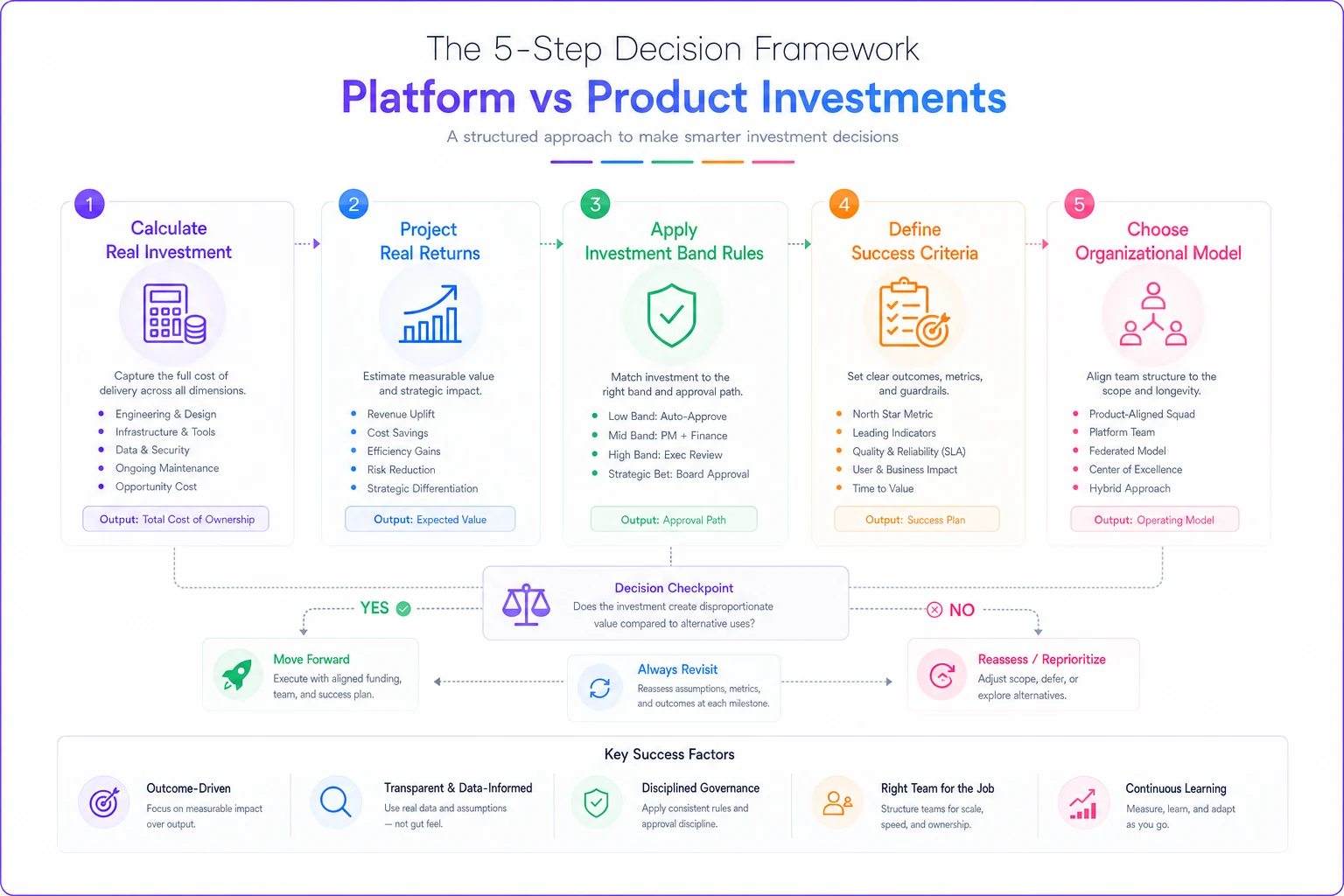
-
Calculate Real Investment — Direct platform engineering hours, migration hours across all teams (usually 2-3x platform hours), coordination overhead (add 20%), and feature delay cost based on delayed revenue.
-
Project Real Returns — Developer time saved per month, operational cost reduction, new capability enablement value, and risk mitigation value where applicable.
-
Apply Investment Band Rules — Under 200 hours
team-level approval if payback is under 3 months. 200-800 hours: product leadership approval if payback is under 6 months. Over 800 hours: executive approval with a strategic business case.
-
Define Success Criteria — Three measurable SLAs, a consumer impact metric, an adoption target, and a delivery milestone schedule.
-
Choose Organizational Model — Tactical work gets embedded engineers. Strategic work gets strike teams. Foundational work gets a dedicated platform team.
A social media analytics company used this framework to evaluate five platform proposals in a single planning session. Two cleared the bar immediately (build pipeline improvements and monitoring upgrades). Two failed ROI calculations (service mesh and event streaming platform). One went back for SLA definition (authentication service).
Below is a visual workflow of the decision framework to use during planning sessions.
That kind of clarity prevents the months-long "maybe we should" discussions that plague most platform decisions.
When platform work actually makes sense
Platform investments consistently succeed in four scenarios:
Velocity multiplication: When the same friction hits multiple teams multiple times per day. Every hour saved multiplies across teams and instances. Build improvements, test frameworks, and deployment pipelines fall here.
Scaling breakpoints: When current architecture mathematically cannot handle projected growth. If you're approaching 80% of system capacity with 50% annual growth, platform work isn't optional.
Compliance forcing functions: When regulations require capabilities your current platform cannot deliver. GDPR, PCI compliance, or SOC2 requirements create non-negotiable platform needs.
Competitive platform advantages: When platform capabilities directly enable features competitors cannot match—real-time systems, machine learning infrastructure, or edge computing setups that become actual competitive moat.
Making platform decisions with operational software
The teams that consistently get platform vs product decisions right track their metrics obsessively. Manual spreadsheet tracking breaks down fast—you need systems that capture real velocity data, actual time spent, and migration progress without requiring someone to maintain them by hand.
Modern product operations platforms now include AI-powered analytics that surface platform investment opportunities directly from your development metrics. They identify patterns in build times, deployment frequency, and incident data to show which platform improvements would deliver the highest ROI—instead of guessing based on engineering intuition.
These platforms also automate the intake and scoring process for platform proposals. Engineers submit ideas through standardized forms, the system scores them against your criteria, and leadership sees a ranked list with projected ROI calculations already attached. The automation can also flag when similar proposals could be combined, or when a proposed solution is missing critical dependencies.
The coordination overhead of platform work—often the hidden cost that destroys ROI—becomes visible through workflow tracking. You can see exactly how many hours teams spend in migration meetings, how long cutovers actually take, and where handoffs break down. That data feeds back into future platform ROI models, making each decision sharper than the last.
Platform work isn't about technical excellence
The best platform decisions come from treating platform work as product work with internal customers. Every platform investment needs the same rigor as customer-facing features—clear problem definition, measurable success criteria, validated ROI.
Most platform vs product roadmap debates fail because they turn into philosophical arguments about code quality versus feature velocity. The framework above makes these decisions mechanical. Calculate the real costs including migrations and delays. Project returns based on specific time savings and capabilities. Apply investment bands to determine approval level. Define SLAs that connect to business value.
Teams that get this right stop having the painful platform debates. They make quick decisions based on data, fund platform work that actually delivers returns, and avoid multi-quarter projects that deliver nothing but engineering satisfaction.
The platform investments that succeed share three characteristics: they solve problems multiple teams face daily, they deliver measurable time savings or new capabilities within around six months, and they include migration support from day one. Everything else is mostly just engineers wanting to play with new toys.
Your next planning session doesn't need another philosophical debate about technical debt versus features. It needs ten minutes with a calculator and this framework. The math will tell you which platform bets actually make sense.
Ready to elevate your product management?
Join 2,000+ product teams using Itemyly to accelerate delivery, improve alignment, and build better products.