


Your engineering team finally got approval for that technical debt retirement plan. Six months later, you're nowhere near done, feature delivery has slowed to a crawl, and leadership is asking uncomfortable questions about why the platform still feels sluggish.
Technical debt retirement fails when teams try to fix everything at once while keeping the lights on. After watching dozens of teams struggle through debt paydown initiatives, the pattern is pretty clear: successful debt retirement happens in carefully orchestrated waves with built-in circuit breakers, not heroic all-hands efforts.
Teams that actually retire technical debt without wrecking product delivery treat it like a multi-quarter campaign. They align debt work to OKRs, set realistic capacity boundaries, and — maybe most importantly — they know when to stop.
Why traditional debt retirement plans collapse
Most technical debt retirement plans fail in predictable ways. Teams create comprehensive inventories, score everything meticulously (as covered in our debt scoring framework), then launch into retirement work without really accounting for operational reality.
The failure pattern is almost always the same. Engineering leadership allocates 30% of team capacity to debt work. Product managers grudgingly accept slower feature delivery. Everyone agrees this quarter will be different.
By week three, critical bugs appear. By week six, a major customer threatens to churn without a specific feature. By week eight, debt work gets quietly deprioritized. The retirement plan becomes another abandoned document in Confluence.
Three operational realities keep getting ignored:
Capacity estimates assume perfect conditions. That 30% allocation assumes no one gets sick, no critical incidents occur, and estimates are accurate. Real capacity fluctuates between 15-40% depending on the week.
Business conditions change faster than debt work completes. A three-month database migration assumes the priorities in month three match those from month one. They rarely do.
All-or-nothing approaches create political vulnerability. When debt work blocks feature delivery entirely, product leadership has ammunition to kill the whole initiative. "We paused revenue features for this?"
Wave-based retirement changes the game
Wave-based retirement treats technical debt like a series of focused campaigns rather than one continuous effort. Each wave targets specific debt categories, runs for a fixed duration, and includes clear escape hatches.
Eliminate product chaos and align your team.
Itemyly helps you plan, prioritize, and track every product milestone seamlessly.
- Centralized roadmap management
- Stakeholder collaboration
- Release tracking & analytics
No credit card required
A typical wave structure looks like this:
-
Wave 1 (Weeks 1-6)
Critical infrastructure
- Database connection pooling issues - Memory leaks in core services - Monitoring gaps in payment systems - Target: 25% capacity allocation - Success metric: P1 incident reduction by 40% -
Wave 2 (Weeks 8-13)
Developer velocity debt
- Test suite optimization - Build pipeline improvements - Local development environment fixes - Target: 20% capacity allocation - Success metric: Deploy frequency increase by 30% -
Wave 3 (Weeks 15-20)
Architecture debt
- Service boundary cleanup - Event system migration - API versioning implementation - Target: 30% capacity allocation - Success metric: Service coupling score improvement
The gaps between waves aren't breaks — they're pressure release valves. Teams catch up on feature work, absorb learnings, and decide whether to continue, adjust, or hold the next wave.
The image below shows the typical workflow for running waves with pause weeks and governance triggers.
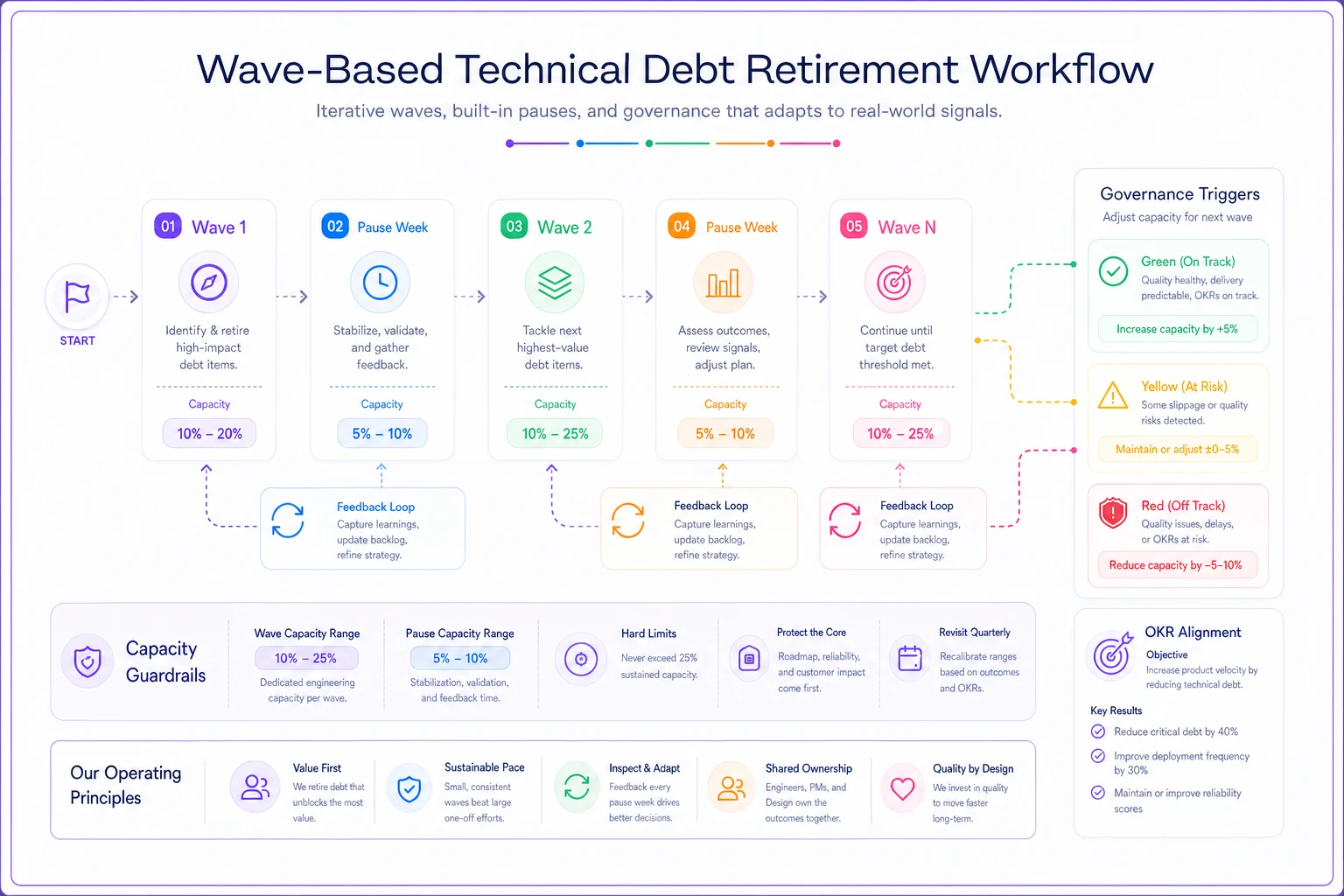
Use the workflow to visualize how waves, pause weeks, and triggers interact with OKR checkpoints.
Aligning waves to OKR cycles
The most successful debt retirement initiatives align waves to existing OKR cycles rather than creating parallel tracking systems. This does three things: it forces debt work to justify itself in business terms, creates natural checkpoints, and prevents the "invisible work" problem that quietly kills engineering initiatives.
Here's how alignment actually works in practice:
Quarter objective: Improve platform reliability to support 2x growth
Key Result 1: Reduce P1 incidents from 8/month to 3/month
-
Wave 1 contributes
Fix connection pooling (prevents ~3 incidents/month)
-
Wave 1 contributes
Add circuit breakers (prevents ~2 incidents/month)
Key Result 2: Improve deploy success rate from 87% to 95%
-
Wave 2 contributes
Stabilize test suite (increases success by 5%)
-
Wave 2 contributes
Fix deployment rollback issues (increases success by 3%)
This transforms debt retirement from "engineering wants to refactor things" into "engineering is directly supporting our growth objectives." It also creates natural governance moments — if Wave 1 doesn't move the incident metric, leadership has actual data to decide whether Wave 2 proceeds or needs rethinking.
Capacity estimation that reflects reality
Traditional capacity planning for debt work follows what I'd call the "hope and pray" method — allocate a percentage, hope it works out, panic when it doesn't. Wave-based planning uses bounded capacity estimates that acknowledge operational reality.
Instead of saying "we'll allocate 30% to debt," wave planning uses ranges tied to triggers:
| Capacity Scenario | Debt Allocation | Trigger |
|---|---|---|
| Smooth sailing | 35-40% | No P1 incidents, feature work on track |
| Normal operations | 20-25% | Standard bug rate, minor delays acceptable |
| Constrained | 10-15% | Customer escalations, release pressure |
| Crisis mode | 0% | Major incident, revenue impact, all-hands situation |
These ranges map to specific wave activities. During smooth sailing, teams tackle complex migrations. During normal operations, they focus on incremental improvements. In crisis mode, waves pause entirely.
A practical wave plan also includes capacity buffers:
-
Wave 2 Plan (6 weeks, 20-25% allocation) - Week 1-2
Test suite optimization (40 engineer-hours) - Week 3-4: Build pipeline upgrade (35 engineer-hours) - Week 5: Buffer for overrun (20 engineer-hours) - Week 6: Documentation and handoff (15 engineer-hours)
-
The buffer week isn't padding. When test suite work takes 50 hours instead of 40, the wave doesn't collapse.
Build buffer weeks into every wave so overruns don't collapse subsequent work.
The buffer protects the overall program timeline and prevents a single overrun from derailing future waves.
Success metrics that matter
Most debt retirement metrics focus on technical improvements — code coverage increases, cyclomatic complexity decreases, dependency versions updated. These matter to engineers but mean almost nothing to the business.
Wave-based retirement uses dual metrics — technical indicators for engineering, business outcomes for leadership:
Wave 1: Database and infrastructure debt
-
Technical metrics
- Connection pool utilization: 85% → 45% - Query timeout rate: 1.2% → 0.3% - Memory heap usage: 78% avg → 52% avg
-
Business translation
- Customer-facing latency: p99 reduced from 1.8s to 0.9s - System stability: roughly 6 fewer middle-of-night pages per month - Cost efficiency: ~$4k/month reduction in cloud spend from right-sizing
Wave 2: Developer productivity debt
-
Technical metrics
- Test suite runtime: 47 min → 18 min - Build success rate: 81% → 94% - Local environment setup: 3 hours → 45 minutes
-
Business translation
- Feature delivery: 15% more story points per sprint - Incident response: ~25 min faster mean time to resolution - Onboarding: New developers productive in 3 days vs. 8
The business translations aren't perfect conversions, but they create meaningful conversations. "We reduced test suite time by 29 minutes" means nothing to a VP of Product. "Engineers can now run 3x more experiments per day" is something they'll actually engage with.
Governance triggers that prevent derailment
The biggest innovation in wave-based retirement isn't the waves themselves — it's the governance triggers that automatically pause, slow, or accelerate waves based on real conditions.
Traditional debt work operates in binary mode: either we're doing it or we're not. Wave governance uses graduated responses:
Green light (proceed as planned):
-
Feature delivery within 10% of target
-
No P1 incidents from debt work
-
Engineering morale stable or improving
-
Customer satisfaction metrics holding steady
Yellow light (slow down, adjust scope):
-
Feature delivery 10-25% below target
-
Minor incidents traced to debt work
-
Engineering overtime creeping up
-
Customer escalations about missing features
Red light (pause wave immediately):
-
Feature delivery 25%+ below target
-
P1 incident caused by debt work
-
Key engineer burnout or departure risk
-
Revenue impact or major customer churn risk
These aren't suggestions — they're circuit breakers. When conditions hit yellow, wave capacity automatically drops to the lower bound. When they hit red, all debt work stops until things stabilize.
Here's what this looks like operationally:
-
Week 3 of Wave 2
Test suite optimization causes intermittent CI failures - Trigger: Yellow light (minor incidents from debt work) - Response: Reduce debt allocation from 25% to 15% - Action: Focus only on critical test fixes, defer nice-to-haves
-
Week 5 of Wave 2
Major customer demands urgent feature - Trigger: Evaluate against red light criteria - Assessment: Would delay feature 30% (red light threshold) - Response: Pause wave, deliver feature, resume week 7
The triggers remove politics from the equation. Nobody has to make the uncomfortable call to stop debt work — the framework handles it.
A real wave implementation
A mid-size SaaS platform serving logistics companies had accumulated five years of technical debt. Their monolithic Node.js application took 45 minutes to deploy, tests were flaky, and every new feature touched code nobody fully understood.
Previous attempts at debt retirement had gone nowhere. Two "refactoring sprints" produced minimal improvement. A "20% time for tech debt" policy lasted one quarter before being quietly abandoned.
The team implemented a wave-based approach aligned to Q3 OKRs around platform stability:
-
Wave 1 (Weeks 1-4)
Deploy pipeline stabilization
- Capacity: 30% (two engineers from eight-person team) - Focus: Fix flaky tests, optimize build process - Success metric: Deploy time under 20 minutes - Result: Deploy time down to 18 minutes, 95% success rate -
Pause week (Week 5) - Team caught up on feature backlog - Incorporated Wave 1 learnings - Adjusted Wave 2 scope based on discoveries
-
Wave 2 (Weeks 6-11)
Core service extraction
- Capacity: 25% (started at 35%, triggered yellow light in week 8) - Focus: Extract authentication into standalone service - Success metric: Reduce auth-related incidents by 50% - Result: Auth incidents dropped to near-zero, 30% less code in the monolith -
Wave 3 (Weeks 13-16)
Database optimization
- Capacity: 20% (reduced from plan due to Q4 revenue push) - Focus: Query optimization, connection pooling - Success metric: Reduce database CPU by 30% - Result: 40% CPU reduction, ~$3k/month cost savings
The whole program ran four months, retired significant debt, and never blocked critical features for more than a week. More importantly, it established a pattern the team still follows.
Making waves work with your OKR system
Implementing wave-based retirement means adapting your existing OKR operating model rather than layering on new processes. The integration happens at three levels:
Planning integration: During quarterly planning, debt waves become first-class work items alongside features. Each wave gets sized, scoped, and explicitly tied to key results.
Tracking integration: Wave metrics appear in the same dashboards as feature delivery metrics. This prevents the "hidden work" problem where debt retirement happens in the shadows and nobody knows what's actually getting done.
Review integration: Sprint reviews include wave progress. Stakeholders see debt work impact in terms they understand — fewer incidents, faster delivery, happier developers.
The integration also changes how you frame debt work in conversations. Instead of "we need to refactor the authentication system," it becomes "Wave 2 will reduce authentication incidents that currently burn 15 engineering hours per month."
Common wave implementation mistakes
Even with good intentions, teams make predictable mistakes when running their first few waves.
Waves that are too large. Six-week waves sound reasonable until week four when it's obvious the work won't finish. Smaller waves (3-4 weeks) with pause weeks create more flexibility to adapt.
Metrics without baselines. Claiming 50% improvement means nothing without knowing where you started. Measure current state before each wave, not after.
Governance without teeth. Yellow light triggers that nobody enforces aren't triggers — they're suggestions. Automated enforcement through tooling or process removes the human tendency to keep pushing when you should pause.
Trying to plan everything upfront. Planning all waves before starting assumes perfect information. Plan one wave ahead, adjust based on what you learn, and adapt as conditions change.
Building your wave-based retirement plan
Start with a simple three-wave pilot before committing to a multi-quarter program. For most teams, the first wave should target developer productivity debt — slow builds, flaky tests, painful deployments. This debt affects every engineer every day, making progress immediately visible and building political capital for future waves.
-
Choose obvious debt that directly impacts daily work
-
Set conservative capacity targets (15-20% max)
-
Define clear, business-relevant success metrics
-
Build simple governance triggers
-
Plan explicit pause weeks between waves
The template:
-
Wave 1
Developer velocity (Weeks 1-3)
- Capacity: 20% (roughly 1.5 engineers from an 8-person team) - Scope: Fix top 5 flaky tests, optimize CI pipeline - Success metric: Reduce build time 30%, eliminate false failures - Yellow trigger: Feature velocity drops 15% - Red trigger: Customer-facing regression -
Pause (Week 4) - Retrospective on Wave 1 - Adjust Wave 2 based on learnings - Clear feature backlog
-
Wave 2
Monitoring debt (Weeks 5-7)
- Capacity: 20-25% depending on Wave 1 outcomes - Scope: Add alerts for critical paths, implement tracing - Success metric: Reduce time-to-detection by 50% - Triggers: Same as Wave 1
This incremental approach proves the model before asking for a larger commitment.
The governance conversation you need to have
Before launching waves, align with leadership on non-negotiable governance triggers. This conversation needs to happen when everyone's calm — not mid-crisis.
The agreement should cover:
-
Automatic pause triggers
- P1 incident caused by debt work - Customer churn risk from delayed features - Revenue targets in jeopardy
-
Automatic acceleration triggers
- Feature delivery ahead of schedule - Multiple stability incidents from known debt - Engineering retention risk from technical frustration
-
Capacity boundaries
- Minimum: 10% even during crunches - Maximum: 40% even during smooth periods - Default: 20-25% normal operations
Write it down. When the VP of Sales demands all engineering capacity for a deal, point to the agreed boundaries. When debt work causes problems, follow the agreed triggers.
Why wave-based retirement actually works
Wave-based retirement succeeds where traditional approaches fail because it works with operational reality instead of against it.
Waves create natural boundaries that prevent debt work from becoming an endless slog. Engineers see finish lines. Product managers see predictable impact windows. Leadership sees measurable progress tied to things they care about.
The capacity ranges acknowledge that perfect conditions don't exist. Building in triggers means the plan survives contact with reality rather than falling apart at the first crisis.
And the governance triggers take emotion out of difficult decisions. When a P1 hits, nobody has to argue about whether to keep working on debt — the framework already decided.
Technical debt won't ever disappear entirely, but it doesn't have to derail your engineering org. Wave-based retirement with clear OKR alignment and governance triggers turns debt paydown from a perpetual burden into a manageable operational rhythm.
The teams that succeed with this aren't necessarily better at estimating or more disciplined about debt work. They've just accepted that this is a marathon requiring pace management, not a sprint requiring heroics. Start small. Run one three-week wave with clear triggers. Measure what actually happens versus what you planned. Adjust accordingly. The perfect debt retirement plan doesn't exist — but a good-enough plan that actually executes beats a perfect plan that never survives week three.
Ready to elevate your product management?
Join 2,000+ product teams using Itemyly to accelerate delivery, improve alignment, and build better products.