



Most enterprise churn doesn't happen at renewal. It happens quietly in the first 90 days, when a customer's admin logs in, can't figure out how to provision their team, files a ticket that sits for two days, and mentally files your product under "we'll deal with it later." By the time renewal comes around, you're not fighting for expansion—you're fighting to not lose the logo.
The frustrating part is that product teams usually treat onboarding as something Customer Success owns. The roadmap tracks features, integrations, platform work. Onboarding lives in a runbook somewhere, disconnected from the backlog. So when onboarding breaks at scale, there's no mechanism to feed that signal back into what gets built next.
This post is about closing that gap—treating enterprise onboarding triggers as real roadmap deliverables with acceptance criteria, gating rules tied to onboarding health, and a repeatable way to convert onboarding friction into backlog items that actually get prioritized.
Why onboarding falls through the roadmap cracks
The core issue is ownership boundaries. In most orgs, the moment a deal closes, the customer crosses an invisible line from Sales to CS. Product sits somewhere off to the side. Onboarding failures show up as CS escalations, not product tickets, so they get patched with human effort—a Slack message, a shared doc, a quick screen-share—instead of getting fixed structurally.
This works fine at low volume. When you're onboarding three enterprise accounts a quarter, a solutions engineer can white-glove each one. The cracks stay invisible because heroics paper over them.
Then you scale. Now you're onboarding twelve accounts a quarter, each with different SSO setups, different data migration needs, different admin structures. The heroics don't scale linearly—they scale worse than linearly, because every custom onboarding creates a slightly different production configuration that someone has to remember and support later.
What tends to happen across a lot of B2B products is that onboarding quietly becomes the most complex, least-documented workflow in the entire company. And nobody owns it end to end. Sales owns the promise, CS owns the execution, Product owns the tooling—and the seams between them are exactly where enterprise customers fall through.
The three things that actually break
When you look at onboarding at scale, failures cluster into three patterns. Each maps to a different roadmap intervention.
Eliminate product chaos and align your team.
Itemyly helps you plan, prioritize, and track every product milestone seamlessly.
- Centralized roadmap management
- Stakeholder collaboration
- Release tracking & analytics
No credit card required
1. No definition of "onboarded." Ask five people when a customer is officially onboarded and you'll get five different answers. Sales says "when the contract is signed." CS says "when they've had their kickoff call." Product has no opinion at all. Without a shared definition, you can't measure onboarding health—and if you can't measure it, it will never make it onto a roadmap that's driven by metrics.
2. Manual gates disguised as automated ones. A lot of onboarding flows look self-serve but secretly require a human somewhere. The admin invites their team, but role assignment requires a backend flag only your team can set. The customer uploads their data, but the import needs manual validation. These hidden manual steps are the ones that fail silently as volume climbs.
3. No feedback loop from onboarding friction to the backlog. Support tickets from week-one customers contain some of the richest product signal you'll ever get—and it usually goes nowhere. Tickets get resolved individually, the pattern never gets aggregated, and the same friction repeats for the next fifty customers.
Onboarding success triggers as roadmap deliverables
The fix starts with a reframe: an onboarding trigger isn't a CS milestone, it's a product deliverable with acceptance criteria. A trigger is a specific, observable event that signals a customer has crossed a real threshold toward value.
| Vague onboarding stage | Instrumented onboarding trigger |
|---|---|
| "Customer had kickoff" | 3+ admin users active within 7 days of provisioning |
| "Data is imported" | First successful production import >500 records, zero validation errors |
| "They're using it" | 60% of licensed seats logged in at least twice in 14 days |
| "Integration is set up" | At least one live API call from customer's environment in the last 72 hours |
| "They're happy" | First self-initiated workflow completed without a support ticket |
The right-hand column is buildable. Each trigger can become a roadmap deliverable, because each one implies real work: instrumentation to detect it, a health metric to track it, and a gate that fires when it doesn't happen on schedule.
Writing acceptance criteria for triggers
Every onboarding trigger you promote to a deliverable needs acceptance criteria the same way any feature does. Loose triggers create more confusion than they solve.
-
The event — what specifically must happen (e.g., first production data import completes)
-
The threshold — the quantitative bar that counts as success (e.g., >500 records, <2% error rate)
-
The window — the time bound (e.g., within 10 business days of account provisioning)
If a trigger can't be written this way, it's not ready to be a deliverable. It's still a feeling. And feelings don't survive contact with a prioritization meeting.
Gating tied to onboarding health metrics
Once triggers are instrumented, you can build gates around them—not gates that block customers, but gates that block you from ignoring problems.
The pattern that works: define an onboarding health score per account, built from your triggers, and set thresholds that automatically change how the account is handled. This is closer to a go/no-go gating model than a dashboard. The gate forces a decision.
A realistic health scoring model for an enterprise account in its first 30 days:
-
Provisioning complete within 5 days — 20 points
-
Admin has invited 50%+ of contracted seats within 10 days — 20 points
-
First production data event within 14 days — 25 points
-
Second distinct workflow used within 21 days — 20 points
-
Zero unresolved P1 tickets older than 48 hours — 15 points
Score above 80: account is healthy, standard cadence. Score 50–79: automatic flag to CS and a defined intervention. Below 50: escalation that includes Product, because a cluster of low scores means something in the product is broken, not just this one customer.
When gating like this actually makes sense
This model earns its keep when you're onboarding enough enterprise accounts that patterns become visible—roughly ten or more meaningful accounts a quarter. Below that, you don't have enough volume for health scores to reveal systematic issues, and the overhead of instrumenting everything outweighs the benefit. White-glove is genuinely the right call at low volume.
It also makes sense when your onboarding is multi-step and technical—SSO, data migration, integrations, admin configuration. If your product onboards in a single self-serve flow with no real configuration, most of this is overkill.
When it's a bad idea
Don't build this if your onboarding friction is really a sales-qualification problem in disguise. If customers are failing to onboard because they were sold the wrong thing, no amount of trigger instrumentation fixes that—you're measuring the symptom. Fix the sales fit first.
And don't build elaborate gating if you can't act on it. A health score that fires an escalation nobody has capacity to handle just becomes noise people learn to ignore. The gate is only worth building if there's a real intervention behind it.
Converting onboarding friction into backlog items
This is the part most teams skip, and it's where the whole system either works or stays theoretical. You need a repeatable template for turning an onboarding signal into something engineering can actually pick up.
The conversion has to strip out the anecdote and keep the pattern. A single ticket saying "the import failed" is noise. Thirty tickets across twelve accounts all failing at the same validation step is a prioritized backlog item with revenue attached.
A conversion template that works:
-
Trigger that's failing — which specific onboarding trigger is under-performing
-
Failure rate — what percentage of accounts miss this trigger in-window
-
Affected ARR — total contract value of accounts that hit this friction in the last two quarters
-
Manual cost — hours of CS/SE time currently spent working around it per account
-
Proposed change — the smallest product change that would move the trigger
-
Expected lift — how much the failure rate should drop
The "affected ARR" line is what gets this work prioritized over another feature request. When onboarding friction carries a dollar figure, it competes properly for engineering time. This ties directly into building an ARR-backed decision pipeline—onboarding friction is one of the cleanest revenue signals you can feed into that pipeline, because it maps to accounts you're actively at risk of losing.
Here's a simple workflow that shows how a failing trigger becomes a prioritized backlog item.
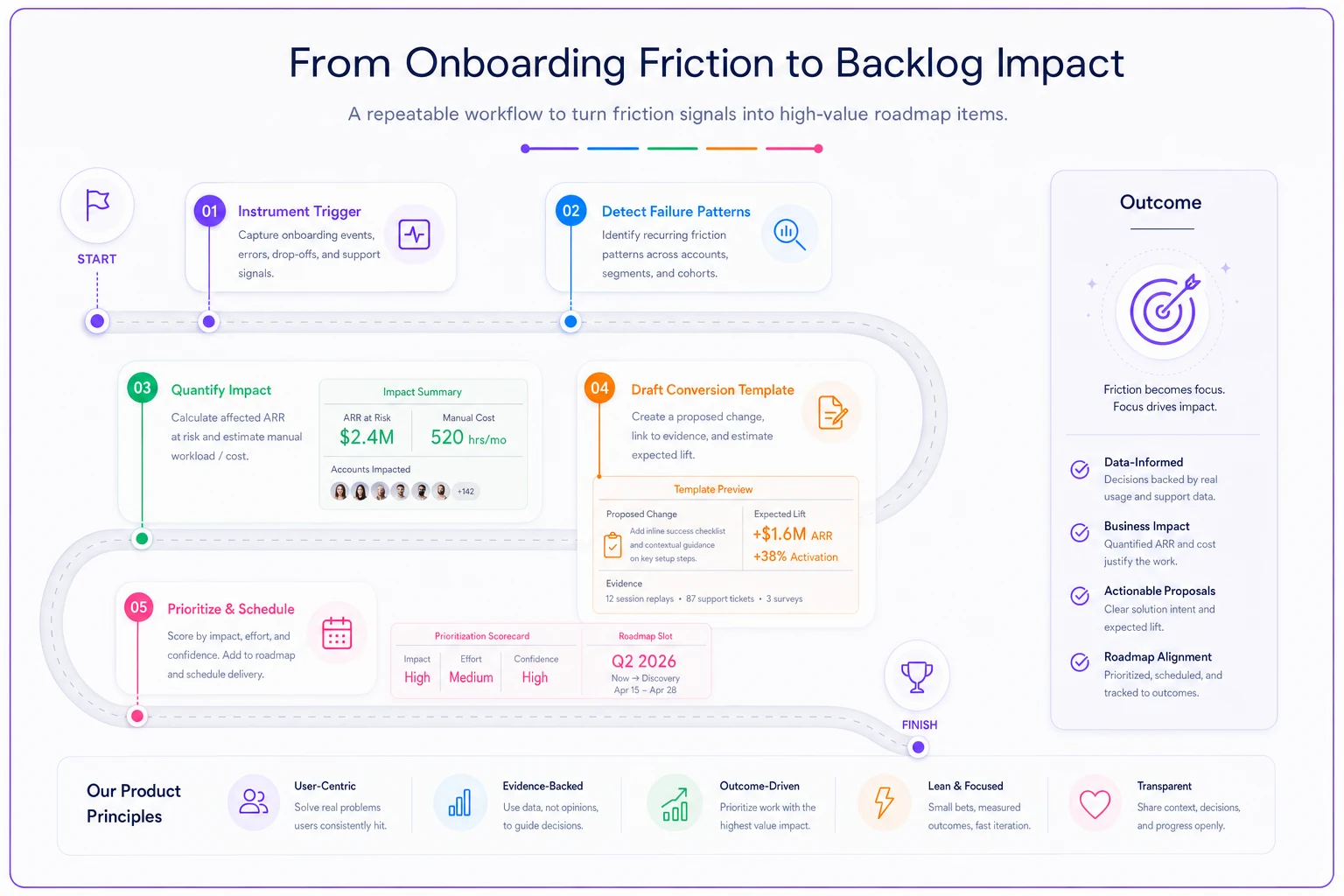
The visual maps each step so teams can align on handoffs and required artifacts.
Include a clear ARR estimate in the conversion template to make prioritization straightforward.
A conversion template that includes ARR and manual cost moves work out of anecdote and into prioritization.
A short real scenario
A mid-market B2B analytics platform was onboarding around 14 enterprise accounts a quarter. Their CS team kept flagging that new accounts "took forever to get going," but there was no shared definition of what "going" meant, so it never became actionable.
They instrumented five onboarding triggers and started scoring accounts. Within about six weeks, one pattern jumped out: roughly 40% of new accounts were stalling at the same step—the initial data import kept failing when customers uploaded files with more than around 10,000 rows, and each failure meant a support ticket plus a manual re-import by a solutions engineer.
That single failure point was touching accounts worth somewhere in the range of $600k–$700k in combined ARR and eating around 4–6 hours of SE time per stalled account. Written up with that ARR figure attached, the fix jumped the queue past two feature requests it had been losing to for months.
After the import handling was fixed, the failure rate on that trigger dropped to under 10%, and median time-to-first-production-event went from around 18 days to closer to 9. No dramatic revenue miracle—but a noticeably smoother first month, fewer week-one escalations, and CS getting a meaningful chunk of their time back.
How this connects to the rest of the roadmap
Onboarding triggers don't live in isolation. They sit right on top of your integration and partner work, because for enterprise customers a large share of onboarding friction is integration friction—SSO, data sync, API setup. If your onboarding triggers keep failing at integration steps, that's a strong argument to coordinate with your partner integration roadmap, where change windows and acceptance tests can prevent the exact breakage that stalls new accounts.
The bigger structural point is that onboarding spans Sales, CS, Product, and Engineering—and systems that span multiple teams are exactly the ones that decay when no one owns the seams. Triggers give you a shared language across those teams. Gates give you a forcing function. Conversion templates give you the bridge from signal to backlog.
The shift worth making
The teams that get enterprise onboarding right aren't the ones with the most solutions engineers. They're the ones who stopped treating onboarding as a service delivered by humans and started treating it as a product capability—with instrumented success triggers, health-based gates, and a real pipeline from friction to fix.
You don't need to build all of this at once. Start by defining one honest trigger: what does "this customer has actually started getting value" mean in a way you can query? Instrument that. Watch how many accounts miss it. That single number, tied to the ARR behind it, will do more to get onboarding onto your roadmap than any amount of CS escalation ever will.
Onboarding rarely fails because teams don't care. It fails because nobody has made the signal legible enough for the roadmap to absorb it. Triggers, health scores, and a solid conversion template are what make it legible—and once it's legible, it competes.
You don't need to build all of this at once. Start by defining one honest trigger: what does "this customer has actually started getting value" mean in a way you can query? Instrument that. Watch how many accounts miss it. That single number, tied to the ARR behind it, will do more to get onboarding onto your roadmap than any amount of CS escalation ever will.
Onboarding rarely fails because teams don't care. It fails because nobody has made the signal legible enough for the roadmap to absorb it. Triggers, health scores, and a solid conversion template are what make it legible—and once it's legible, it competes.
Ready to elevate your product management?
Join 2,000+ product teams using Itemyly to accelerate delivery, improve alignment, and build better products.