


Most roadmap arguments aren't really arguments about the roadmap. They're arguments about fear. The exec is afraid of missing a revenue number. The customer is afraid you're deprioritizing the thing they care about. Your eng lead is afraid you're about to commit to something that'll eat the next two quarters. And you're stuck in the middle trying to make a call with half the information and a calendar invite that ends in 20 minutes.
These conversations go sideways not because people are unreasonable, but because nobody has a shared language for comparing one trade-off against another. "Feature A is important" and "Feature B is strategic" aren't comparable statements. They're both just vibes wearing suits.
Decision economics gives you that shared language — not the academic version, the operational one. Three concepts do most of the heavy lifting: opportunity cost, regret minimization, and investment bands. Together, they turn roadmap negotiation from a persuasion contest into a reasoning exercise where the strongest evidence wins instead of the loudest voice.
This piece walks through how the system fits together, where it breaks as teams scale, and the actual templates and scripts you can paste into your next planning cycle.
Why roadmap negotiations break down (the real mechanism)
There's a pattern underneath almost every stuck roadmap debate: people compare the benefit of options without ever pricing the cost of what they're giving up.
A sales leader pushes hard for a custom reporting feature because a $400k deal "needs it." Reasonable on its face. But the question that never gets asked is: what are the three things that don't ship because that feature does? If building custom reporting pushes back an onboarding redesign that's bleeding churn every month, you might be trading a one-time $400k for a recurring loss that's larger over 18 months.
That's opportunity cost. And the brutal truth is that opportunity cost is invisible by default. Nobody walks into the room holding a slide labeled "the stuff we silently killed to say yes to this." So the loudest, most concrete request wins, and the quiet strategic work keeps getting deferred until it becomes an emergency.
The teams that negotiate well aren't smarter — they've just made the invisible costs visible and comparable before the meeting starts. That's the whole game.
The three tools, and how they actually connect
These aren't three separate frameworks you pick from. They're layers. Each one answers a different question, and you stack them.
Eliminate product chaos and align your team.
Itemyly helps you plan, prioritize, and track every product milestone seamlessly.
- Centralized roadmap management
- Stakeholder collaboration
- Release tracking & analytics
No credit card required
| Tool | Question it answers | When it drives the decision |
|---|---|---|
| Opportunity cost | What are we not doing if we do this? | Early — framing the real menu of options |
| Regret minimization | Which choice are we least likely to regret in 12 months? | When options are close and uncertainty is high |
| Investment bands | How much are we allowed to spend before we re-decide? | Committing — turning a yes into a bounded yes |
Opportunity cost frames the menu. Regret minimization breaks ties when the numbers are fuzzy. Investment bands keep your "yes" from quietly becoming a blank check. Skip any one layer and the other two get weaker.
Opportunity cost: price the alternatives, not just the ask
The mistake people make is treating opportunity cost as a feeling ("yeah, there's a cost to this"). It has to be a list. A specific, named list of what moves or dies.
In practice, this usually means a PM sitting down before the planning meeting and writing out the three highest-value things their team would otherwise work on in the same window — three named alternatives, each with a rough value estimate and a rough effort estimate. When someone asks for Thing X, you're no longer comparing "X vs. nothing." You're comparing "X vs. the best thing X displaces."
Write the three alternatives before the meeting so the trade-offs are tangible when someone asks to jump the queue.
A typical example: an enterprise customer wants SSO support, estimated at around 6 engineer-weeks. The team's best alternative use of those 6 weeks is a billing-retry system that would recover maybe $8k–$12k/month in failed payments. Suddenly SSO isn't just "a good feature" — it's "a good feature that costs us roughly $100k+ in recovered revenue over a year if it jumps the queue." Maybe SSO still wins. But now the decision is honest.
Regret minimization: when the spreadsheet can't decide
Sometimes two options are genuinely close on value and cost. The spreadsheet shrugs. This is where teams waste weeks going in circles.
Regret minimization reframes it: forget which option is "optimal." Ask which one you'd be most upset about getting wrong. You're not maximizing expected value anymore — you're minimizing the worst-case strategic hit.
The practical version is a two-column exercise:
-
Regret if we do it and it fails sunk cost, opportunity cost, reputational hit with the team or customer
-
Regret if we don't do it and it turns out we should have missed market window, competitor capture, customer churn, a problem that compounds
One pattern worth noticing: reversible decisions almost never deserve the agonizing. If you can ship a thin version, measure, and roll it back cheaply, regret is low regardless of outcome — so just move. The decisions that deserve this analysis are expensive and hard-to-reverse ones: platform bets, public commitments, data model changes, API contracts you can't walk back without breaking clients.
Investment bands: turn "yes" into a bounded yes
This is the layer most PMs skip, and it's the one that saves you six months later.
An investment band is a pre-agreed spending ceiling attached to a decision, plus a trigger for re-deciding. Instead of "yes, let's build the integration," you commit to "yes, up to 8 engineer-weeks and $0 third-party cost; if we blow past either, we stop and re-decide."
The most common roadmap failure isn't picking the wrong thing. It's picking a reasonable thing and letting it quietly consume triple its budget because nobody set a stopping rule. Bands give you a natural, non-dramatic checkpoint — without anyone having to admit they were wrong. "We hit the band, let's reassess" is a lot easier to say than "this was a mistake."
Here's a simple workflow showing how the layers stack in practice.
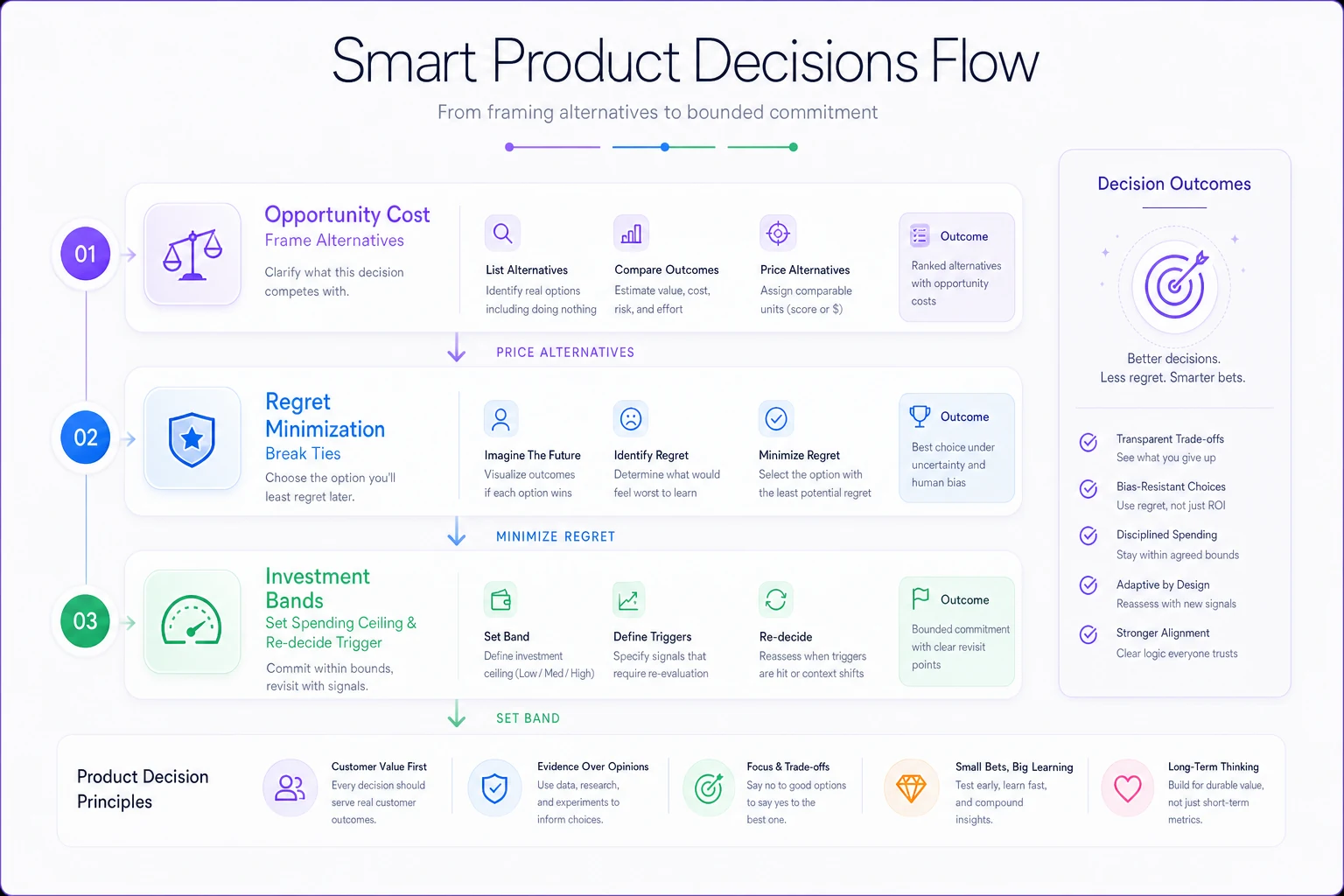
Use the sequence as a checklist: frame options, check regret for hard bets, then attach a band before committing.
Templates you can actually paste in
The trade-off quantification template
``
OPTION:
Primary benefit (one sentence):
Rough value estimate (range + basis):
Effort estimate (eng-weeks, range): __
What this DISPLACES (top 1–2, with value):
Reversibility: Easy / Hard
Investment band:  weeks,  $ cost
Re-decide trigger: _
Confidence in estimates: Low / Med / High
``
The "confidence" field does more work than it looks like. A high-value option built on a low-confidence estimate is a candidate for a cheap experiment first, not a full commitment.
The one-page decision memo (for execs)
-
The decision we're asking for — one sentence, phrased as a choice, not a feature.
-
The options — 2 to 4, never more. Include "do nothing / defer."
-
The trade-off table — value, effort, what it displaces, reversibility.
-
The recommendation — which option and the one reason it wins.
-
The band — budget ceiling and re-decide trigger.
-
What we need from you — the specific approval or input required.
The point of the memo isn't to inform. It's to force the comparison into the open so the discussion is about evidence instead of advocacy.
A negotiation script that doesn't turn into a fight
The words matter more than people admit. Here's a structure that de-escalates most trade-off conversations, with language you can lift directly.
When a customer pushes for a feature:
> "I want to make sure this lands, so let me be straight about the trade-off. If we pull this forward, it displaces [named work], which is currently [doing X / recovering Y]. I'm not saying no — I'm asking: is this more valuable to you than that? If yes, help me make that case internally with the numbers."
That last move is key. You're not defending a wall. You're recruiting the customer into the decision by making the cost real. Most of the time they didn't know there was a cost at all.
When an exec asks why something slipped:
> "We hit the investment band we agreed on for [project]. It was going to cost roughly double the original estimate to finish, so per our rule, we stopped to re-decide. Here are the two options now and what each one costs us."
No defensiveness, no surprise. The band did the hard emotional work for you.
When two internal stakeholders are deadlocked:
> "Both options are close on value, so let's switch the question. Which one would we regret more if we got it wrong — and which is harder to reverse? That's the tiebreaker."
When this makes sense — and when it's overkill
When to run the full system
-
The decision is expensive or hard to reverse (platform work, public commitments, contract changes)
-
Multiple stakeholders disagree on priority and keep re-litigating it
-
There's real money or churn riding on the outcome
-
You're repeatedly getting ambushed by urgent requests and need a defensible framework
When it's a bad idea
Running a full decision memo on a reversible, low-cost call is theater. If you can ship a thin test and roll it back in a day, just do it — the analysis costs more than the mistake would. Decision economics is for the decisions that actually bite, not every backlog grooming item.
Who should NOT lean on this
If your org doesn't have even rough value and effort estimates, don't start here. You'll produce confident-looking math on garbage inputs, which is worse than honest guessing. Fix your estimation discipline first. The way you surface and size the right bets is upstream of all of this — if that pipeline is broken, no amount of trade-off math fixes it. This is where an organizational system to surface the right high-impact bets earns its keep before you ever get to negotiation.
Where it breaks as you scale
At a small team, one PM holding the trade-off math in a doc works fine. The breakdown starts around the point where multiple product lines are competing for shared engineering and platform capacity.
The failure chain looks like this:
-
Each PM prices opportunity cost locally. PM A's "best alternative" and PM B's "best alternative" are measured in different units, with different confidence levels. The memos stop being comparable.
-
Investment bands get set but never enforced. Nobody owns checking whether a project blew past its band. The stopping rule exists on paper and dies in practice.
-
Regret analysis gets gamed. Smart stakeholders learn to frame their option as the high-regret one. "We'll lose the enterprise segment forever" becomes the universal trump card.
The fix is less about a smarter framework and more about shared inputs and consistent governance. Trade-off decisions across product lines only stay honest when everyone's pulling value and effort estimates from the same source of truth, and when bands have an owner who actually watches them. Platform-level trade-offs especially need this — deciding between platform investment and shippable product features is its own discipline, and it falls apart without a consistent SLA-and-ROI framework to prioritize platform work so those bets get compared on the same axes as everything else.
A lightweight workflow that holds up at scale looks something like this:
-
Every significant trade-off decision produces a one-page memo.
-
The memo pulls value and effort from a shared estimate source.
-
The decision ships with an investment band and a named band owner.
-
When a band trips, it surfaces for a re-decide instead of quietly continuing.
The parts matter less than the fact that the same ritual runs every time, so decisions stay comparable across teams and quarters.
A real scenario
A mid-size B2B SaaS company — roughly 40 people, three product lines sharing one platform team — kept losing the same fight every quarter. Sales would drag in a "must-have for this deal" feature, it'd jump the queue, and the platform work that kept the whole thing from falling over kept sliding.
They started doing one thing: every request over about 2 engineer-weeks had to come with a trade-off row naming what it displaced and a rough dollar value on both sides. No fancy tooling, just a shared doc and a rule.
The first noticeable change wasn't in the roadmap — it was in sales' behavior. Once they had to see that their feature displaced a billing fix recovering around $9k/month, a chunk of the "must-haves" quietly turned into "actually, next quarter is fine." Over roughly two quarters, the platform team's planned work shipped on schedule for the first time in over a year, and mid-sprint priority swaps dropped from several a month to maybe one.
Nothing about the team got smarter. They just made the cost of saying yes impossible to ignore.
The thing to take away
Roadmap trade-off negotiation stops being a war of opinions the moment opportunity cost is on the table in numbers, the hard-to-reverse bets get a regret check, and every yes comes with a band and a stopping rule. The framework isn't the hard part — the discipline of running it every time, with shared inputs, is.
Start with your next genuinely contested decision. Write the three alternatives the ask displaces. Put a rough value on each. Bring the one-pager instead of the opinion. The room shifts from "who's most convincing" to "what does the evidence say" — and that shift, more than any single decision, is what actually protects your roadmap.
Ready to elevate your product management?
Join 2,000+ product teams using Itemyly to accelerate delivery, improve alignment, and build better products.