



Most roadmap failures don't look like failures at first. The team hits sprint goals. Dashboards are green. Everyone's KPIs are trending up. And yet the roadmap slips, launches wobble, and by the end of the quarter you're wondering how three "successful" teams produced a broken outcome.
The usual explanation—"communication issues," "we weren't aligned"—misses the actual mechanism. The teams communicated fine. They were aligned to different scoreboards. Support was measured on ticket resolution speed. Engineering on velocity and uptime. Sales on signed contracts. Product on shipped features. Each of those incentives is defensible on its own. Stacked together, they pull in opposite directions, and the roadmap is where the collision shows up.
This is the case for cross-functional scorecards done properly—not as a shared dashboard nobody trusts, but as a scoring system that converts competing KPIs into harmonized incentives.
The invisible mechanic: how competing KPIs sabotage a roadmap
People optimize for what they're measured on even when it hurts the larger goal. Not because they're selfish—because the alternative is missing their number and getting asked why.
A typical example: Product commits to a Q3 launch that requires a mid-sized migration. Engineering's scorecard weights incident rate and velocity heavily. So engineering rationally deprioritizes the migration—it's risky, it dents velocity, and if something breaks it tanks their incident numbers. Meanwhile support is measured on backlog size and average handle time, so they're pushing hard for the migration because the old system generates a steady stream of tickets. Two teams, both hitting their KPIs, both blocking the same launch.
This gets worse the more mature your metrics program is. Immature teams argue in meetings. Mature teams argue through their scorecards, silently, and the roadmap absorbs the damage without anyone raising their hand. The metrics are working exactly as designed—they're just designed in isolation.
-
Local optimization beats global outcomes. Each team maxes its own metric and the combined result is a slower, more fragile roadmap.
-
The loudest scorecard wins. Whichever function has executive attention that quarter effectively sets priorities, regardless of ROI.
-
Nobody owns the seam. Cross-team work lives between scorecards, so it belongs to no one's number.
-
Gaming looks like performance. Teams learn which behaviors move their metric and quietly stop doing the things that don't.
That last one is the dangerous one.
Gaming isn't a character flaw—it's a design flaw
When you put a number on someone's performance review, assume it will be gamed. Not maliciously—just optimized to the letter rather than the intent. This is the part most scorecard rollouts ignore, and it's why so many die within two quarters.
Eliminate product chaos and align your team.
Itemyly helps you plan, prioritize, and track every product milestone seamlessly.
- Centralized roadmap management
- Stakeholder collaboration
- Release tracking & analytics
No credit card required
Some real gaming patterns worth naming:
| Metric | The intent | How it actually gets gamed |
|---|---|---|
| Ticket resolution time | Faster help for customers | Tickets closed prematurely, reopened under new IDs |
| Velocity / story points | Predictable throughput | Point inflation—same work, bigger estimates |
| Feature ship count | More customer value | Trivial features shipped, hard ones deferred |
| Uptime / incident rate | Reliable systems | Risky-but-valuable work avoided entirely |
| Experiment win rate | Better decisions | Only "safe" experiments run, real bets skipped |
| NPS / CSAT | Happier customers | Surveys timed after wins, unhappy users not sampled |
Every one of these metrics is reasonable. The gaming isn't happening because the metric is dumb. It's happening because it was set without a counterbalancing constraint. A speed metric with no quality guardrail will produce speed at the cost of quality. Every time.
So the first rule of a scorecard that survives contact with real teams: no metric goes in without a paired guardrail. If you reward speed, you constrain quality. If you reward throughput, you constrain rework. Guardrails aren't bureaucracy—they're what stops your incentives from eating your outcomes.
What breaks specifically at scale
At five people, none of this matters much. One team, one implicit scoreboard, everyone can see everyone's work.
The trouble starts around three or four teams, when several things happen at once.
Interfaces multiply faster than headcount. Two teams have one seam. Five teams have ten. Each seam is a place where two scorecards can conflict, and that number grows roughly quadratically while your ability to eyeball them stays flat.
Attribution gets murky. When a launch succeeds, three teams claim it. When it fails, it belonged to "the process." Without clear scoring rules, credit and blame both drift toward whoever tells the story best, which corrodes trust in the whole measurement system.
Local metrics harden into identity. Give a team a KPI for a year and it stops being a measurement—it becomes who they are. "We're the reliability team." Now asking them to accept a temporary reliability hit for a strategic launch feels like an attack, not a tradeoff.
Roadmap decisions get made in the hallway. When the formal scorecard doesn't resolve conflicts, real decisions migrate into side channels and one-off escalations. This is exactly the failure mode covered in stop losing roadmap decisions in meetings—except now the meetings aren't even the problem, the incentive structure feeding the meetings is.
At scale, informal alignment stops working and you haven't replaced it with anything formal. A cross-functional scorecard is the formal replacement.
Designing a scorecard that harmonizes instead of divides
The goal isn't to give every team the same metrics. That's the mistake people make when they first try this—they flatten everyone onto one KPI set and destroy the useful specialization. Support should care about resolution time. Engineering should care about reliability. You don't want to erase those.
What you want is a two-layer structure: local metrics each team owns, plus a small set of shared outcome metrics that everyone is jointly scored on. The shared layer is the harmonizing force. When engineering and support are both partially scored on "launch landed on time and healthy," the migration standoff resolves itself—blocking it now hurts both their numbers.
A workable template:
Layer 1 — Shared outcome metrics (weighted ~40% of each team's roadmap score):
-
Roadmap commitments delivered within the agreed band
-
Post-launch health at 30 days (composite
incidents + adoption + regression)
-
Cross-team dependency SLAs met
Layer 2 — Local performance metrics (~60%):
-
Team-specific KPIs, each with a mandatory paired guardrail
-
Owned entirely by the team, but visible to everyone
Let teams propose the guardrail during design—ownership over the guardrail increases acceptance of shared outcomes.
The exact split matters less than the principle: the shared layer has to be heavy enough to change behavior. At 10% weight, teams ignore it. Somewhere around 35–45% is where it actually moves decisions. Below that, local optimization wins and you're back where you started.
Scoring rules that hold up under pressure
A scorecard without explicit rules becomes a debate every quarter. The rules are what make it a system instead of a recurring argument. Write them down before anyone's number is on the line.
-
Every metric ships with its guardrail. No exceptions. Speed pairs with quality, volume pairs with rework, growth pairs with retention. Reviewers check the guardrail before the primary metric.
-
Shared outcomes are scored jointly, not divided. Everyone attached to a launch gets the same launch score. No splitting credit. This is what forces cooperation—you sink or swim together on the seam.
-
Gaming triggers a review, not a penalty. If a metric moves but the guardrail doesn't, that's a signal to inspect, not to punish. Punishing gaming just teaches better hiding. Inspecting it fixes the metric design.
-
Qualitative overrides are allowed but logged. Sometimes the number lies. Let a lead override a score, but require a written reason that gets reviewed. Undocumented overrides destroy trust faster than any bad metric.
-
Reweight quarterly, but slowly. Metrics that never change get gamed. Metrics that change constantly can't be planned around. Adjust weights once a quarter, telegraphed a quarter ahead.
Rule 2 does the heavy lifting. Once two teams share an undivided launch score, most of the cross-functional friction disappears—sabotaging the other team now shows up on your own scorecard.
The negotiation script that actually converts competing KPIs
Rolling this out isn't a spreadsheet exercise—it's a negotiation. Team leads will (correctly) resist being scored on outcomes they don't fully control. A mandate produces compliance and quiet sabotage. A real conversation produces buy-in.
A structure that works:
-
Open with the shared failure, not the new metric. "Last quarter the payments launch slipped three weeks. Both your teams hit your KPIs. Walk me through how that happened." Let them articulate the misalignment themselves. They usually will.
-
Name the tradeoff explicitly. "This shared metric means you'll sometimes take a velocity hit for a launch that matters. In exchange, you get a say in which launches count and a guardrail that protects you when reliability dips for a good reason."
-
Give them control over the guardrail. The fastest way to get a team to accept a shared metric is to let them define the guardrail that protects them. Now the scorecard feels like armor, not a leash.
-
Agree on the escalation path up front. Everyone needs to know what happens when the shared metric and a local metric genuinely conflict. Deciding that in the heat of a slipping launch is too late.
This connects directly to how orgs surface the right work in the first place—if prioritization is broken upstream, no scorecard downstream will save you. That upstream system is laid out in prioritization keeps missing high-impact work, and the two fit together: prioritization decides what matters, the scorecard makes teams behave like it matters.
A real scenario: three teams, one recurring standoff
A B2B software company—somewhere around 45 people, three product teams plus a shared platform team—kept missing quarterly launches by two to four weeks. Same story each time. Platform was scored almost entirely on stability and infra cost. Product teams were scored on shipped features. Platform kept deprioritizing enabling work product teams needed, because doing it dented their stability numbers and blew the cost ceiling.
Nobody was wrong. Platform was protecting exactly what they'd been told to protect.
They introduced a shared outcome layer weighted at about 40%: enabling-work SLAs and 30-day launch health, scored jointly across platform and the relevant product team. Platform got to define the stability guardrail themselves—if enabling work pushed incidents past their line, the launch score absorbed the penalty for everyone. That gave product teams a real reason to scope enabling work carefully instead of dumping it on platform at the last minute.
The results weren't dramatic on paper, which is honestly how you know it was real. Launch slippage dropped from that two-to-four-week range down to under a week for most releases over the next two quarters. The bigger shift was qualitative—the standing "platform is blocking us" tension mostly disappeared, because both sides were being graded on the same seam.
When you're scored together, you plan together.
How the scorecard system flows in practice
Understanding the structure is one thing. Seeing how it actually sequences—from misaligned KPIs through to harmonized scoring—makes it easier to implement without skipping steps.
Here's a quick visual of the workflow.
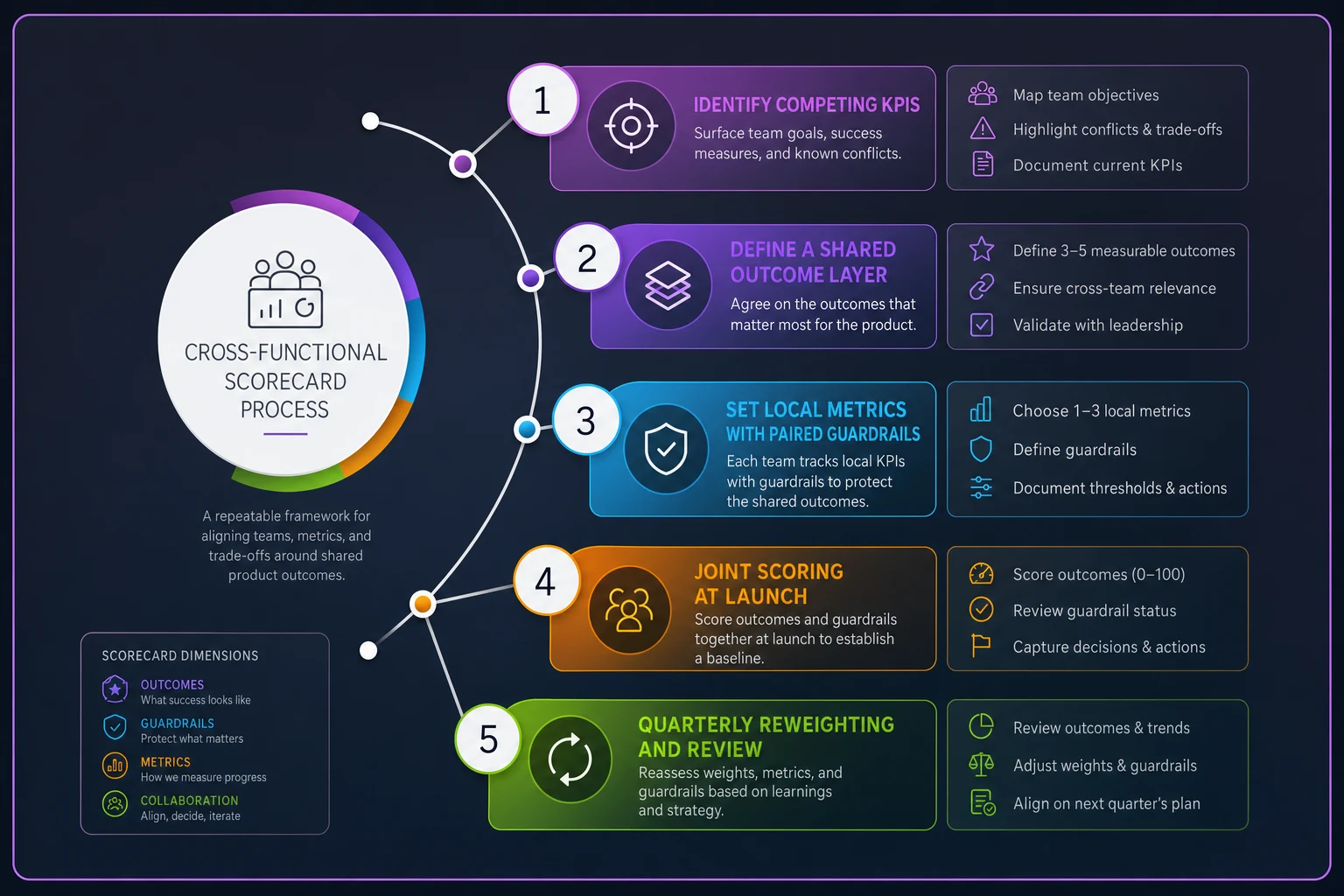
The sequencing matters because most teams try to jump straight to shared metrics without first auditing where their existing KPIs conflict. That audit is what surfaces the seams worth scoring, and skipping it means you'll design the shared layer around the wrong problems.
When this actually makes sense
Cross-functional scorecards are worth the effort when:
-
You have three or more teams whose work depends on each other's
-
Launches keep slipping despite individual teams hitting their numbers
-
You can already see teams optimizing locally at the expense of shared outcomes
-
Leadership will actually let scores influence real decisions and reviews
Cross-functional scorecards are worth the effort when:
When it's a bad idea
Skip it, or wait, if:
-
You're small enough that one implicit scoreboard still works—don't add machinery you don't need
-
Your metrics are still immature and noisy; formalizing bad metrics just cements them
-
Leadership won't back the shared layer with real weight, in which case it's theater
-
Your culture punishes gaming instead of inspecting it—the scorecard will drive behavior underground
Your culture punishes gaming instead of inspecting it—the scorecard will drive behavior underground
The uncomfortable truth about all of this
A scorecard doesn't fix misalignment. It surfaces it. The first time you roll out shared outcome metrics, things often feel worse—suddenly the conflicts that were hiding inside separate KPIs are visible on one page, and people argue about them openly. That's not the system failing. That's the system working. Those arguments were always happening; they were just happening silently through deprioritized tickets and quiet standoffs.
The teams that get real value treat the scorecard as a living instrument, not a report card. They reweight it as strategy shifts. They inspect gaming instead of punishing it. They keep the shared layer heavy enough to matter and the local layer specific enough to respect expertise.
The point isn't a perfect number—it's getting three teams to finally pull toward the same outcome, with their incentives actually pointing the same direction. That's what harmonized incentives buy you. Not a greener dashboard. A roadmap that stops getting quietly torn apart by people doing exactly what you told them to do.
The point isn't a perfect number—it's getting three teams to finally pull toward the same outcome, with their incentives actually pointing the same direction. That's what harmonized incentives buy you. Not a greener dashboard. A roadmap that stops getting quietly torn apart by people doing exactly what you told them to do.
Ready to elevate your product management?
Join 2,000+ product teams using Itemyly to accelerate delivery, improve alignment, and build better products.