


Most release plans assume the world is one big deployment target. You cut a version, you ship it, you watch the dashboard. That works fine until you're pushing a schema migration into EU, APAC, and US regions that each have different maintenance windows, different data-residency rules, and different tolerance for downtime — and suddenly the plan that worked for a single region is why you're on a 2 a.m. incident call explaining why Frankfurt rolled back but Singapore didn't.
What breaks here isn't the code. It's the planning artifact. A release that spans regions needs a runbook that treats each region as its own release — with its own acceptance gate, its own dry-run, and its own rollback branch — not a shared checklist with "repeat per region" scribbled at the bottom. This post is about building that artifact for micro-release planning multi-region work, specifically the three things that fall apart first: region windows, migration dry-runs, and rollback decision trees keyed to regional constraints.
Why "repeat per region" quietly fails
The copy-paste approach to multi-region releases fails for a boring reason: the constraints that actually matter per region are invisible in a generic checklist.
Take maintenance windows. A US-East window at 3 a.m. ET is mid-afternoon in Singapore. If your runbook says "deploy during low-traffic window" without pinning the actual local clock per region, someone will run the APAC migration during peak business hours because they followed the same step they followed for US-East. Nobody made a dumb mistake — the artifact just didn't force the region-specific value.
Then there's residency. A migration that backfills a column by reading from a central service might be fine in three regions and illegal in the fourth, because that region can't move personal data across its border. The migration script is identical. The legality isn't. A shared runbook hides that difference inside an assumption.
And rollback — this is the one that burns teams. Rolling back a stateless service is easy. Rolling back after a data migration that's already written new rows is not. The point of no return lands at a different step in each region depending on replication lag, backup cadence, and how long that region's compliance rules require you to retain the pre-migration state. A single rollback plan can't be correct for all of them.
The incident almost never comes from the region you worried about. It comes from the one you assumed was "the same as the others."
Treat each region as a micro-release, not a step
The mental shift that fixes most of this is small but annoying to actually adopt: a region is not a step in one release. It's a separate micro-release that happens to share code.
Eliminate product chaos and align your team.
Itemyly helps you plan, prioritize, and track every product milestone seamlessly.
- Centralized roadmap management
- Stakeholder collaboration
- Release tracking & analytics
No credit card required
-
An acceptance test suite keyed to that region's constraints — not just "does the app load" but "does the app load and respect this region's residency, latency, and regulatory rules."
-
A migration dry-run against a production-shaped copy of that region's data, not a generic staging dataset.
-
A rollback decision tree that encodes that region's specific point-of-no-return and recovery path.
Structured this way, sequencing becomes a real decision instead of an afterthought. You ship to your lowest-risk region first, let it bake, and use the real acceptance results — not instinct — to gate the next region. It's the same orchestration discipline that turns cross-team launches from chaos into predictable releases, just applied along the geographic axis instead of the team axis.
Region window planning: pin the actual clock
The first artifact is the region window table. The mistake is describing windows relationally — "off-peak," "overnight" — instead of absolutely. Pin the real local time, the UTC equivalent, who's watching, and what makes that window shrink or disappear entirely.
| Region | Local window | UTC window | On-call watching | Window blockers |
|---|---|---|---|---|
| US-East | Tue 02:00–04:00 ET | Tue 06:00–08:00 | US ops | Month-end billing freeze |
| EU-Central | Wed 01:00–03:00 CET | Wed 00:00–02:00 | EU ops | GDPR DPO sign-off pending |
| APAC-SG | Thu 02:00–04:00 SGT | Wed 18:00–20:00 | APAC ops | Lunar New Year freeze |
| AU-Southeast | Thu 03:00–05:00 AEST | Wed 17:00–19:00 | shared w/ APAC | EOFY reporting window |
A few things this forces that a generic checklist doesn't. It surfaces that AU and SG windows are only an hour apart in UTC, which means you can't realistically have one person watching both closely. It makes window blockers explicit — a billing freeze or a pending compliance sign-off means the window doesn't exist this week, and that should block the release automatically, not surface when someone tries to deploy. It also ties each window to a named on-call group so there's no ambiguity about who owns the watch.
One pattern worth borrowing: never schedule two region cutovers inside the same person's waking shift if both carry data migrations. The second one gets a tired reviewer, and tired reviewers make rollback-vs-continue calls badly.
Migration dry-runs: the template that catches the real failures
A dry-run against clean staging data proves almost nothing. The failures that matter live in the shape of real production data — the unexpected nulls, the legacy rows from three schema versions ago, the one region where a field is populated differently because of a local integration nobody documented.
The dry-run template per region should produce measured numbers, not a green checkmark. At minimum:
-
Row count affected — and whether it matches the estimate. If you expected to touch around 40k rows and the dry-run touches 400k, stop.
-
Duration on production-shaped data — not staging. A migration that takes 90 seconds in staging can take 40 minutes against a region with 10x the row count.
-
Lock behavior — does it hold a lock long enough to matter during the window? In a region with a tight 2-hour window, a 45-minute lock is a different risk than in a region with a 6-hour window.
-
Replication lag introduced — this is often the real driver of where the rollback point-of-no-return lands.
-
Reversibility check — can the down-migration actually restore the pre-state, and how long does that take?
A realistic example of why this matters: a team ran a migration that added a computed column and backfilled it. Three regions behaved exactly as expected. The fourth — the oldest, running since before a major data model change — tried to backfill against roughly 6x the rows plus a pile of legacy nulls the backfill logic didn't handle. The generic staging dry-run never caught it because staging didn't have those rows. The region-specific dry-run, run against a production-shaped copy, caught it two days before the window. The fix was cheap at that point. At 3 a.m. mid-migration, it would have been an outage.
That gap — "it passed in staging but staging didn't look like this region" — is probably the most common reason multi-region migrations go sideways.
Rollback decision trees keyed to regional constraints
This is the artifact most teams skip, and it's the one that determines whether a bad night is a 15-minute blip or a six-hour recovery.
A rollback decision tree isn't "if broken, roll back." It's a branching set of decisions where the branches are specific to the region's state and constraints. The core question it has to answer: where is the point of no return, and what do we do on each side of it?
A per-region rollback tree usually has three zones:
-
Pre-migration zone — code is deployed, migration hasn't run. Rollback is trivial: redeploy the previous version. Decision: roll back freely, no data concern.
-
Migration-in-progress / reversible zone — migration has started but the down-migration can still cleanly restore state within the window's remaining time. Decision: run the down-migration only if remaining window exceeds measured down-migration duration plus buffer. Otherwise, hold and fix forward.
-
Post point-of-no-return zone — new data has been written in a shape the old code can't read, or replication and retention rules mean you can't cleanly revert. Decision: fix forward only. Rollback is off the table.
The region-specific part is where those zone boundaries actually land. In a region with fast backups and loose residency rules, the point of no return might be late — you have room to revert a lot. In a region where compliance requires retaining the pre-migration snapshot in-region and replication lag is high, the point of no return arrives early and the reversible zone is narrow. Same migration, different tree.
Write the tree as an actual branching document per region, with the dry-run numbers filled in. "Reversible zone lasts around 20 minutes in APAC-SG given a 12-minute down-migration plus 8-minute buffer" is a usable instruction at 2 a.m. "Roll back if needed" is not.
A sequencing process you can actually run
Here's the end-to-end flow for a single change rolling across four regions, in the order the work actually happens:
-
Build the region window table and confirm no window blockers are active this cycle.
-
Run per-region dry-runs against production-shaped copies. Record row counts, durations, lock behavior, replication lag, and reversibility times.
-
Fill in each region's rollback tree with the real dry-run numbers. If a region's reversible zone is shorter than its window allows for safe recovery, flag it before anything ships.
-
Ship to the lowest-risk region first — usually the smallest or the one with the most forgiving rollback zone.
-
Run that region's acceptance suite and let it soak for a defined period before touching the next region.
-
Gate the next region on real results, not the calendar. A soft failure in region one pauses the whole train.
-
Advance region by region, re-checking that each next window is still open and its on-call is actually staffed.
-
Close out with each region's post-migration verification, including the reversibility check expiring — the point where you accept you're committed.
A visual overview of this sequencing process helps teams follow the steps.
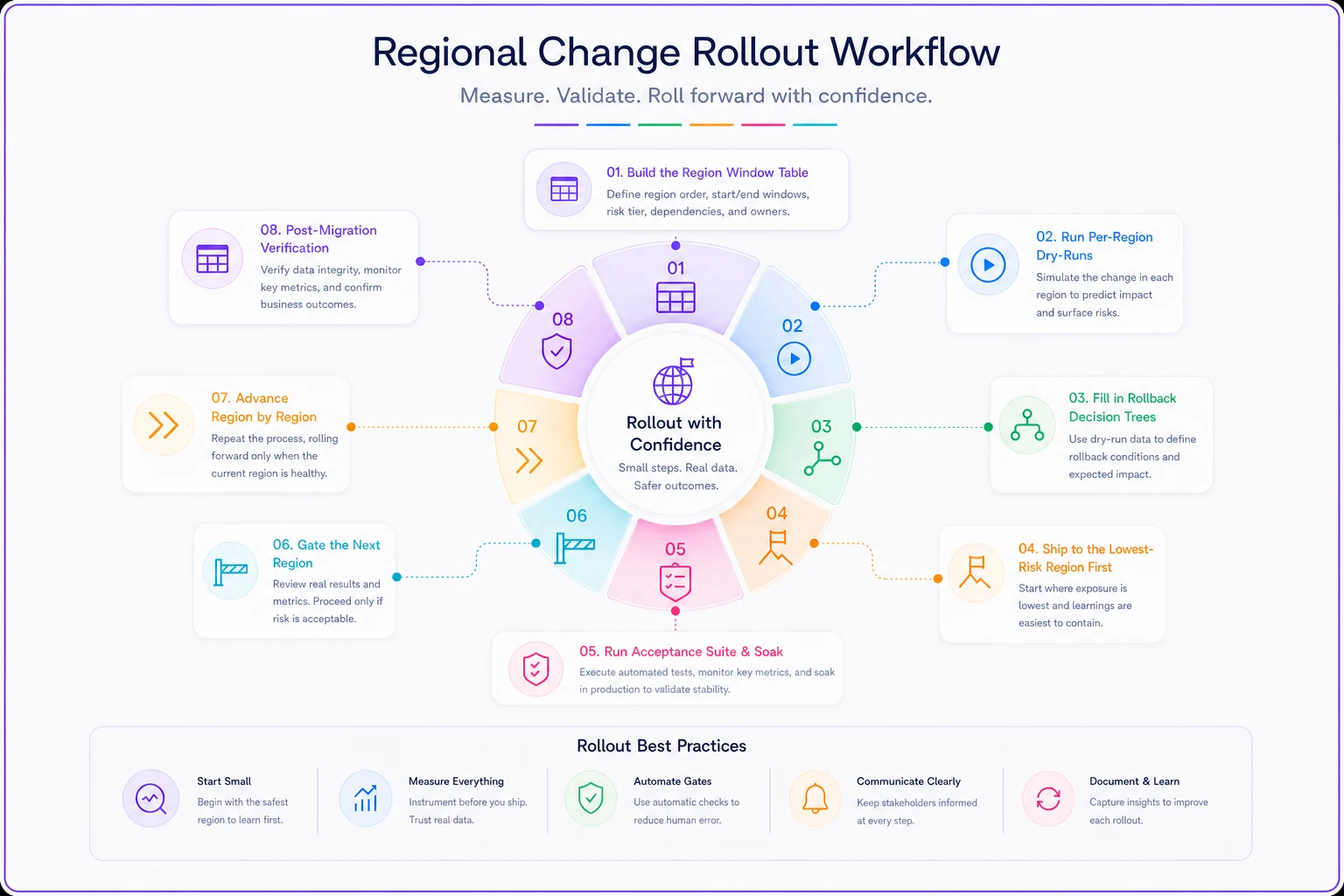
The non-obvious discipline here is step 6. Teams build careful region-specific artifacts and then ship all four regions in one night because the schedule said so. The whole point of micro-releasing per region is that region one is your real test. If you don't gate on it, you've done a synchronized global deploy with extra paperwork.
When this level of rigor makes sense — and when it doesn't
This is heavier than most changes need, so be honest about when to use it.
When it's worth it:
-
Any change involving a data migration that writes or transforms rows across regions.
-
Changes where regions have genuinely different regulatory or residency constraints.
-
Services where a single region's downtime has real revenue or contractual consequences.
-
Changes to shared schema or APIs where a half-rolled-out state could break clients — closely related to the discipline in API change management and versioning windows.
When it's overkill:
-
Stateless config changes or feature-flag flips with no data component — the rollback is trivial everywhere, so a full per-region tree is just bureaucracy.
-
Changes that genuinely behave identically across regions with no residency or timing differences. Don't manufacture four windows for a CSS fix.
Who should skip most of this: single-region teams, and teams whose "regions" are actually just availability zones inside one jurisdiction. If every region shares the same clock, regulator, and backup policy, you don't have a multi-region planning problem — you have a normal release with redundancy.
A short real scenario
A mid-sized B2B scheduling service ran across four regions and treated releases as one event. A migration that reindexed a core table went fine in three regions and stalled in EU-Central, where the table had grown considerably larger and lock behavior under load was different. Because there was one shared rollback plan and the team had already committed all four regions the same night, the EU rollback decision got made under pressure, in the wrong zone, and turned a stalled migration into roughly four hours of degraded service.
The next quarter they restructured around per-region micro-releases: separate windows, dry-runs against production-shaped copies, and a rollback tree per region. On the next comparable migration, the EU dry-run flagged the lock duration ahead of time, the window was extended specifically for that region, and the other three shipped a day earlier without waiting on EU. No incident. The total engineering time spent on the artifacts was maybe a day and a half — against the four-hour outage and the customer credits from the previous cycle, it paid for itself immediately.
The takeaway
The reason multi-region releases go wrong usually isn't the change itself — it's that teams plan them as one thing that repeats, when they're really several related-but-different things that happen to share code. Pin the real clock per region. Dry-run against data that looks like production in that region. Draw the rollback tree where the point of no return actually lands for each one. Gate each region on real results from the one before it, not the schedule.
Do that, and the 2 a.m. call stops being about surprises and becomes, at worst, "region three is holding, the other three are fine, we'll resume tomorrow." Boring is the whole goal.
Ready to elevate your product management?
Join 2,000+ product teams using Itemyly to accelerate delivery, improve alignment, and build better products.