



Your localization roadmap probably looks like a messy spreadsheet with 47 columns tracking different markets, each with its own special requirements, random deadlines, and that one legal requirement nobody remembered until two weeks before launch. The French team needs GDPR compliance docs. Brazil requires tax documentation you've never heard of. Japan wants a completely different UX flow because apparently your navigation makes no sense there.
Most teams handle this by creating entirely custom plans for each market, burning through resources and missing launch windows because they're basically reinventing their go-to-market process from scratch every time.
The baseline template trap kills velocity
Every product team starts their localization roadmap the same way — they pick their "easiest" market and ship a basic translation. English to Spanish. Maybe French. They celebrate the launch, then realize they've created zero reusable infrastructure for the next 15 markets on their list.
The second market needs a payment gateway integration. The third needs a completely different onboarding flow. By market four, you're maintaining four different codebases and your engineers are quietly updating their resumes.
This happens because teams confuse translation with localization. Translation is changing words. Localization is adapting your entire product experience to work naturally in a new market — and that includes everything from date formats to regulatory compliance to cultural expectations around user privacy.
Take a fintech product launching in Germany that discovers BAFIN requirements three months into development. Their baseline template assumed standard KYC would work everywhere. Suddenly they need custom identity verification flows, different data retention policies, and specialized audit trails just for one market. The entire roadmap shifts two quarters.
Meanwhile, their competitor uses phased market templates. They identified three core market archetypes upfront: low-regulation English-speaking markets, EU markets with GDPR requirements, and high-regulation markets with specific financial oversight. Each archetype has its own baseline template, localized UX patterns, and regulatory gates built in from day one.
Market templates prevent constant reinvention
Phased market templates work because they acknowledge that markets cluster into similar patterns. You're not launching into 50 unique markets — you're launching into maybe 5-7 market types that share operational characteristics.
Eliminate product chaos and align your team.
Itemyly helps you plan, prioritize, and track every product milestone seamlessly.
- Centralized roadmap management
- Stakeholder collaboration
- Release tracking & analytics
No credit card required
Start with your baseline template. This covers the absolute minimum viable localization: language translation, currency conversion, basic date/time formatting. Every market gets this foundation. It's your starting point, not your ending point.
The baseline for a SaaS product might include:
-
Core UI string translations
-
Currency display logic
-
Basic timezone handling
-
Standard payment methods
-
Default terms of service
Nothing fancy. Just enough to make the product technically functional in a new language.
Next layer: localized UX patterns. This is where markets start diverging based on user expectations, not just language. Asian markets often expect denser information layouts. European markets want explicit data privacy controls visible everywhere. Latin American markets might need WhatsApp integration because that's how business actually gets done there.
Your localized UX layer adapts based on market clusters:
-
Navigation patterns (horizontal vs vertical menus)
-
Information density preferences
-
Communication channel priorities
-
Trust signals and social proof styles
-
Payment method preferences beyond just credit cards
Then comes the regulatory gating layer — the stuff that actually blocks launches if you get it wrong.
Regulatory gates determine your real launch timeline
A marketplace platform targeting Europe built their entire localization roadmap around language translation. Six weeks before launch, their legal team flagged the Digital Services Act requirements. They needed content moderation systems, transparency reports, and risk assessment documentation they hadn't started.
Launch pushed back four months. The team scrambled to retrofit compliance into an already-built product. Half the planned features got cut because engineering resources went entirely to compliance work.
Regulatory gating means building compliance checkpoints directly into your market templates. You identify regulatory requirements upfront and make them launch blockers, not last-minute surprises.
For each market cluster, map out:
-
Data residency requirements
-
Industry-specific regulations
-
Consumer protection laws
-
Tax and financial reporting needs
-
Content moderation standards
-
Accessibility requirements
These aren't nice-to-haves. They're binary gates. You either meet them or you don't launch.
An edtech platform learned this the hard way. They had three market clusters: US (COPPA/FERPA compliance), EU (GDPR plus country-specific education laws), and Asia-Pacific (varying data localization requirements). Their APAC template looked solid until they hit South Korea's mandatory local data storage requirement. The entire infrastructure assumption fell apart.
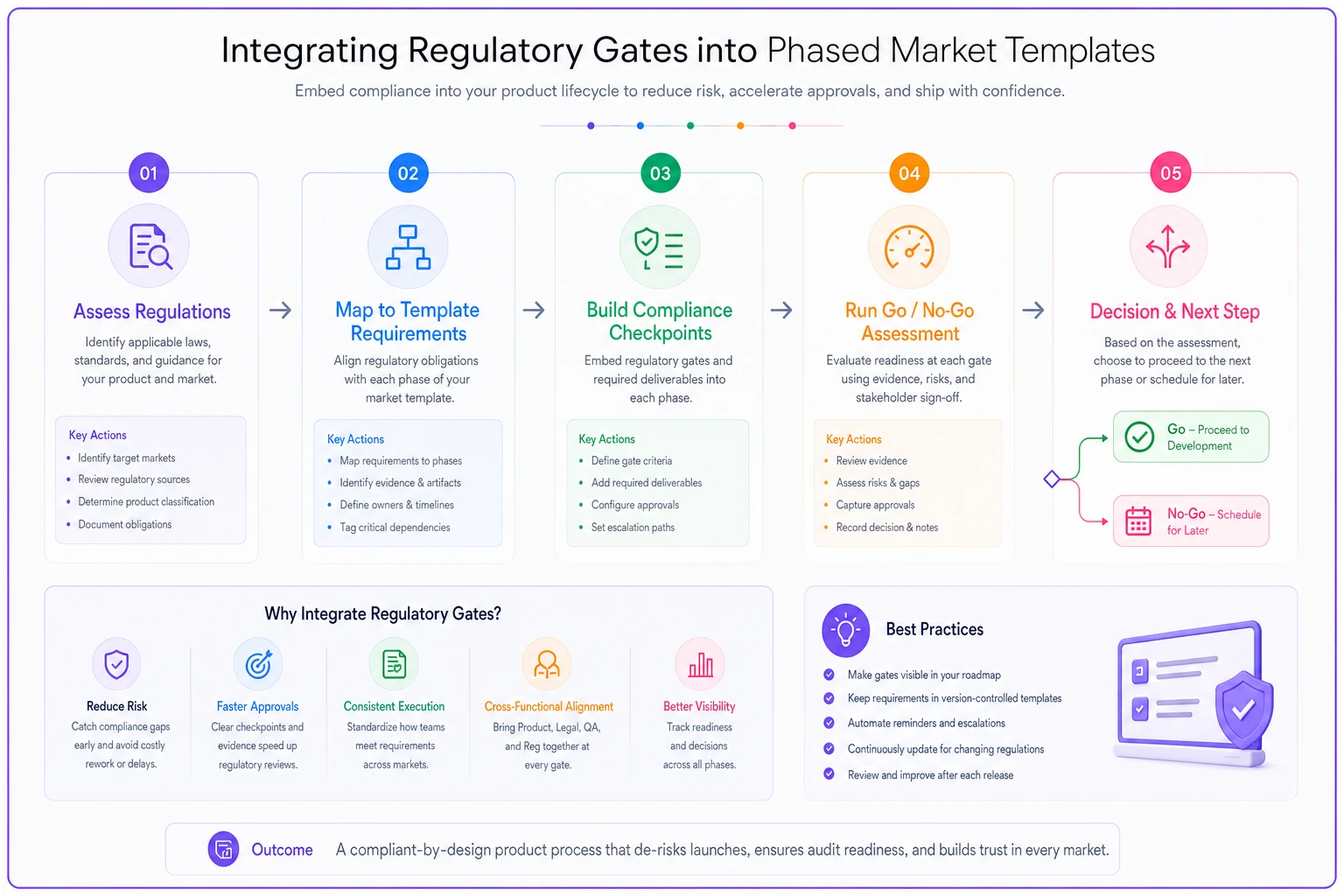
Now they use strict regulatory gates. Before any market enters development, they run a regulatory assessment that produces a clear yes/no on whether their current infrastructure can support it. If it's a no, that market waits until the next roadmap window.
Go/no-go metrics stop zombie market launches
Most localization roadmaps fail because teams launch markets that never had a chance of succeeding. They hit their launch date, celebrate the milestone, then watch as the market generates 0.3% of projected revenue for the next eighteen months while still consuming support resources.
You need quantifiable go/no-go metrics before each phase. Not gut feelings or executive opinions — actual measurable thresholds that determine whether you proceed or pivot.
Phase 1: Market validation metrics
Before you even start localization:
-
Organic traffic from target market (minimum threshold)
-
Support ticket volume in target language
-
Competitor market share data
-
Total addressable market size vs. development cost
A B2B software company set their validation threshold at 500 organic visits per month from a target market. Germany hit 2,000. France hit 900. Italy barely scraped 200. They postponed Italy and reallocated those resources to deeper German localization. Italy still isn't launched two years later, and nobody misses it.
Phase 2: Baseline launch metrics
After your minimal viable localization:
-
Trial signup rate vs. English baseline
-
Feature adoption patterns
-
Support ticket complexity
-
Payment method success rates
If trial signups are below 40% of your English market baseline, something fundamental is broken. Don't move to localized UX until you fix it.
Phase 3: Scaled growth metrics
Post-full localization:
-
Customer acquisition cost vs. market average
-
Monthly recurring revenue growth rate
-
Churn rate vs. global average
-
Net promoter score vs. other markets
One marketplace killed their Brazilian expansion after six months when CAC hit 3x their threshold. They'd spent around $400k on localization, but the math simply didn't work. Better to cut losses than keep funding a market that isn't responding.
Resource estimation breaks without market clustering
Teams consistently underestimate localization resources because they calculate each market individually instead of looking at cluster patterns. You think Germany will take three months. Then France will take three months. Then Spain will take three months. Nine months for three markets, right?
Wrong. Germany takes five months because you discover all the EU regulatory requirements. France takes two months because you can reuse 80% of the German work. Spain takes six weeks for the same reason. But if you'd planned them as an EU cluster from the start, you could have done all three in roughly six months total.
Resource patterns by cluster:
Low-complexity markets (English-speaking, similar regulations):
-
4-6 weeks for baseline
-
2-3 weeks for localized UX
-
Minimal regulatory gating
-
1-2 engineers, 1 PM, 0.5 designer
Medium-complexity markets (Single language, some regulatory differences):
-
6-8 weeks for baseline
-
4-6 weeks for localized UX
-
2-4 weeks for regulatory compliance
-
2-3 engineers, 1 PM, 1 designer, 0.5 legal
High-complexity markets (Multiple languages, strict regulations, cultural adaptation):
-
8-12 weeks for baseline
-
8-10 weeks for localized UX
-
4-8 weeks for regulatory gating
-
3-4 engineers, 1-2 PMs, 1 designer, 1 legal, local consultants
A productivity app targeting LATAM initially calculated each country would need its own team. Then they realized Mexico, Colombia, and Chile had nearly identical requirements aside from payment methods and tax rates. They launched all three with one team in four months instead of three teams over nine months.
Release pacing tied to roadmap windows
The biggest localization roadmap mistake? Treating market launches as independent from your product roadmap. You plan Q2 for the French launch, Q3 for Germany, Q4 for Japan. Meanwhile, your product team plans Q2 for a major architecture change, Q3 for the annual UI refresh, Q4 for the feature your biggest customer has been demanding for two years.
Every market launch ends up conflicting with product development. Engineers get pulled between localization and features. Testing gets compressed. Bugs multiply because nobody has time to properly validate across markets.
Successful localization roadmaps align market launches with natural roadmap windows:
Technical debt windows
Those quarterly cleanup sprints where you're refactoring anyway? Good time to add internationalization improvements. You're already touching the codebase — might as well fix date handling for all markets while you're in there.
Feature freeze periods
The two weeks before major launches when you're not adding new features are ideal for localization testing and market-specific bug fixes. Engineers aren't context-switching between new development and market adaptation.
Post-launch stabilization periods
After big features ship, you usually have a couple weeks of lower-intensity work while gathering feedback. Schedule market launches here. The team can focus on localization without juggling major product changes.
An ecommerce platform aligned their German launch with their Q3 architecture refactor. They needed to rebuild their payment system anyway for technical debt reasons. Adding German payment methods and tax calculations during the rebuild added maybe 15% more work versus retrofitting later, which would have taken 3x longer.
The compound effect of template reuse
When you actually nail phased market templates, the first market in a cluster takes 12 weeks. The second takes 6 weeks. The third takes 3 weeks. By the fourth market in that cluster, you're basically flipping configuration flags.
A project management tool built their EU template for the French market. Took 14 weeks end-to-end. Germany launched 5 weeks later — they added language strings and adjusted some regulatory documentation. Netherlands took 3 weeks. Belgium was a two-day configuration change plus translation time.
Twenty-seven weeks for five markets versus the 70 weeks it would have taken treating each market independently. That's the difference between capturing market opportunity and watching competitors get there first.
The template approach also reduces ongoing operational overhead. Your support team learns one process for all EU markets. Your legal team maintains one compliance framework with market-specific addendums. Your engineering team debugs one codebase instead of five.
When templates break: market-specific pivots
Templates aren't rigid rules. Sometimes a market requires something so fundamentally different that forcing it into an existing template creates more problems than it solves.
A food delivery app had a solid APAC template working across Singapore, Malaysia, and Thailand. Then they hit Indonesia. The payment landscape was completely different — cash on delivery wasn't just an option, it was 70% of transactions. Their entire template assumed digital payments with occasional cash. They needed a fundamental rethink.
The solution isn't abandoning templates. It's recognizing when to create a new cluster. Indonesia became the anchor for a "cash-first markets" template that later simplified launches in Philippines and Vietnam.
Know your break conditions:
-
Payment infrastructure fundamentally different from existing clusters
-
Regulatory requirements that affect core architecture
-
User behavior patterns that break basic product assumptions
-
Market-specific competition requiring feature differentiation
When you hit a break condition, you're not failing at templates — you're discovering a new cluster that needs its own.
The coordination overhead nobody accounts for
Every market launch creates permanent operational overhead. Support tickets in new languages. Legal compliance updates. Market-specific bug reports. Payment reconciliation across multiple currencies and processors. This compounds fast.
A B2B SaaS launched into twelve markets in eighteen months. Looked successful until they realized they were spending 60% of their support resources on 15% of their revenue. Non-English markets generated roughly 3x more support tickets per customer. The localization was technically correct, but users still struggled with features designed around US business practices.
This is where cross-team coordination patterns become critical. Each market launch needs clear ownership across product, engineering, support, and operations. Without explicit coordination, markets launch but never truly succeed.
Build operational metrics into your go/no-go decisions:
-
Support ticket ratio vs. revenue contribution
-
Engineering maintenance hours per market
-
Legal compliance cost per market
-
Market-specific feature requests vs. global roadmap
If a market generates 2% of revenue but 10% of support tickets, you have a template problem or a market-fit problem. Either way, scaling that template to similar markets will scale the problem too.
Migration patterns for existing multi-market chaos
What if you've already launched six markets with six different approaches? You can't un-launch them to implement templates. But you can migrate gradually during natural update windows.
Pick your highest-value market cluster first — usually wherever you have the most markets with similar characteristics. Create the template based on the most successful market in that cluster, then migrate others during their next required update.
A learning platform had custom implementations for UK, Australia, Canada, and New Zealand. During a mandatory payment processor update, they rebuilt all four using their new English-speaking market template. The migration added about 20% to the update timeline but eliminated 70% of market-specific code.
Use phased migration patterns to move markets onto templates:
-
Start with configuration and settings
-
Move UI components next
-
Migrate business logic in phases
-
Keep market-specific overrides as a last resort
The goal isn't perfect template adherence — it's reducing maintenance cost while improving launch velocity for new markets.
Measuring template effectiveness
How do you know if your phased templates actually work? Track the delta between markets in the same cluster.
| Metric | What to track |
|---|---|
| Development time per market | Should decrease with each subsequent market in a cluster |
| Bug rate per launch | Should stabilize as the template matures |
| Time to revenue positive | Should compress across cluster markets |
| Support ticket variance | Should narrow within a cluster |
| Feature parity maintenance cost | Should drop significantly by market 3+ |
An enterprise software company tracks a "template efficiency score" — the ratio of effort for market N+1 versus market N within a cluster. Anything above 0.6 triggers a template review. They've gotten most clusters down to 0.3-0.4, meaning each subsequent market takes 30-40% of the previous market's effort.
That kind of tracking is worth building into your operational reporting early. Most teams only realize their templates aren't compounding properly after they've done five markets and still feel like they're starting fresh each time.
AI automation for template operations
Modern localization roadmaps increasingly use AI-powered operational software to manage template complexity. Not for the actual localization work — that still needs human oversight — but for the operational coordination around templates.
AI automation helps with:
-
Identifying which template applies to new markets
-
Flagging regulatory changes that affect existing templates
-
Detecting when markets diverge from expected patterns
-
Predicting resource needs based on historical cluster data
-
Surfacing reusable components across templates
The real value is in pattern recognition at scale. An AI-assisted platform can identify that your German and French deployments both ran into the same payment integration issue, suggesting a template fix before you hit the same wall in Italy. That kind of insight would take months to surface manually, if it surfaced at all.
The reality of market prioritization
Every localization roadmap eventually hits the same brutal question: which markets actually matter? You can't launch everywhere, and even with solid templates, each market carries ongoing operational cost.
The obvious markets often aren't. Brazil has 200 million people, but if your customer acquisition cost is 5x your English markets, those 200 million people might as well be on Mars. Singapore has 5 million people but might generate more revenue than Brazil ever will.
Use templates to run quick market tests. Launch baseline localization only. Give it three months. If key metrics don't hit thresholds, don't proceed to localized UX. This prevents the sunk cost fallacy where you keep investing because you've already spent so much.
A subscription box service tested twelve markets with baseline templates. Only four met their success criteria for full localization. They killed the other eight and reallocated resources to double down on what worked. Revenue per market went up 3x compared to their previous approach of chasing every opportunity at once.
Building your first phased template
Start with your next market launch, not a theoretical perfect template. Pick a market that represents a cluster you'll likely expand into. Build the template as you build the market, documenting decisions and creating reusable components along the way.
Your first template should include:
-
Market selection criteria
-
Baseline feature set
-
Regulatory requirement checklist
-
Resource allocation model
-
Go/no-go metrics for each phase
-
Timeline tied to roadmap windows
-
Migration path for future markets
Don't overthink it. A functional template you'll actually use beats a perfect template sitting in a wiki. Focus on capturing patterns that'll save time on the next market, not creating comprehensive documentation nobody reads.
The template evolves with each launch. Version 1 will be rough. By version 4, after three markets have used and improved it, you'll have something genuinely valuable. That's when the compound efficiency really starts to show.
Actually making this work
Localization roadmaps fail when teams treat each market as a special snowflake requiring completely custom everything. They succeed when you recognize that markets cluster into patterns, and those patterns can be templatized, measured, and improved over time.
The phased approach — baseline, localized UX, regulatory gating — gives you clear decision points. Either a market justifies moving to the next phase based on quantifiable metrics, or it doesn't. No politics, no executive pet projects, no "but we promised the board we'd be in 15 markets by year-end."
Resource estimation becomes predictable when you stop calculating each market from scratch and start thinking in clusters. The first EU market might take three months. The fifth takes three weeks. That efficiency only comes from templates and systematic reuse.
Tying releases to roadmap windows means localization stops being a constant distraction and starts being a predictable part of your development cycle. Engineers know when market launches happen. PMs can plan features around them. Support can staff appropriately.
The teams getting this right are launching new markets in weeks, not months, while keeping operational overhead under control. They're not smarter or better funded — they just stopped reinventing their process for every flag on the map.
Ready to elevate your product management?
Join 2,000+ product teams using Itemyly to accelerate delivery, improve alignment, and build better products.