

The worst outcome of a good postmortem isn't a bad postmortem. It's a well-run one that produces 14 action items, all of which get pasted into a "Reliability" backlog and quietly rot until the next incident recreates half of them.
You've seen the pattern. The room is sharp during the review. Someone writes down "add retries to the payments webhook," "improve alerting on queue depth," "document the failover runbook," and everyone nods. Six weeks later the tickets are still sitting there, unranked next to feature work, competing against a Q3 launch, and nobody can explain why item #7 matters more than item #12. So none of them get done, and the incident report becomes a document that describes a past you never actually fixed.
This is a translation problem. Postmortems produce findings. Roadmaps consume prioritized, effort-bounded, owned work. Nobody builds the bridge between those two things, and that's where the whole practice leaks.
This post is about that bridge — a repeatable way to go from postmortem to roadmap using a severity→effort conversion, remediation SLAs, owner templates, and decision gates that map recurrence and impact to priority bands. Not vibes. Not "we should really get to that."
Why postmortem action items don't survive contact with the roadmap
The findings coming out of an incident review are written in the wrong language for prioritization. That's the core issue.
An incident finding sounds like: "The retry logic on the notification service caused a thundering herd when the downstream recovered." That's a cause. It tells you what happened. It tells you nothing about how big the fix is, who owns it, how urgent it is relative to a churning enterprise account, or whether it'll ever happen again.
Roadmaps run on comparable units. When a payments-hardening ticket lands next to a growth experiment, someone needs a way to say "this one is a band-1 must-do this sprint, that one is a band-3 backlog item." Incident findings arrive with none of that metadata. So they either get over-inflated — every incident becomes "critical, drop everything" — or they get quietly demoted the moment the emotional heat fades, usually within a couple weeks.
A second reason: severity of the incident gets confused with priority of the fix. A SEV-1 outage feels like it should spawn SEV-1 work. But sometimes a SEV-1 was a one-in-a-thousand fluke that's genuinely not worth engineering time, and a boring SEV-3 is caused by a design flaw that'll bite you monthly. Incident severity measures the blast that already happened. Fix priority should measure future expected pain. Those are different axes, and teams that collapse them into one end up doing expensive theater on rare events while ignoring the slow bleed.
The conversion: from finding to a scored, ownable item
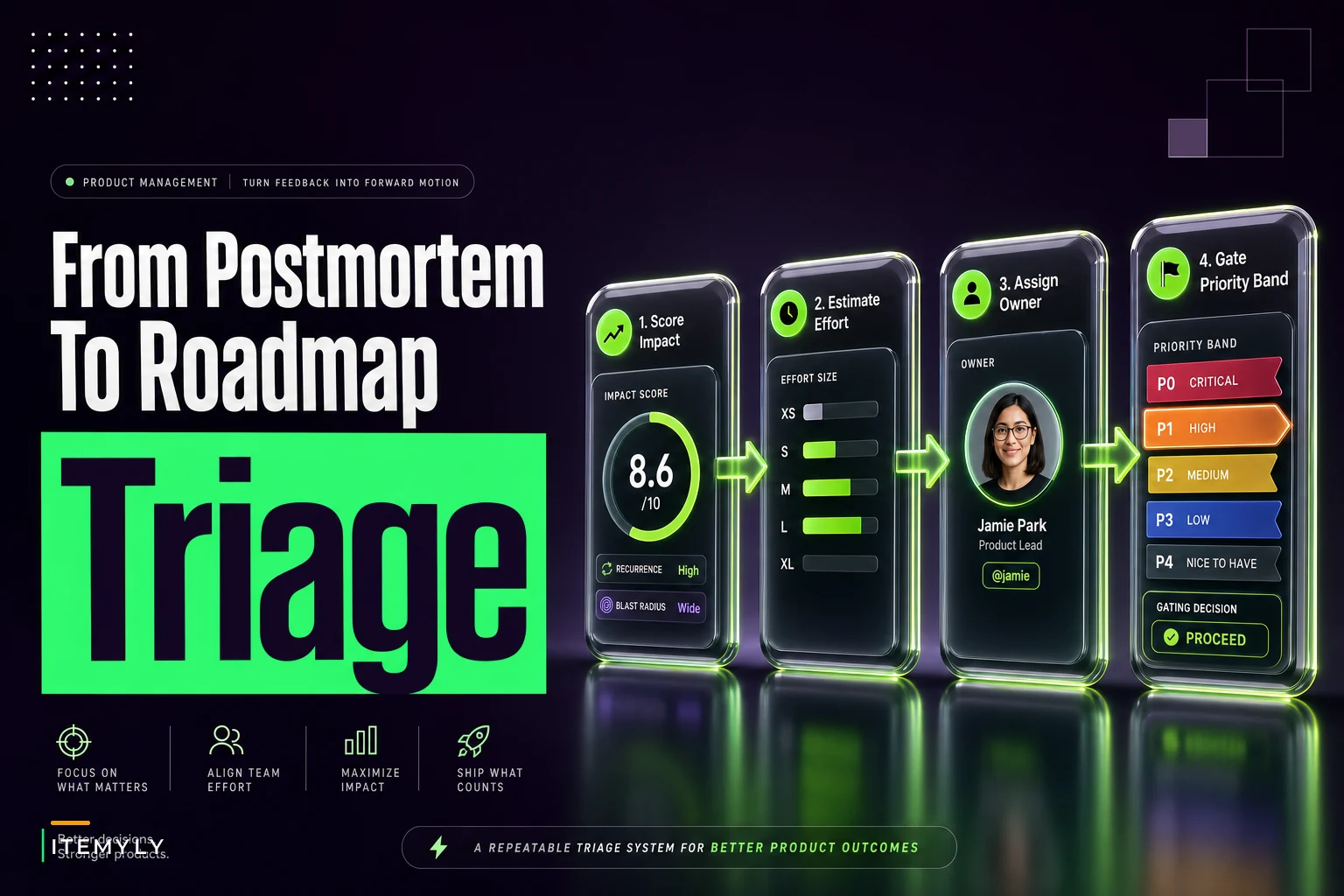
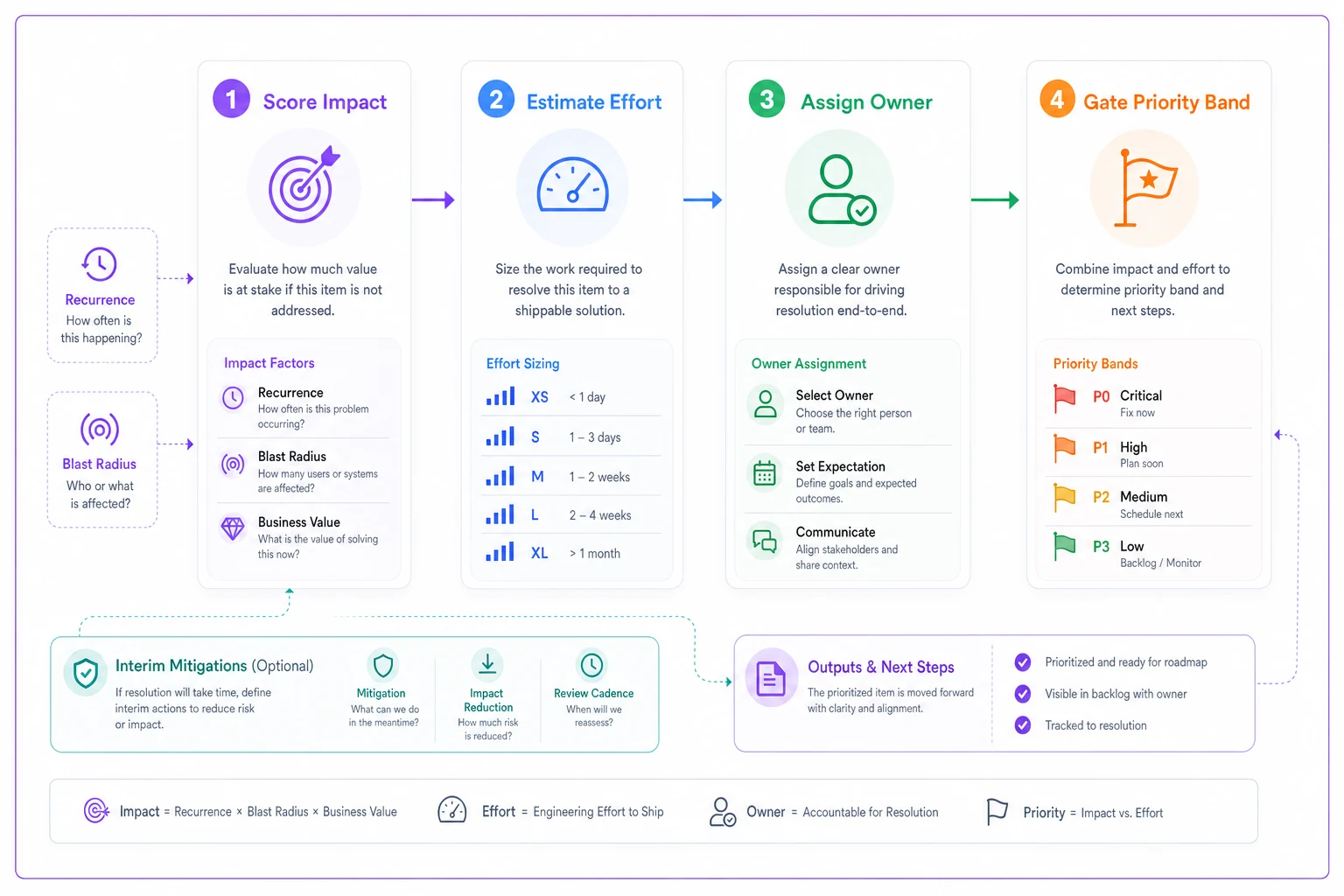
The fix is a small, boring pipeline that every incident finding passes through before it's allowed near the roadmap. Four stages: score the impact, estimate the effort, assign the owner, and gate the priority band. Each stage forces a decision that the postmortem left implicit.
Eliminate product chaos and align your team.
Itemyly helps you plan, prioritize, and track every product milestone seamlessly.
- Centralized roadmap management
- Stakeholder collaboration
- Release tracking & analytics
No credit card required
A simple visual of this pipeline helps make the steps concrete.
Step 1 — Restate every finding as a discrete remediation
Findings are often bundled. "Improve monitoring and add retries and update the runbook" is three items pretending to be one. Split them. Each remediation should be something one person could own and one PR — or a small cluster — could resolve.
A quick test: if you can't write an acceptance criterion for it, it's not a remediation yet, it's a theme. "Improve alerting" is a theme. "Add a page-on-call alert when the webhook DLQ exceeds 500 messages for 5 minutes" is a remediation.
Step 2 — Score impact using recurrence × blast radius, not incident severity
This axis swap is what fixes most of the noise. Score each remediation on two things the incident actually taught you:
-
Recurrence likelihood — how often will the underlying condition recur if you do nothing? Once ever, a few times a year, or basically monthly?
-
Blast radius — when it recurs, how bad is the realistic impact? A handful of internal users, or a revenue-path outage touching paying customers?
This deliberately ignores how scary the original incident felt. A SEV-1 triggered by a genuinely once-off cloud-provider fault scores low on recurrence. A SEV-3 rooted in a race condition that trips whenever traffic spikes scores high. That's the whole point.
Step 3 — Convert severity to effort, then to a priority band
Now you have an impact score. Pair it with an honest effort estimate and you get a priority band. The conversion isn't automatic — a high-impact, high-effort item and a medium-impact, trivial item can land in the same band, and that's correct. Cheap high-value fixes should jump the queue.
Here's the conversion grid that tends to hold up across very different teams:
| Impact (recurrence × blast) | Effort: S (≤2 days) | Effort: M (≤2 weeks) | Effort: L (>2 weeks) |
|---|---|---|---|
| High (monthly + revenue path) | Band 1 — this sprint | Band 1 — this sprint | Band 2 — next planning cycle, with a stopgap now |
| Medium (few/year, partial impact) | Band 2 — next cycle | Band 2 — next cycle | Band 3 — backlog, revisit if recurrence climbs |
| Low (rare + contained) | Band 3 — backlog | Band 3 — backlog | Band 4 — document risk, don't build |
The two most important cells are the corners nobody wants to look at.
High impact / Large effort → Band 2 plus a stopgap. You can't ship a two-month fix this sprint, but a monthly revenue-path failure can't wait two months either. So the rule forces a cheap interim control now — a manual alert, a feature flag, a rate limit — while the real fix schedules into the next cycle. This is the single most useful cell, because it's where teams usually either over-react (drop everything for the big fix) or under-react (log it and pray).
Low impact / Large effort → Band 4, "document risk, don't build." This is permission to not do work. A rare, contained failure that costs two months to fully prevent is often not worth preventing. Writing "we accept this risk, here's why, revisit if it recurs twice" is a legitimate, defensible roadmap decision. Teams that never allow this cell drown in expensive low-value hardening.
Remediation SLAs: putting a clock on each band
A priority band without a deadline is a suggestion. The band has to carry an SLA — not for how fast you resolve it, but for how fast it's committed and started. That distinction matters, because a Band-1 item might take three weeks of real work; what you're guaranteeing is that it enters an active sprint within a bounded window, not that it magically completes overnight.
-
Band 1 interim mitigation live within 48 hours; permanent fix committed into the current or next sprint (≤2 weeks to start).
-
Band 2 committed into next planning cycle; started within roughly 4–6 weeks.
-
Band 3 lives in the backlog with a review trigger, not a date. Gets re-scored if recurrence climbs.
-
Band 4 no build SLA. Gets a written risk acceptance and a recurrence trigger.
The recurrence trigger is the quiet hero here. Band 3 and Band 4 items shouldn't rot silently — they should carry a rule like "if this condition recurs one more time, auto-promote to Band 2." That way a slow bleed you decided to tolerate can't stay tolerated forever without someone actively re-deciding. This is closely related to how interest accrual works in technical-debt scoring — a low-priority item isn't static; its priority should climb as it keeps costing you.
Owner templates: the item that can't be assigned won't get done
The fastest way to kill a remediation is to write it without an owner and without acceptance criteria. It becomes a wish. Every item leaving the postmortem should be pasteable directly into your tracker with the fields already filled.
A working owner template looks like this:
-
Remediation one sentence, action-shaped ("Add DLQ depth alert to on-call rotation")
-
Root finding the incident cause it maps back to, linked to the postmortem
-
Impact score recurrence band + blast radius, one line each
-
Effort S / M / L with a rough estimate
-
Priority band 1–4, and why (which grid cell)
-
Owner a named person, not a team. Teams don't own things; people do.
-
Acceptance criteria how you'll know it's done and verified
-
SLA / trigger the date or the recurrence condition
-
Interim mitigation if Band 1/2-with-stopgap, what's the temporary control
Assign the owner during the postmortem so the item leaves the room with a name.
The "named person, not a team" line causes the most friction and matters the most. "Platform team will handle alerting" is where items go to die, because everyone assumes someone else picked it up. Assign a directly-responsible individual even for shared work — they can delegate, but they can't disappear.
Decision gates: where the roadmap actually says yes or no
The conversion produces bands. The gate is the meeting — or the async review — where bands turn into roadmap commitments. Without a gate, everything defaults to "we'll get to it," which is the failure state we started with.
-
Band 1 items enter the current cycle automatically. No debate. They earned it via the grid. The only discussion is sequencing and interim mitigations.
-
Band 2 items compete in normal planning, but they enter planning pre-scored, so they're arguing on equal footing with feature work instead of pleading for special treatment.
-
Band 3 items require zero action except confirming the recurrence trigger is set.
-
Band 4 items require a written risk acceptance signed off by someone with authority to accept that risk — usually a senior eng lead or the PM.
The value of pre-scoring is that it defuses the "everything from the incident is urgent" reflex. When a remediation shows up already labeled Band 3 with a clear recurrence trigger, the room stops arguing about whether it's important and moves on. This is the same discipline that keeps urgent one-off requests from hijacking the roadmap — the triage happens before the emotional argument, so the argument mostly evaporates.
A real scenario: the payments team that stopped re-fixing the same outage
A mid-sized B2B SaaS company, payments and billing team of about nine engineers. They ran good postmortems — genuinely thoughtful ones — but tracked remediation completion informally. Over roughly two quarters they had three separate incidents, and two of them shared a root cause: a downstream billing provider's timeouts weren't handled gracefully, so retries piled up.
The finding "handle billing provider timeouts better" had appeared in the first postmortem. It got logged as a generic backlog item, unranked, and lost. It resurfaced almost verbatim after the second incident. That's the tell: when the same finding shows up twice, your pipeline from postmortem to roadmap is broken, not your engineering.
They introduced the severity→effort grid and the owner template. When the timeout issue got re-scored properly — recurrence "few times a quarter," blast radius "revenue path, billing" — it landed clearly as High impact. Effort came in around a week and a half, so Medium. Grid said Band 1. They had an interim circuit-breaker mitigation up within two days and a permanent fix committed that sprint.
The measurable shift wasn't dramatic in a highlight-reel way, and that's kind of the point. Repeat-cause incidents on that team dropped to near zero the following quarter. The postmortem action-item backlog, which had been sitting at around 40-some stale items, shrank to roughly a dozen live, owned, banded items — because Band 3 and Band 4 stuff either got a recurrence trigger or an honest risk acceptance instead of pretending to be pending work. Time spent in planning arguing about whether incident items were important dropped noticeably, because pre-scored items don't invite the debate.
When this makes sense — and when it's overkill
This pipeline earns its overhead when you're running incidents often enough that findings pile up faster than they get resolved. If you're a small team with an incident every couple of months and you actually close the action items each time, you don't need a scoring grid — you need a checklist and discipline. Formalizing this too early just adds ceremony.
It also makes sense the moment you notice a repeat-cause incident. That's the unambiguous signal that findings are leaking between the postmortem and the roadmap. One repeat is a fluke; two is a broken pipeline.
Where it's a bad idea: don't use this to avoid fixing things by scoring everything into Band 4. The risk-acceptance cell is a scalpel, not a place to dump work you don't feel like doing. If a senior lead is signing off on "accept this risk" for five items a month, the framework has become a laundering mechanism for neglect. The recurrence triggers exist precisely to catch that — an item you accepted last quarter that just recurred should be climbing bands, loudly.
And who should skip it entirely: teams whose real problem is that they don't run postmortems at all, or run them as blame sessions. No conversion pipeline fixes a culture that doesn't surface honest findings in the first place. Fix that first.
Keeping the pipeline honest over time
The part that decays fastest is the recurrence tracking. It's easy to set a Band-4 risk acceptance and never revisit it, which quietly turns "we decided to tolerate this" into "we forgot about this." The discipline that keeps the whole thing alive is a lightweight recurring review — monthly is usually enough — where you look at only two things: did any accepted or backlogged item recur, and did any Band-1 item blow its interim-mitigation SLA.
Whether you run that review out of a spreadsheet, your issue tracker, or a workflow tool that can auto-promote items when a linked incident recurs, the mechanism matters less than the rule: no accepted risk stays accepted without a trigger that can un-accept it. That single rule is what separates a real remediation practice from a folder of good intentions.
The whole point of the severity→effort conversion isn't more process for its own sake. Incident findings and roadmap items speak different languages, and until you translate one into the other — scored, effort-bounded, owned, and gated — your best postmortems will keep producing work that no one ever actually does. Get the translation right and the same incident stops showing up twice.
Ready to elevate your product management?
Join 2,000+ product teams using Itemyly to accelerate delivery, improve alignment, and build better products.