
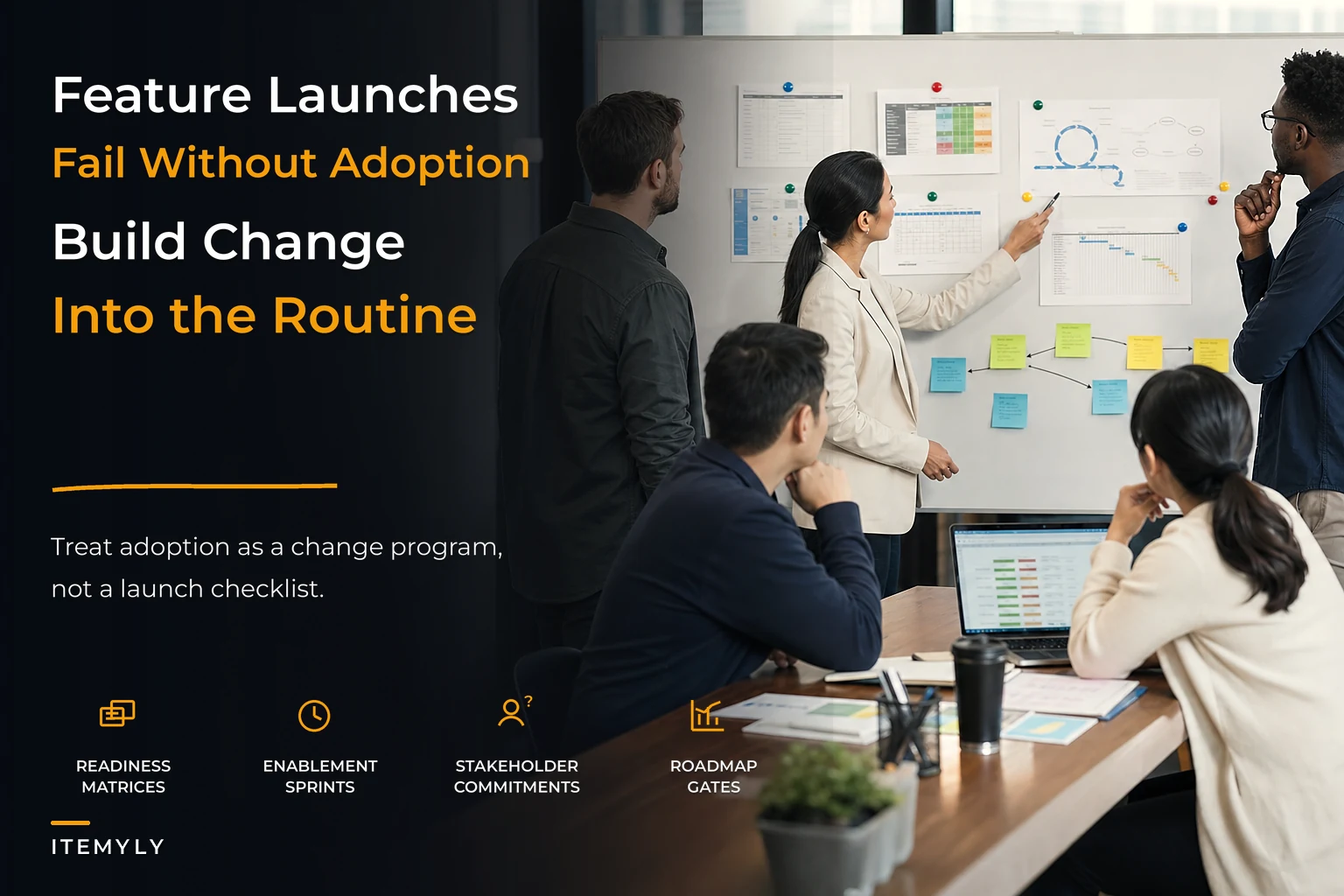

Most product teams treat launch day as the finish line. Code is merged, the flag is flipped, the announcement goes out, and everyone moves on to the next sprint. Three months later someone opens the analytics dashboard and realizes adoption stalled at 8%. The feature technically works. Nobody's using it. And now there's an awkward conversation with leadership about why the thing that took two quarters to build isn't moving any of the numbers it was supposed to move.
This isn't a discovery problem or an engineering problem. It's a change management problem, and it's the part of the launch lifecycle that almost nobody staffs, plans, or owns. Feature adoption change management deserves the same rigor you'd apply to a migration or a compliance gate—readiness matrices, real sign-offs, enablement work, and governance hooks that tie back to your roadmap. Skip that, and you're not launching a feature. You're publishing one and hoping.
The gap between "released" and "adopted" is an organizational one
Here's the pattern that shows up over and over. A team builds something that internal stakeholders genuinely need. Sales asked for it. Support flagged it. The customer advisory board voted for it. Everyone's excited. Then it ships, and the same people who asked for it never change their behavior.
-
Sales to update their demo scripts and stop pitching the old workaround
-
Support to retrain on the new flow and update their macros
-
Customer success to proactively walk accounts through the change
-
Marketing to reposition, not just publish a changelog
-
Customers themselves to abandon a habit they've built over months
Each of those is a behavior change owned by a different team with its own priorities and its own backlog. If you don't coordinate them, they don't happen. The feature sits in the product like a room nobody walks into.
Adoption failures are almost never about feature quality. They're about the six or seven handoffs that were supposed to happen after the merge and didn't. Nobody owned them, so nobody did them.
What actually breaks as you scale
At a five-person startup, adoption "management" is one person walking around the office saying "hey, use the new thing." It works because coordination cost is basically zero. Everyone's in the same conversation.
Eliminate product chaos and align your team.
Itemyly helps you plan, prioritize, and track every product milestone seamlessly.
- Centralized roadmap management
- Stakeholder collaboration
- Release tracking & analytics
No credit card required
The moment you have multiple squads, a real go-to-market org, and thousands of customers across different segments, that informal approach collapses. Here's where the cracks appear.
Enablement becomes a bottleneck, not an afterthought. With one product surface, you can train the whole company in a lunch-and-learn. With eight squads shipping monthly, your enablement team is drowning. They can't build training for everything, so they prioritize—and your feature loses that prioritization fight to something louder.
Sign-off becomes theater. Early on, a thumbs-up in Slack from the sales lead means something. At scale, "sign-off" turns into a passive Slack reaction from someone who skimmed the summary. They didn't actually commit their team to anything. So when launch day comes, sales isn't ready, and everyone acts surprised.
Governance gets bypassed under pressure. When a launch date slips and leadership is watching, the first thing teams cut is the "soft" stuff—enablement sprints, readiness checks, adoption tracking. It feels optional because it's not blocking the release. Except that's exactly the work that determines whether the release matters.
Nobody owns the outcome. The PM owns "shipped." Marketing owns "announced." But who owns "40% of eligible accounts actively using this within 90 days"? In most orgs, the answer is nobody, which is why that number never gets hit.
Treating adoption like a change program, not a launch checklist
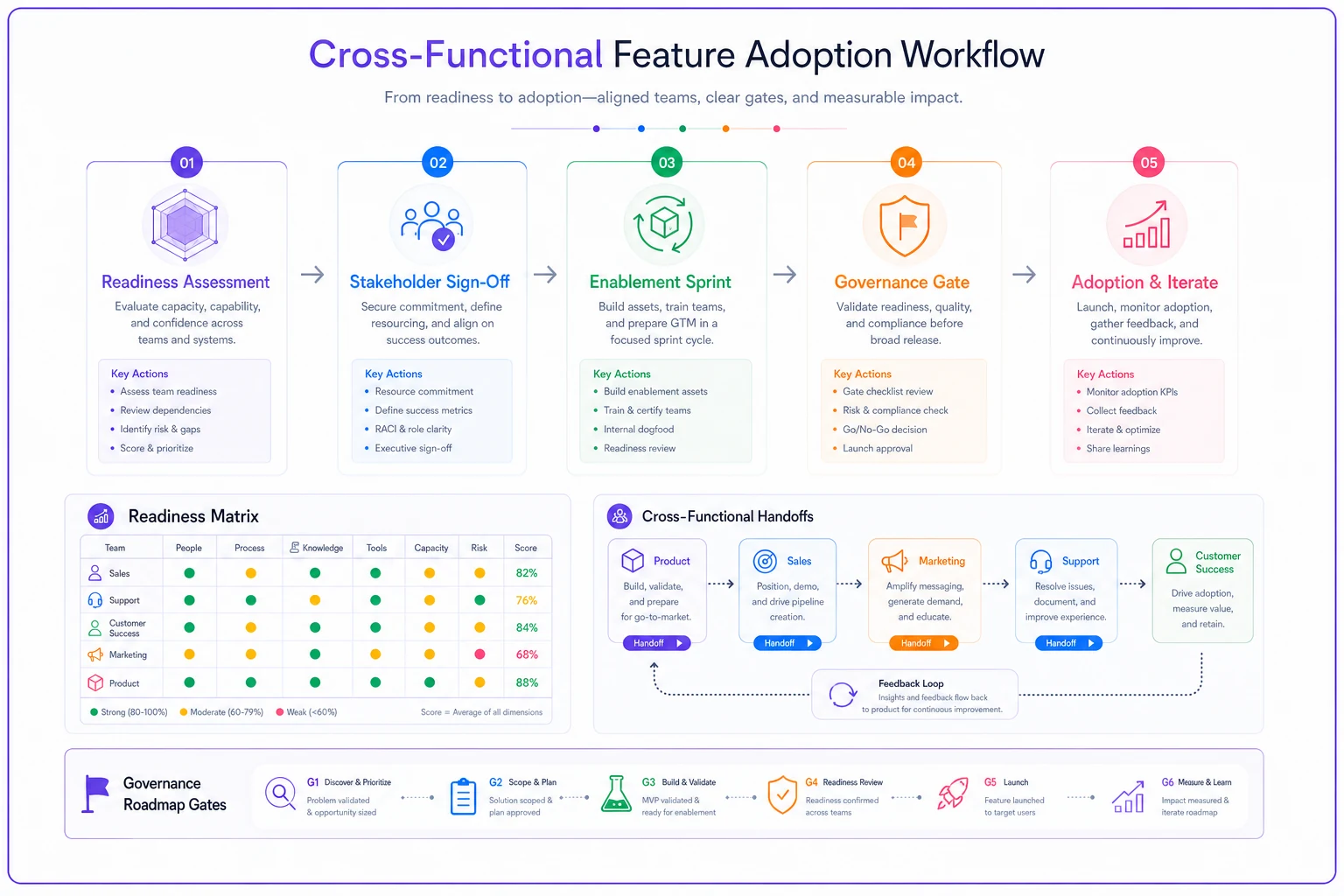
The mental shift that fixes this: stop treating adoption as a series of tasks and start treating it as an organizational change program with the same structure you'd use for any serious cross-functional initiative. That means four things working together—readiness matrices, stakeholder sign-offs that actually commit resources, enablement sprints, and governance hooks tied to your roadmap gates.
The value is in the system, not any single piece.
Here's a quick visual of that workflow.
1. A readiness matrix that scores the whole org, not just the code
Most launch checklists ask "is the feature done?" A readiness matrix asks "is the organization ready to absorb this change?" Those are different questions.
| Stakeholder | Awareness | Trained | Materials ready | Owner assigned | Ready? |
|---|---|---|---|---|---|
| Sales | Yes | No | Partial | Yes | ❌ |
| Support | Yes | Yes | Yes | Yes | ✅ |
| Customer Success | Partial | No | No | No | ❌ |
| Marketing | Yes | N/A | Yes | Yes | ✅ |
| Customers (target segment) | No | N/A | In-app guide pending | PM | ❌ |
The value isn't the table itself—it's what it forces. When you look at this, you immediately see that launching next week is a mistake. Customer Success has no owner, no training, and no materials. If you ship anyway, CS will be caught flat-footed on the exact accounts you most want to adopt the feature. The matrix converts a vague sense of "we're probably fine" into a specific list of gaps you can either close or explicitly accept.
One mistake people make is filling this out once and treating it as done. Readiness decays. Someone trained in March forgot half of it by June. Keep the matrix live through the ramp period, not just the day before launch.
2. Sign-offs that commit resources, not just approval
A signature that doesn't cost the signer anything is worthless. The whole point of a stakeholder sign-off is that the person putting their name down is committing their team's capacity to specific adoption work.
There's a real difference between:
-
"Sales approves this launch" (means nothing)
-
"Sales commits to updating all outbound demo decks by the 15th, running a 30-minute enablement session for the AE team, and having the RevOps lead track pipeline mentions for 60 days" (means something)
The second version has an owner, a deliverable, and a date. When you frame sign-offs this way, you find out fast which stakeholders were actually bought in versus which ones were being polite. The ones who hesitate to commit resources were never going to drive adoption regardless of what they said in the planning meeting.
This is also where a lot of the cross-team coordination lives. Adoption commitments should be a first-class part of that same orchestration rather than a separate track—there's a good breakdown of how to make those handoffs predictable in this piece on turning cross-team launches from chaos into predictable releases.
3. Enablement sprints instead of one-off training dumps
The single-session "here's the new feature" training doesn't work at scale because retention is terrible and the feature keeps evolving after launch. What works better is treating enablement like a short, scoped sprint that runs alongside the launch ramp.
A basic enablement sprint as a repeatable process:
-
Build the core materials once — a short internal doc, a two-minute Loom, updated support macros, and a one-pager for customer-facing teams. Do this before launch, not after.
-
Run live sessions per team — not one giant all-hands, but focused 20–30 minute sessions tailored to what that team actually needs to do differently.
-
Ship an in-product moment — a tooltip, an empty state, a guided flow. This is the highest-leverage enablement because it reaches the customer at the point of use, not in an email they'll ignore.
-
Set a checkpoint at week two — pull adoption numbers, gather friction reports from support, and decide whether you need a second wave of enablement or a fix.
-
Close the sprint with a retro — what stuck, what didn't, and update the materials for the next similar launch.
The highest-adoption features almost always have an in-product enablement moment, not just external comms. A changelog email drives a spike for two days and then nothing. A well-placed in-app nudge drives adoption for months because it meets people who are already in the flow.
Ship the core enablement materials before launch and follow up with short, team-specific live sessions.
4. Governance hooks tied to roadmap gates
This is the piece that makes the whole thing durable instead of dependent on one diligent PM. You wire adoption readiness into your existing roadmap gates so that "not ready for adoption" can actually block or delay a launch the same way a failing test or an unresolved security review would.
Concretely, that means gates like:
-
Gate
pre-build
— adoption target defined, target segment identified, owner named -
Gate
pre-launch
— readiness matrix at or above threshold, all resource commitments signed, enablement materials shipped -
Gate
post-launch (30/60/90)
— adoption tracked against target, decision made to double down, iterate, or sunset
Gates have teeth. A checklist gets skipped when things get busy. A gate that leadership reviews doesn't. When adoption readiness lives inside the same governance your roadmap already respects, it stops being the first thing cut under pressure.
This also gives you the language for the leadership conversation. Instead of "we're not sure the org is ready," you can say "we're at 60% on the readiness gate and here are the three specific gaps." That framing—evidence over vibes—is the same discipline that makes executive roadmap narratives land, and adoption readiness deserves a seat in those conversations.
A real scenario: the feature nobody used
A mid-sized B2B SaaS company—maybe 40 people, a few thousand active accounts—built a reporting module their sales team had been asking for. Two quarters of engineering work. Big internal announcement. They flipped it on for everyone.
Ninety days later, adoption was sitting around 9% of eligible accounts. The team was baffled because sales had specifically asked for this.
What happened was predictable in hindsight. Sales asked for it, but nobody updated the demo scripts, so AEs kept pitching the old export-to-spreadsheet workaround out of habit. Support wasn't trained, so when customers hit a snag in the new module, tickets got resolved by pointing them back to the old workaround. There was no in-app moment—just a changelog email that most admins never opened. And nobody owned the adoption number, so nobody noticed the stall until the quarterly review.
They re-ran it as an actual change program. Built a readiness matrix and found four gaps. Got real commitments from sales and CS with dates attached. Ran three short enablement sessions instead of one all-hands. Shipped an in-app guided flow into the empty state. Added a 30/60/90 governance checkpoint to their roadmap.
Over the next quarter, adoption climbed from 9% into the low 30s. Not a miracle number, but roughly a 3x improvement on the exact same feature with zero additional engineering. The feature didn't change. The change program around it did.
When this level of rigor makes sense—and when it doesn't
You don't need a full change program for every checkbox tweak. Applying this machinery to a minor UI fix is overhead nobody will thank you for.
This makes sense when:
-
The feature requires a behavior change from internal teams or customers
-
Adoption is the actual success metric, not just "it exists"
-
Multiple teams need to do something different after launch
-
The feature replaces an existing workflow or workaround people are attached to
This is overkill when:
-
It's a bug fix or performance improvement nobody needs to be told about
-
The change is invisible to users and internal teams
-
Adoption is automatic because the feature sits directly in an existing high-traffic flow
Very early-stage teams where informal coordination still works fine don't need this either. If your whole company fits in one room, adding readiness matrices and formal sign-offs is process for the sake of process. The complexity should scale with your coordination cost, not arrive before it does.
The system view
Adoption isn't a phase that happens after the build—it's a parallel workstream that starts when you decide to build. The readiness matrix tells you where the org stands. The sign-offs turn intention into committed resources. The enablement sprints do the actual behavior-change work. The governance hooks make sure none of it gets quietly dropped when the schedule gets tight.
Miss any one of those and the system leaks. A great readiness matrix with no committed resources is just a nicely formatted list of things nobody will do. Perfect enablement materials with no governance gate get skipped the first time a deadline slips. These pieces only work together, which is also why you can't treat any single one of them as optional.
Features don't fail because they're bad. Most of them fail because the organization around them never actually changed to make room for them. Treat that change as the real work—plan it, staff it, gate it—and your launch stops being a hopeful announcement and starts being something people actually use.
Ready to elevate your product management?
Join 2,000+ product teams using Itemyly to accelerate delivery, improve alignment, and build better products.