


The roadmap review goes fine until minute eleven. You've walked through the plan, the slides look clean, and then the VP of Sales leans forward and asks, "Why aren't we doing the enterprise SSO work first?" Now you're improvising. You know the answer—you've thought about it for weeks—but the version that comes out sounds defensive and half-formed. Ten minutes later the room has quietly decided your roadmap is negotiable.
That gap—between the thinking you actually did and the artifact you brought into the room—is where most executive roadmap narratives fall apart. Not because the strategy was wrong, but because the story wasn't built to survive a skeptical audience.
This piece is about the artifacts themselves. The one-pager. The evidence layout. The Q&A script. What each one should contain, how to structure it so you can paste it into a leadership deck, and the rehearsal work that separates narrating a plan from actually defending one.
Why the plan is fine but the narrative isn't
PMs over-invest in the roadmap and under-invest in the argument for it.
You'll spend three weeks on prioritization, capacity math, dependency mapping—real work. Then you dump it into a Gantt-style slide with quarters across the top and swim lanes down the side, and you walk in expecting the timeline to speak for itself. It never does. Executives don't read timelines the way you do. They read them as a list of things they could reorder.
The narrative fails in predictable spots:
-
No stated problem. The deck jumps straight to "here's what we're building" without anchoring on why it matters now. Leadership can't evaluate a solution when they haven't been sold the problem first.
-
No visible trade-off. If a slide shows only the chosen path, the audience assumes you never considered alternatives. That invites the "why not X instead" question every single time.
-
No evidence attached to the claim. You say "customers are churning on onboarding" and there's no chart, no quote, no number. Now it's your opinion versus the VP's opinion, and they outrank you.
A good narrative closes all three gaps before anyone opens their mouth. And the structure that does it isn't a longer deck—it's a tighter set of artifacts.
The three artifacts, and what each one is actually for
Think of these as layers. The one-pager is what people remember. The evidence deck is what they interrogate. The Q&A script is what saves you when they do.
Eliminate product chaos and align your team.
Itemyly helps you plan, prioritize, and track every product milestone seamlessly.
- Centralized roadmap management
- Stakeholder collaboration
- Release tracking & analytics
No credit card required
The one-pager is what people remember. The evidence deck is what they interrogate. The Q&A script is what saves you when they do.
| Artifact | Purpose | Lives in the deck as | Read time |
|---|---|---|---|
| One-pager narrative | The core argument, memorable and skimmable | 1 slide (appendix has the full version) | 60–90 seconds |
| Evidence wireframe | Proof behind each claim | 2–4 backup slides | pulled up on demand |
| Q&A script | Pre-loaded answers to predictable objections | speaker notes / hidden slides | never presented, always ready |
The mistake is treating these as one document. When your evidence is jammed into the main narrative, the story gets buried in charts. When your Q&A lives only in your head, you improvise under pressure. Separating them lets the narrative stay clean while the ammunition stays reachable.
This diagram shows the preparation and usage flow for the three artifacts during a roadmap review.
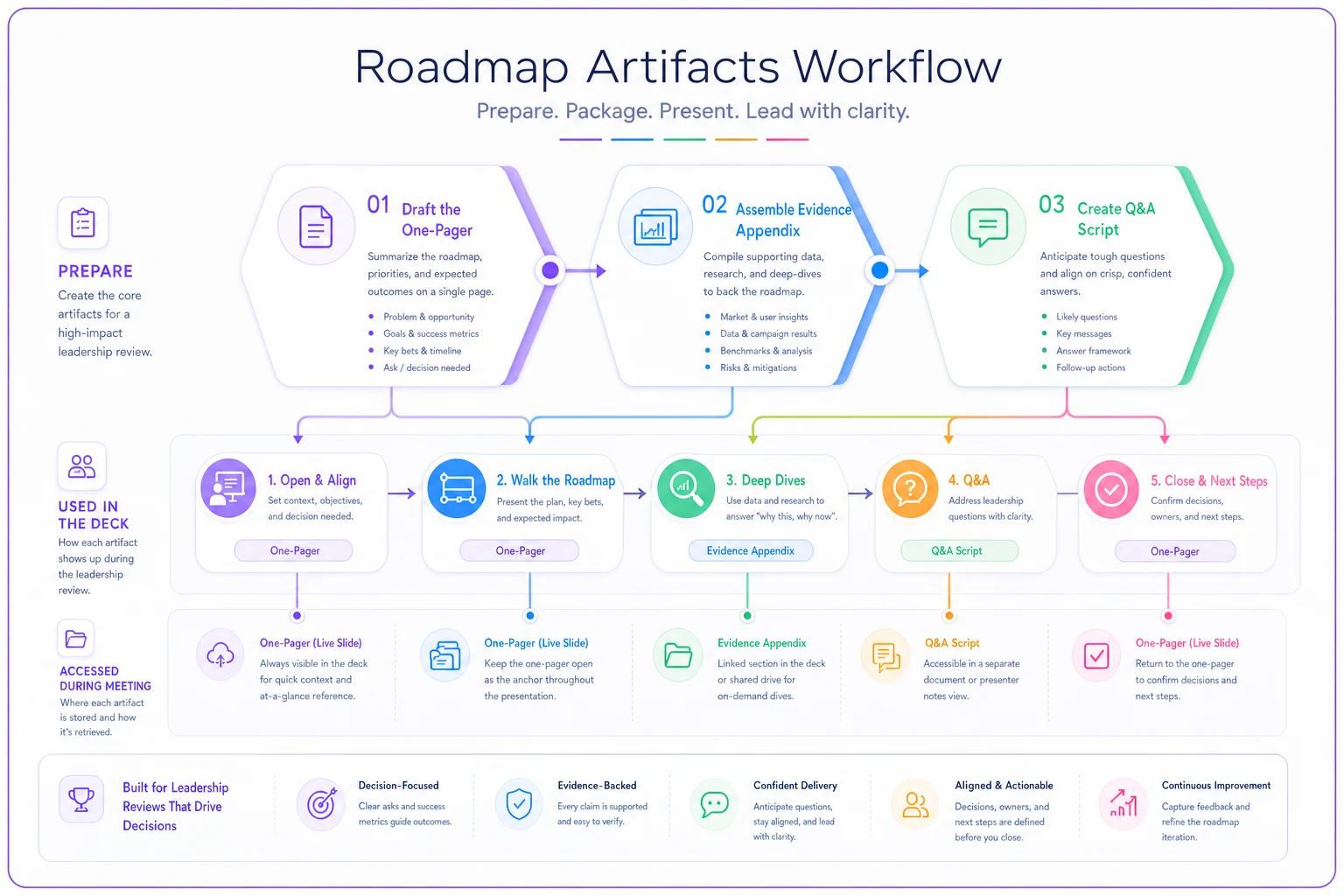
Use this flow to decide what you build first and what stays hidden until it's needed.
The one-pager: Problem → Opportunity → Options → Decision
This is the spine. Every roadmap narrative that survives a leadership review runs on some version of this four-part shape, and it maps almost perfectly onto how executives actually make decisions.
Here's the wireframe you can paste and fill in:
PROBLEM (2–3 sentences)
> What's broken or blocked, stated in business terms, with one number.
> Example: "Onboarding drop-off has crept from ~18% to ~27% over two quarters. Every point of drop-off is roughly $40k–$50k in lost first-year ARR at current volume."
OPPORTUNITY (2–3 sentences)
> What becomes possible if we fix it. Tie it to a company-level goal so it doesn't read as a pet project.
> Example: "Recovering half of that drop-off puts us back on the net-revenue-retention target the board is tracking this year."
OPTIONS (a short table, 2–4 rows)
> This is the part most people skip, and it's the single most valuable block on the page. Showing the roads you didn't take is what stops the "why not X" derail before it starts.
| Option | What it costs | What we get | Why not this |
|---|---|---|---|
| A: Rebuild onboarding flow | ~2 sprints, 1 squad | Addresses root cause | Chosen |
| B: Add in-app guides | ~3 days | Quick, cheap | Treats symptom, drop-off likely returns |
| C: Assign onboarding CSMs | ~2 hires | Human touch | Doesn't scale past current volume |
DECISION (1–2 sentences)
> State the choice and the one condition that would change it.
> Example: "We're going with A. If drop-off doesn't move 5+ points within 6 weeks of launch, we revisit and layer in B."
That last line matters more than it looks. Naming the condition that would reverse your decision makes you sound like someone managing risk, not someone defending turf. Executives trust that voice a lot more.
Naming the condition that would reverse your decision makes you sound like someone managing risk, not someone defending turf.
If you already keep one-page decision records, this one-pager is the outward-facing cousin—same discipline, tuned for an audience that has thirty seconds and a lot of skepticism.
The evidence wireframe: don't make them take your word for it
The evidence slides aren't part of the walk-through. They're what you flip to when someone challenges a claim—which means each one should be built around a single assertion, not a dashboard.
A working pattern for each evidence slide:
-
The claim, as a headline. Not "Onboarding Metrics" but "Drop-off is concentrated in the first 3 steps."
-
One visual that proves it. A funnel, a trend line, a cohort table—whatever directly supports the headline and nothing else.
-
The source and the date. "Product analytics, last 90 days, n≈4,200 signups." Undated evidence gets waved away.
-
One sentence of interpretation. What the reader should conclude, so they don't draw their own.
The failure mode here is the kitchen-sink chart—six metrics on one slide, none of them clearly connected to the argument. When challenged, you're hunting through your own visual for the number, which reads as unpreparedness even when you're right.
A useful rule: one claim, one chart, one sentence. If a slide needs two charts, it's two claims, and it should be two slides.
Keep the evidence slides in an appendix or hidden section. You don't present them—you arrive at them when the room asks. That move alone, flipping instantly to the exact proof for a challenged claim, does more for your credibility than any amount of polish on the main deck.
The Q&A script: anticipating the objections you already know are coming
The hard questions in roadmap reviews are almost never surprises. You know the VP of Sales wants enterprise features. You know the CFO will ask about cost. You know engineering is worried about the migration risk. You just haven't written down your answers, so you re-derive them live under pressure.
The Q&A script fixes that. It's a private document—speaker notes, a hidden slide, whatever format works—structured as objection and response.
-
List the five questions you're most afraid of. The ones you hope nobody asks. Those are exactly the ones to prep.
-
Write the one-sentence answer first, then a supporting fact, then the evidence slide it points to.
-
Include the concession. The most trust-building answers acknowledge what's true in the objection before redirecting. "You're right that this delays SSO by a quarter—here's why that trade still comes out ahead."
> Q: "Why not do enterprise SSO first? That's blocking two deals." > A: "Those two deals are real, roughly $180k combined. But SSO is ~4 sprints and unblocks maybe two more prospects a quarter. The onboarding work is ~2 sprints and touches every signup—around 4,200 last quarter. Same engineering cost, much wider blast radius. SSO is next in line; slide 14 has the sequencing."
The answer doesn't dodge. It grants the deal value, puts a number on the alternative, and points to where the sequencing lives. That's the difference between defending a decision and getting bullied out of one.
The connection between what you build and what leadership prioritizes only holds when your reasoning is visible. If prioritization keeps drifting in these rooms, the deeper fix is an organizational system that surfaces the right bets before you ever get to the review—but a sharp Q&A script is your defense in the meantime.
The rehearsal checklist
Artifacts don't save you if the first time you say the words out loud is in front of the leadership team. A short rehearsal—even fifteen minutes with one colleague playing the skeptic—catches the wobble before it counts.
-
[ ] Can I state the problem in one breath without looking at the slide?
-
[ ] Does my one-pager show at least two options I rejected, with a reason for each?
-
[ ] Is every claim in the narrative backed by an evidence slide I can reach in one click?
-
[ ] Have I written answers to my five scariest questions?
-
[ ] For each hard answer, do I have a number ready, not just a rationale?
-
[ ] Have I named the condition that would reverse my decision?
-
[ ] Did someone play devil's advocate and try to reorder my roadmap live—and did I hold?
-
[ ] Is the main deck skimmable in under two minutes if the meeting gets cut short?
That last item earns its place more often than you'd think. Leadership reviews get compressed constantly—your forty-minute slot becomes twelve. A narrative that collapses gracefully into "problem, opportunity, decision" and still lands is worth more than a beautiful deck that needs the full runtime.
A real scenario
A product team at a ~40-person B2B SaaS company kept losing roadmap arguments in quarterly reviews. Their decks were thorough—too thorough. Twenty-plus slides, dense timelines, every quarter mapped out. And every review, sales leadership would successfully lobby to shove one more enterprise feature to the front, and the carefully sequenced plan would get reshuffled.
The PM rebuilt the next review around the three artifacts. One-pager per major initiative with an explicit options table. Evidence moved to a hidden appendix, one claim per slide. A Q&A script with the six objections she knew were coming, each with a number attached.
The review ran differently. When sales pushed the usual enterprise-first argument, she flipped to the options table—it was already on the page—and walked through the trade in about ninety seconds, ending on "and it's next in the queue, here's the sequencing." The reorder didn't happen. Not because she out-argued anyone, but because the alternative was already visible and already answered.
Over the next couple of quarters the pattern held: fewer live reorders, shorter reviews, and roadmap commitments that actually survived the meeting they were made in. The prep time per review went up by maybe an hour. The re-planning time saved on the back end was considerably more than that.
When this level of rigor is overkill
Not every roadmap conversation needs the full artifact set. Building a one-pager, evidence appendix, and Q&A script for a routine team sync is a waste of an afternoon.
Use the full system when:
-
The audience can reorder or kill your plan.
-
Real budget or headcount rides on the decision.
-
You know specific stakeholders will push back for known reasons.
Skip most of it when:
-
It's an internal working session, not a decision meeting.
-
The room already agrees and you're just aligning on sequence.
-
The stakes are low enough that a live improvised answer costs nothing.
The judgment call is basically: how expensive is it if I lose this argument? The more it costs, the more the artifacts earn their keep.
The point
The roadmap and the argument for the roadmap are two different deliverables, and PMs who get overruled in leadership reviews are usually great at the first and thin on the second. The one-pager makes your thinking skimmable. The evidence wireframes make your claims defensible. The Q&A script keeps you steady when the room gets sharp.
None of it changes what you're building. It changes whether what you're building survives the meeting where someone with more authority than you decides it's negotiable. Write the objections down before they're asked, put the options you rejected on the page, and keep the proof one click away. That's the whole game.
The roadmap and the argument for the roadmap are two different deliverables, and PMs who get overruled in leadership reviews are usually great at the first and thin on the second. The one-pager makes your thinking skimmable. The evidence wireframes make your claims defensible. The Q&A script keeps you steady when the room gets sharp.
Ready to elevate your product management?
Join 2,000+ product teams using Itemyly to accelerate delivery, improve alignment, and build better products.