

A feature shipping to 100% and then just… sitting there is one of the more uncomfortable moments in product work. Everyone celebrated the release. The launch channel got the gif. And then two weeks later someone opens the dashboard and adoption is parked at 4% with no sign of movement.
The instinct usually swings one of two ways. Either the team panics and starts shipping "fixes" based on hunches, or it does nothing and quietly lets the feature rot because admitting it flopped feels worse than ignoring it. Both are expensive. The first burns sprint capacity chasing the wrong cause. The second leaves a half-baked feature in the product that confuses new users and generates support tickets for years.
What most teams are missing is a remediation playbook — a timeboxed, pre-agreed way to figure out why adoption stalled, run a small set of corrective experiments, and hit a hard decision point: recover or roll back. No drama, no indefinite "let's give it another quarter." This post is that playbook.
Why flat adoption gets mishandled
The core problem isn't that teams lack ideas for fixing adoption. It's actually the opposite — everyone has a theory, and none of them get tested in any structured way.
A typical post-launch conversation goes something like this: PM thinks the onboarding tooltip is buried. Design thinks the entry point is in the wrong menu. An engineer swears it's a performance issue on first load. Sales says customers don't even know it exists. All four might be partially right. But without triage, the team picks whichever theory belongs to the loudest person in the room, builds a fix, ships it, and waits another two weeks to find out it didn't matter.
The other failure mode is treating "low adoption" as a single number instead of a chain of drop-offs. Adoption is never one event — it's discovery → first use → repeat use → habitual use. A feature at 4% could be failing at any of those stages, and the fix for each is completely different. A discovery problem needs placement and comms work. A first-use problem usually means the UX itself needs reworking. A repeat-use problem often means the feature technically works but isn't worth the effort for the user.
Teams that recover features fast are the ones that stop arguing about causes and go measure where the chain actually breaks.
Phase 1: Timeboxed root-cause triage (five working days, hard stop)
The first rule is the timebox. Triage gets five working days — not "until we understand it fully," because you will never fully understand it, and the longer triage runs the more it becomes a standing meeting that produces nothing.
Eliminate product chaos and align your team.
Itemyly helps you plan, prioritize, and track every product milestone seamlessly.
- Centralized roadmap management
- Stakeholder collaboration
- Release tracking & analytics
No credit card required
The goal is narrow: locate the single biggest drop-off stage and name the two or three most plausible causes behind it. That's it. Nothing gets fixed in this phase.
Here's the structure that keeps it tight:
Day 1 — Rebuild the funnel. Pull the actual stage-by-stage numbers. Not "adoption is 4%," but:
-
Saw the entry point
62% of active users
-
Clicked into the feature
11%
-
Completed first action
7%
-
Returned within 7 days
2%
The instant you lay it out like this, the argument changes. In the example above, discovery isn't the problem — 62% saw it. The cliff is between seeing (62%) and clicking (11%). That's a relevance or clarity problem at the entry point, not some onboarding issue deeper in the flow. Half the proposed fixes just died, which is exactly what you want.
Day 2–3 — Interrogate the biggest cliff. Take the single worst drop and generate causes, each specific enough to be testable. Vague causes like "users are confused" are useless. Testable causes look like:
-
The entry-point label doesn't communicate value ("Insights" vs "See which customers are about to churn")
-
The feature is gated behind a plan tier most active users don't have
-
The entry point only appears on a screen power users rarely visit
Day 4 — Pull qualitative signal fast. Ten minutes of session replay on users who saw-but-didn't-click tells you more than a week of speculation. Scan five to eight support tickets mentioning the feature. If you have a sales or CS channel, ask one direct question: "When you demo this, what do customers actually say?"
Day 5 — Write the triage summary. One page. The broken stage, the ranked causes, and a confidence level on each. Then stop. Triage is over whether or not it feels complete.
The discipline here mirrors the severity-and-effort thinking most teams already use for incidents — you're just applying it to adoption instead of outages.
Here's a simple visual to keep the five-day flow clear.
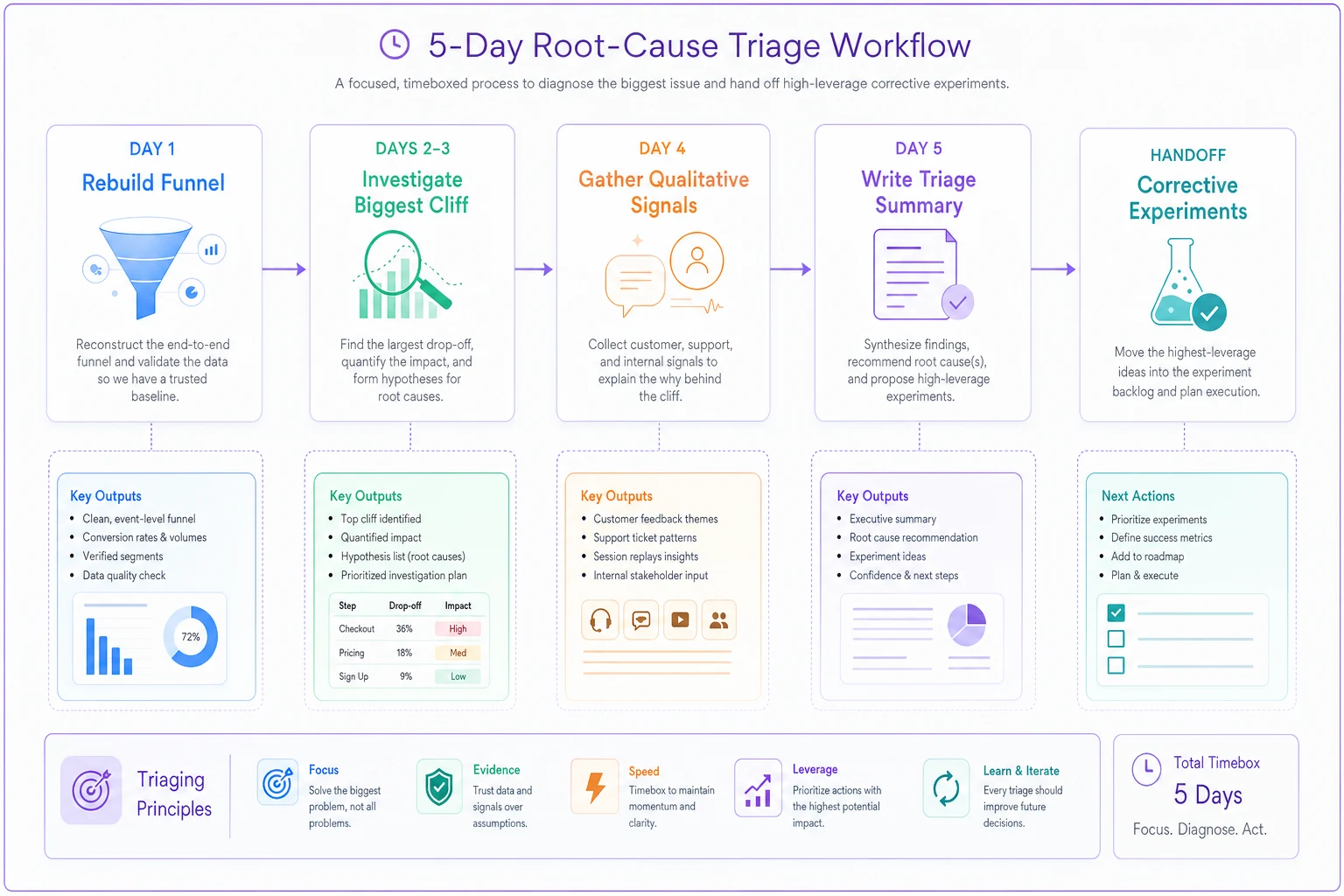
Keep the boxes small and the handoffs explicit so the team can move from triage to experiments without rehashing the same arguments.
Phase 2: Mapping causes to corrective experiments
Every cause from triage gets mapped to exactly one corrective experiment. One cause, one test, one metric. The mistake that kills this phase is bundling — shipping three changes at once "to save time," then having no idea which one moved the number.
The mapping should be explicit enough to paste into a ticket:
| Ranked cause | Corrective experiment | Primary metric | Target to clear |
|---|---|---|---|
| Entry label unclear | A/B the label with value-based copy | Click-through from entry point | Lift from 11% → 20%+ |
| Feature gated by plan tier | Open feature to all tiers for 2 weeks | First-action completion | 7% → 15%+ among newly-eligible |
| Entry point on low-traffic screen | Add secondary entry on dashboard | % of active users who see it | 62% → 80%+ |
If a proposed fix needs a full sprint of engineering, treat it as a separate bet — corrective experiments should be the smallest possible intervention that produces a clear decision.
These are deliberately cheap. Corrective experiments in a remediation phase are not redesigns. They're the smallest possible intervention that can confirm or kill a cause. If a proposed fix needs a full sprint of engineering, it's not a triage experiment — it's a bet, and bets go through your normal validation process. The approach for sizing those lightweight tests is the same one worth using for any roadmap bet: validate with the smallest test that produces a clear decision rather than committing engineering before you understand the cause.
One pattern worth calling out: teams almost always over-engineer the first corrective experiment. Someone wants to rebuild the whole entry flow when swapping a label would've answered the question in four days. Resist it. The point of this phase is cheap evidence, not a finished feature.
Running the experiments on a clock
Each corrective experiment gets its own timebox — usually one to two weeks depending on traffic. Low-traffic features are the hard case. If you only get around 200 users through the entry point per week, you can't run a statistically clean A/B test in two weeks, and pretending otherwise just produces noise.
For low-traffic situations, switch tactics: run the change to 100% and compare against the pre-change baseline, and lean more heavily on qualitative confirmation. It's less rigorous, but a messy signal you can act on beats a clean signal you'll never collect.
Phase 3: Decision thresholds — recover or roll back
This is the part most teams skip, and skipping it is why dead features linger for years. Before you run a single experiment, write down the numbers that will trigger each decision. Deciding the threshold after you see results is how teams talk themselves into keeping things that don't work.
-
Recover (keep investing) At least one corrective experiment cleared its target, and the projected full-funnel adoption now reaches a level that justifies maintenance cost. For a mid-weight feature, that's often repeat-use adoption crossing roughly 15–20% of the relevant segment.
-
Partial recover (narrow the scope) Adoption is real but concentrated in one segment. The feature works for enterprise admins but nobody else — so you keep it for that segment, pull the entry point everywhere else, and stop general investment.
-
Roll back No corrective experiment cleared its target, or the best realistic projection still leaves adoption below the cost-to-maintain line. You remove the feature, clean up the flags, and document why.
The uncomfortable one is rollback, so make the criteria mechanical. A feature that, after two corrective experiments, still can't get repeat-use above low single digits in any segment doesn't have a comms problem. It's a feature the market declined. Keeping it means paying maintenance, support, and onboarding-complexity costs indefinitely for something nobody uses.
Write the rollback threshold in the triage summary, before results come in. That single habit removes most of the emotion from the decision.
A quick note on "give it more time"
"More time" is a legitimate call exactly once, and only when triage shows the funnel is improving on its own — discovery climbing week over week with no intervention. If the curve is flat and nothing you tried moved it, more time is just a slower rollback with extra maintenance cost attached.
Stakeholder scripts that keep this from turning political
Remediation goes sideways when the people who championed the feature feel like rollback is a personal verdict on them. It isn't, but it will feel that way unless you frame it deliberately.
To the exec who asked for the feature, when triage starts:
> "Adoption's parked at 4%, so we're running a two-and-a-half-week remediation pass. We'll test the three most likely causes with cheap experiments and come back with a recover-or-rollback recommendation and the numbers behind it. No guessing, no open-ended investment."
To engineering, when scoping corrective experiments:
> "These aren't redesigns. Each one is the smallest change that tells us whether a specific cause is real. If a fix needs more than a few days, flag it — that's a separate bet, not a triage experiment."
To the room, when recommending rollback:
> "Two corrective experiments, neither cleared threshold, repeat use never got above 3% in any segment. The market told us. Rolling back saves us the maintenance and removes a confusing path for new users. Here's the cleanup ticket."
The framing that matters most: remediation is a process the feature goes through, not a trial of the people who built it. Say that explicitly and most of the defensiveness disappears.
Sample tickets you can lift directly
Keeping the whole remediation visible in tickets is what prevents it from dissolving into hallway conversations.
Triage ticket
-
Title [Remediation] Triage — <feature> adoption stalled at <x>%
-
Timebox 5 working days, closes <date>
-
Deliverable One-page summary — broken funnel stage, ranked causes, confidence levels, written recover/rollback thresholds
-
Owner <PM>
-
Definition of done Summary posted + review booked. No fixes in this ticket.
Corrective experiment ticket
-
Title [Remediation] Experiment — <cause being tested>
-
Hypothesis If <change>, then <metric> moves from <baseline> to <target>
-
Timebox <1–2 weeks>, closes <date>
-
Primary metric + target <metric> clears <number>
-
Rule One change only. No bundling.
Decision ticket
-
Title [Remediation] Decision — recover / partial / rollback <feature>
-
Inputs links to triage summary + all experiment tickets
-
Threshold reminder <paste the pre-written thresholds>
-
Outcome decision + rationale + follow-up ticket (scope-up, narrow, or rollback-and-cleanup)
Linking these three ticket types gives anyone — including the exec who asks three weeks later — the whole story in thirty seconds.
A realistic example
A B2B scheduling tool shipped a "team availability heatmap" aimed at ops managers. Rolled out to everyone, celebrated, then flat. About six weeks post-launch it was sitting at roughly 5% repeat use.
Triage rebuilt the funnel and found the cliff immediately: around 70% of active users saw the entry point, but only about 9% clicked through. Deep-flow onboarding theories were dead on arrival — the problem was the entry point itself. Session replay showed people hovering on the "Team Heatmap" label and moving on. The ranked causes came down to label clarity and the fact that it lived in a reporting menu ops managers rarely opened.
Two corrective experiments, one week each. Experiment one swapped the label to "See who's overbooked this week." Experiment two added a secondary entry on the main dashboard. The label change pushed click-through from roughly 9% to the high teens. The dashboard entry pushed visibility up but barely moved clicks on its own.
Decision point: the label experiment cleared its threshold, repeat use climbed to around 17% among ops managers, and the team chose partial recover — keep it, lead with the value-based label, drop the redundant reporting-menu entry. Total elapsed time from "this is dead" to a documented decision was about two and a half weeks, versus the quarter-plus these things usually drift for.
The feature wasn't broken. The way users met it was. Triage is what separated those two very different problems — and the timebox is what kept the team from arguing about it for three months.
When this playbook fits — and when it doesn't
Use it when: a feature launched to real traffic, had clear adoption expectations, and underperformed them with no obvious cause everyone agrees on. That's the sweet spot — a genuine mystery with enough usage to measure.
Skip it when: the feature is a known compliance or infrastructure requirement that has to exist regardless of adoption. Running a rollback-threshold process on something you're legally required to ship just wastes everyone's time.
Be careful when: traffic is too low for any signal at all. Below a few hundred weekly users through the entry point, lean almost entirely on qualitative work and treat the numbers as directional. Don't dress up noise as a clean result.
One honest caveat worth stating plainly: this process assumes your adoption instrumentation actually works. If you can't rebuild the funnel stage by stage on day one, the real problem is measurement, not adoption — and that gets fixed before any of this is possible.
Closing thought
The reason flat features linger isn't that teams don't care. It's that nobody set a clock or a rule, so "we'll figure out the adoption thing" becomes a permanent background task that never resolves. A remediation playbook replaces that with a short, bounded process: five days to find the broken stage, a couple weeks to test the likely causes, and a pre-written threshold that forces an actual decision at the end.
It pairs naturally with how you coordinate the people side of a release — the same discipline that turns cross-team launches from chaos into predictable releases applies here, just pointed at recovery instead of launch. Decide the thresholds before the results arrive, keep every step in a ticket, and give the team permission to roll back without it feeling like a failure. The feature either earns its place over the next three weeks, or you free up the capacity it was quietly consuming.
Ready to elevate your product management?
Join 2,000+ product teams using Itemyly to accelerate delivery, improve alignment, and build better products.