

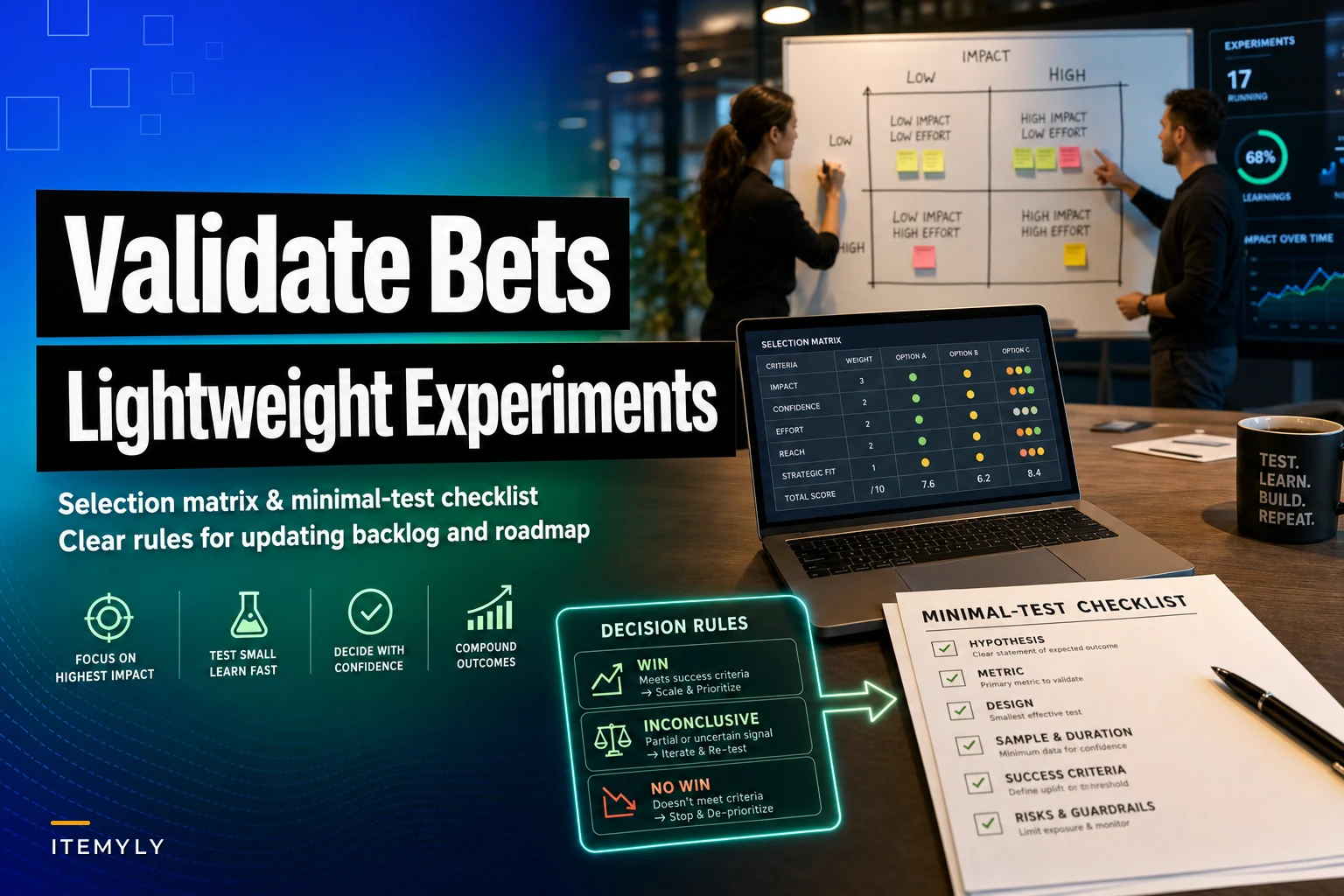

Your roadmap has fifteen major bets for next quarter. Each one represents weeks of engineering time. And yet — somewhere between 60-80% of features deliver minimal value after launch. That number gets cited a lot, but most teams still don't change their behavior.
The problem isn't that the ideas are bad. It's that they ship without validation.
Most teams know they should be running experiments before committing to builds. The execution falls apart immediately. Which bets actually need experiments? How minimal is "minimal"? And when results come back murky, what actually changes on the roadmap?
Without clear frameworks, teams either test nothing or test everything. Both extremes are expensive.
The selection matrix: which roadmap items actually need experiments
Not everything on your roadmap needs an experiment. Regulatory requirements, critical bug fixes, obviously necessary improvements — testing those wastes cycles.
| Quadrant | Guidance |
|---|---|
| High uncertainty + High effort = Always experiment | These are your riskiest bets. A new recommendation engine requiring three sprints. A workflow redesign touching multiple systems. A pricing change affecting all customers. |
| High uncertainty + Low effort = Quick validation | Small features with unclear value. A new dashboard widget, an additional filter, a notification preference. Lightweight validation, but shouldn't block progress. |
| Low uncertainty + High effort = Validate scope, not concept | Infrastructure work, performance improvements, security updates. The need is obvious but the scope can bloat. Test how much improvement users actually notice before you go deep. |
| Low uncertainty + Low effort = Ship and monitor | Bug fixes, minor UI changes, documentation. The overhead of experimentation exceeds the risk of being wrong. |
The matrix forces explicit decisions. At a logistics platform during quarterly planning, the team had twenty-two proposed features. After applying this framework, seven needed proper experiments, five got quick validation tests, six shipped directly, and four got cut entirely when the effort-to-uncertainty math looked bad.
Here's a quick visual of the decision workflow.
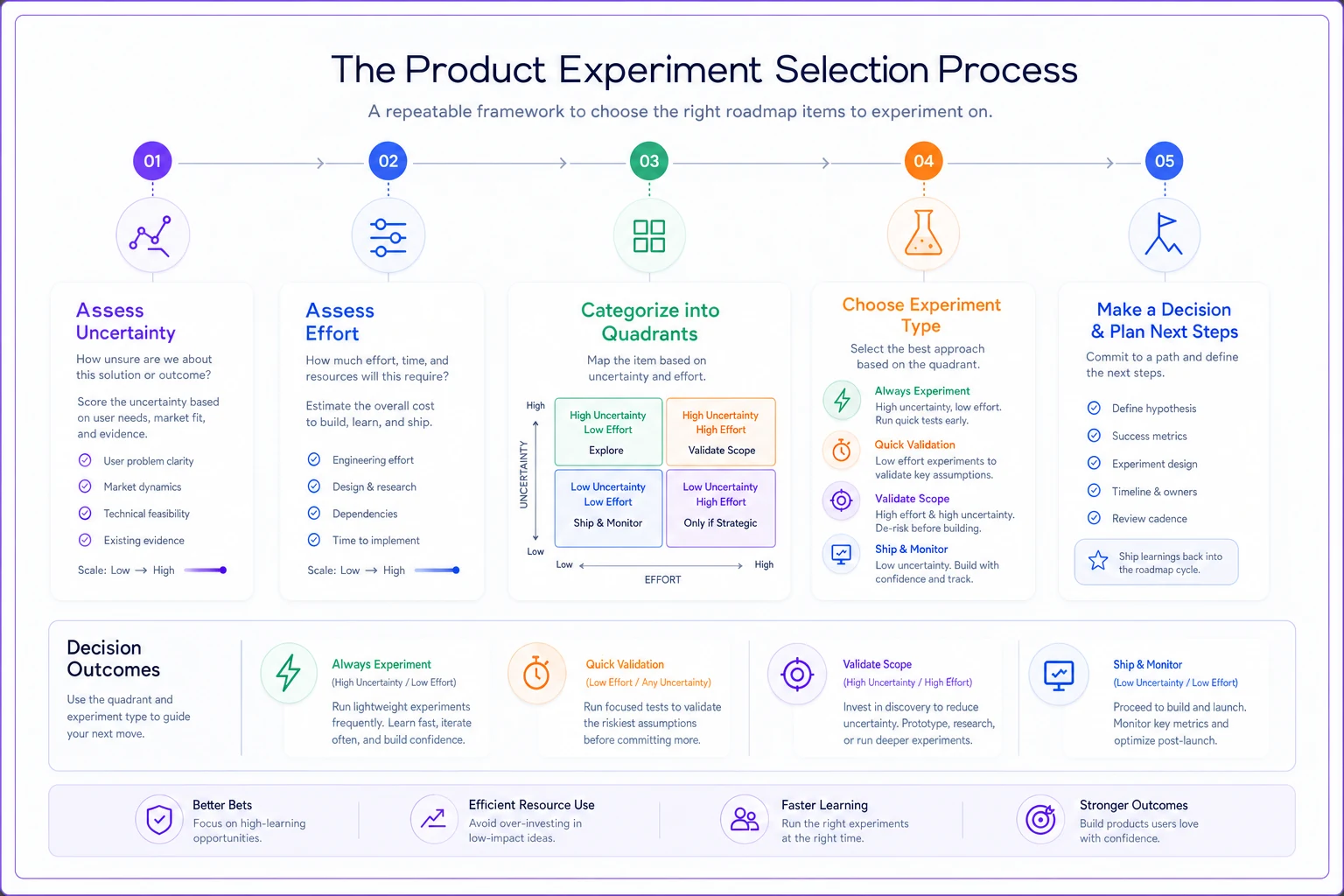
At a logistics platform during quarterly planning, the team had twenty-two proposed features. After applying this framework, seven needed proper experiments, five got quick validation tests, six shipped directly, and four got cut entirely when the effort-to-uncertainty math looked bad.
Building your minimal test: the pre-code validation checklist
Once you know which bets need experiments, the next trap shows up: over-engineering the test.
Eliminate product chaos and align your team.
Itemyly helps you plan, prioritize, and track every product milestone seamlessly.
- Centralized roadmap management
- Stakeholder collaboration
- Release tracking & analytics
No credit card required
Teams spend weeks building "MVP experiments" that are basically full features without polish. That's not experimentation — it's just incremental shipping with extra steps.
The assumption extraction process:
-
Write down what must be true for this feature to succeed
-
Identify the riskiest assumption (usually something about user behavior)
-
Find the cheapest way to test just that assumption
-
Ignore everything else about the feature for now
When in doubt, pick the cheapest possible test that could falsify the riskiest assumption.
One B2B platform wanted to build an AI-powered contract review feature. Initial plans involved weeks of integration work. But the riskiest assumption was simple: would users actually trust AI recommendations on legal documents?
Their minimal test: manually reviewed fifty contracts, generated recommendations in a spreadsheet, sent them to users as "automated insights" via email. Zero code. Eight hours of manual work. Engagement rate came back at 4%. Feature killed before a single line was written.
Common minimal test patterns:
-
Concierge test
Manually perform what the software would automate. Works well for workflow features.
-
Fake door test
Add the UI element, show "coming soon" when clicked. Measures real intent versus what users say they want.
-
Prototype simulation
Use existing tools to mock the experience. Spreadsheets, forms, and email can simulate surprisingly complex features.
-
Limited cohort
Build for five users instead of five thousand. Enough for behavioral validation.
-
Time-boxed pilot
Full feature, but only available for two weeks. Forces quick learning without permanent commitment.
The test only needs to answer one question: will users change their behavior? Not whether your solution is polished.
Decision rules: how experiment outcomes actually change the roadmap
This is where most experiment programs fall apart. The test runs, data comes back, and nothing changes. The feature ships anyway because "we already planned for it" or "the results were mixed."
Pre-commit to outcome scenarios:
Strong positive signal (>40% engagement):
-
Ship as planned
-
Consider expanding scope
-
Look for adjacent opportunities
Moderate positive signal (15-40% engagement):
-
Ship with reduced scope
-
Add instrumentation
-
Plan follow-up iterations
Weak signal (5-15% engagement):
-
Pivot to a different solution for the same problem
-
Move to backlog
-
Combine with other features
Negative signal (<5% engagement):
-
Kill it
-
Document the learning
-
Reallocate resources
These thresholds shift depending on feature type and business model, but having actual numbers is what prevents post-hoc rationalization.
A marketplace startup tested a seller analytics dashboard with a clear pre-commitment: over 30% weekly active usage meant full build, 10-30% meant basic version only, under 10% meant killing it. Results showed 8% usage. Sales had already been promising this feature to prospects. They killed it anyway and redirected effort toward seller onboarding.
The documentation matters too. Write down the original hypothesis, the test methodology, actual results, the decision made, and the rationale if you deviated from the pre-set rules. This creates organizational memory and cuts down on repeated mistakes.
The coordination overhead most teams miss
Running experiments for roadmap validation isn't just about the test itself. The operational burden can quietly kill the whole program.
Timeline coordination challenges:
Experiments need results before development starts, but roadmap planning happens quarterly. That creates a persistent timing mismatch — teams either rush experiments (bad data) or delay development (missed commitments).
Fix: rolling experimentation windows. Instead of batching everything at quarter start, run continuously with six-week cycles. Each cycle validates bets for the following quarter, creating a natural pipeline.
Stakeholder communication patterns:
Product marketing needs to know what might ship. Sales wants to promise features. Engineering needs capacity planning. Customer success needs training materials.
When experiments might kill or significantly change features, these dependencies create friction fast. One enterprise software company had seventeen stakeholders requiring updates on every major experiment. The communication overhead exceeded the experiment work.
Their fix: a simple experiment roster. One page showing all active experiments, status, decision dates, and shipping probability (high/medium/low/killed). Updated weekly, shared async. Stakeholders subscribed to specific experiments for detailed updates.
Resource allocation:
Who actually runs these experiments? PMs are already stretched. Engineers don't want to build throwaway code. Designers resist mockups that might never ship.
The answer varies by company size, but the pattern holds: dedicated experimentation capacity. One engineer who loves prototyping. A growth PM focused on validation. Ops people who can run concierge tests. Protected time for validation work specifically.
When the minimal test reveals maximum problems
Sometimes experiments surface problems that go well beyond the feature being tested.
A project management platform tested a new automation feature with twenty beta users. Engagement was decent, but support tickets revealed something more fundamental: users didn't understand the existing automation features at all. The experiment accidentally exposed a massive documentation and onboarding gap.
This happens more often than you'd expect. Experiments surface workflow confusion affecting multiple features, data quality issues blocking any analytics from working, permission models that block adoption entirely, performance problems masked by low usage.
The experiment might fail, but what it uncovers reshapes roadmap priorities in ways that matter more than the original feature.
The compound effect of systematic validation:
After running experiments for six months, patterns start to emerge. Enterprise users engage with completely different features than SMB users. Features requested by sales rarely get adopted. UI changes consistently outperform new functionality.
A fintech company discovered through repeated experiments that users would try almost anything presented as "limited time beta access" — but ignored the same features when permanently available. They restructured their entire release strategy around that single insight.
The operational reality of experiment-driven roadmaps
Running systematic validation requires more than frameworks. It demands cultural shifts that a lot of organizations resist.
Engineers complain about building "fake" features. They want to write production code, not prototypes. Rotating who does experimentation work helps. Celebrating killed features as wins — resources saved, not ideas failed — helps more.
Sales teams panic when promised features get cut after experiments. They've already sold the vision to prospects. The fix is simpler than most teams think: stop promising experimental features. Use "exploring," "considering," and "researching" instead of "building" or "launching."
Executives question the timeline impact. Experiments feel slow. The counter-argument: show the cost of failed features. One abandoned feature typically equals five to ten experiments worth of capacity. The math becomes obvious.
Integration with existing planning cycles:
-
Quarter minus 6 weeks
Identify next quarter's bets requiring validation
-
Quarter minus 4 weeks
Launch minimal tests
-
Quarter minus 2 weeks
Gather results and make decisions
-
Quarter start
Commit to the validated roadmap
This creates buffer for experiments that need more time while keeping planning predictable.
On tooling — most teams don't need specialized experimentation platforms. Existing tools handle the majority of validation needs:
-
Feature flags for fake door tests
-
Analytics platforms for engagement tracking
-
Forms and spreadsheets for concierge tests
-
Email tools for prototype simulations
-
Staging environments for limited pilots
Specialized tooling only makes sense when you're running dozens of concurrent experiments.
Clear rules beat perfect data
The biggest mistake teams make: waiting for statistical significance that never arrives.
If your B2B product has eight hundred users, you're never reaching textbook statistical significance on most experiments. The goal isn't a research paper — it's better product decisions.
Focus on directional clarity instead:
-
Did anyone use the feature unprompted?
-
Did users complete the intended workflow?
-
Would they notice if you removed it tomorrow?
-
Did it actually solve the original problem?
A document management company tested an AI summarization feature with twelve customers. Not statistically significant by any measure. But when ten of the twelve immediately asked how to disable it because the summaries were misleading, the direction was clear. Feature killed.
The experiment portfolio approach:
-
High-stakes experiments (20% of tests)
Maximum rigor, larger samples, longer duration. For fundamental strategy changes or major investments.
-
Standard validations (60% of tests)
Basic rigor, representative users, one-to-two week duration. Most feature validation lives here.
-
Directional indicators (20% of tests)
Minimal rigor, handful of users, days not weeks. Quick gut checks and assumption testing.
This prevents over-investing in minor features while making sure critical bets get proper attention.
Making experiment results stick
The final challenge: organizational memory. Teams run solid experiments, make smart decisions, then six months later propose the exact same failed feature with a different name.
The experiment repository pattern:
-
Feature tested
-
Date range
-
Methodology
-
Results
-
Decision
-
Key learnings
Before proposing any new feature, check if something similar was already tested. One collaboration platform discovered they'd tested variations of "smart notifications" four times over two years. Each failed for the same reason: users wanted fewer notifications, not smarter ones.
Success metrics that actually matter:
-
Percentage of major features validated before build
-
Resources saved from killed features
-
Cycle time from idea to validation decision
-
Accuracy of positive predictions (did validated features actually succeed post-launch?)
One team tracked a straightforward metric: engineering weeks saved from killed features. After one year, they'd saved roughly forty-two engineering weeks by killing seven features pre-build. That's close to an entire engineer's annual capacity redirected toward work that mattered.
The competitive advantage of validation discipline
Companies that systematically run experiments for roadmap validation ship fewer features but get dramatically better outcomes. Less time wasted on unused functionality. More unexpected user needs discovered. More organizational confidence in the bets that do get made.
One CPO called it "product intuition infrastructure" — the systematic ability to test assumptions quickly and course-correct based on evidence rather than politics.
The framework here — selection matrix, minimal test checklist, clear decision rules — removes the ambiguity from experimentation. You know what to test, how to test it efficiently, and what to do when results come back.
Start with your next quarter's roadmap. Pick the three highest-risk bets. Design minimal tests that validate core assumptions without building features. Pre-commit to decision thresholds. Run the experiments. Follow the rules you set.
The first killed feature feels like failure. By the tenth, it feels like discipline. The avoided waste funds the experiments that discover what users actually need. That's how good products get built — not through perfect planning but through systematic validation and honest course correction based on real behavior.
Ready to elevate your product management?
Join 2,000+ product teams using Itemyly to accelerate delivery, improve alignment, and build better products.