


There's a strange gap in how most product teams treat public roadmaps. Internally, everyone knows a roadmap is a set of intentions that shift constantly. Externally, once you publish "Q3: SSO support" on a customer-facing page, a subset of your customers will treat that line as a promise—and a smaller, more dangerous subset will treat it as a term they can point to in a renewal negotiation or, in the worst cases, a legal dispute.
Most PMs don't find out about this gap until it bites. A large account delays payment because a roadmapped feature slipped. A prospect's procurement team screenshots your public roadmap and attaches it to the MSA as an expectation. Sales quotes your own roadmap back to you in a QBR. The roadmap was supposed to build trust and reduce inbound questions. Instead it created a paper trail of commitments nobody in product actually agreed to be held to.
This isn't an argument against public roadmaps. Transparency wins deals and reduces support noise. The problem is that most teams publish roadmaps with one level of commitment—a flat list of things "coming soon"—when what they actually need is a customer-facing roadmap policy that separates what they're merely exploring from what they're genuinely committing to, with language and governance that matches each tier.
Why a flat public roadmap turns into a liability
The core issue is that a roadmap serves two audiences with opposite needs, and a flat list serves neither well.
Customers want certainty. They're making buying and adoption decisions and they want to know what's real. Your team wants flexibility, because priorities shift with every incident, every big deal, every reprioritization. When you publish a single undifferentiated list, you're implicitly telling customers "all of this is equally real," which is never true. Some items are near-shipped. Some are a designer's rough idea from a planning offsite. Both look identical on the page.
A few patterns make this worse as the company grows:
-
Sales starts treating the roadmap as a sales asset. Reps link to it, quote it, and occasionally promise dates that appear nowhere on it. The roadmap becomes a shared surface that product no longer fully controls.
-
Legal and finance get involved late. Nobody loops in legal when a public roadmap goes live. They find out when a customer's counsel cites it during a dispute over a service credit.
-
The roadmap outlives the intention. An item sits on the public page for eight months after the team quietly killed it. Now you have a published commitment with zero internal owner.
The failure usually isn't one bad promise. It's the slow accumulation of vague, un-owned, un-dated statements that customers reasonably interpret as commitments—and that your own account teams reinforce.
The legal exposure most PMs underestimate
You don't need to be a lawyer to understand the shape of the risk, and you shouldn't let "that's legal's problem" be the reason you avoid it.
Eliminate product chaos and align your team.
Itemyly helps you plan, prioritize, and track every product milestone seamlessly.
- Centralized roadmap management
- Stakeholder collaboration
- Release tracking & analytics
No credit card required
Two things create exposure. First, specificity plus a date plus a channel a customer relied on. "We will deliver X by Q3" published on your official site, cited by your sales team, is materially different from "we're exploring X." The more specific and dated the statement, the easier it is for a customer to argue reliance. Second, inconsistency between the roadmap and your contracts. If your MSA disclaims all forward-looking statements but your sales deck pins hard dates from the roadmap, you've undercut your own protection.
-
A customer withholds payment or demands a discount because a roadmapped item slipped.
-
A prospect makes the roadmap item a contractual condition, and now delivery slipping breaches the contract—not just the roadmap.
-
In regulated contexts, forward-looking product claims intersect with advertising and accuracy rules, which is a separate governance thread worth understanding if your product touches consumer protection surfaces.
The fix is not to hide everything behind mush. Vague roadmaps frustrate customers and don't actually protect you—courts and negotiators look at the whole pattern of behavior, not just the disclaimer at the bottom. The fix is a tiered system where each level of transparency comes with matched commitment language and matched governance.
Tiered transparency: the core of the policy
The whole model rests on one idea: not everything on your roadmap deserves the same level of promise, so it shouldn't get the same language, the same channel, or the same review.
Here's a working four-tier structure you can adapt.
| Tier | What it means internally | What customers see | Commitment language | Governance |
|---|---|---|---|---|
| Exploring | Ideas under research, no committed capacity | Themes only, no dates, no feature names if sensitive | "We're exploring…" / "Areas of interest" | PM can publish freely; no legal review |
| Planned | Prioritized, has an owner, roughly scoped | Feature described, coarse timeframe (e.g. "this half") | "We intend to…" / "Currently planned for…" | PM + product lead sign-off |
| Committed | Funded, in delivery, has a delivery band | Feature + target window, clearly marked as non-binding | "We are working to deliver… target window… not a contractual commitment" | Product lead + legal review; date sourced from capacity forecast |
| Shipped/Rolling out | Live or in staged rollout | Availability + rollout status | Present-tense, factual | Standard release process |
A few things make this actually work rather than becoming decoration:
The tiers map to real internal states. "Committed" should never be a marketing choice. It should mean the item is funded and has a defensible delivery band, ideally coming out of a capacity-forecasting model rather than a wish. If your "committed" tier is just optimism with better fonts, the policy fails on first contact with reality.
Dates only appear where you can defend them. The "Exploring" and most of the "Planned" tier should carry no hard dates. Dates are the single biggest source of both customer frustration and legal exposure, so they're rationed to items where you have genuine forecasting confidence.
Language is fixed per tier. PMs don't freehand commitment phrasing. Each tier has approved language, which brings us to the templates.
Pasteable roadmap language, per tier
The point of standardized language is that PMs stop inventing phrasing under pressure. Paste these, adjust the specifics, and you stay inside the guardrails.
> "This reflects areas we're currently researching. It does not represent committed work, and inclusion here doesn't mean we'll build it. Priorities change based on customer needs and other factors."
> "This capability is currently planned. Timing is approximate and may shift. This is a statement of current intent, not a commitment to deliver by any specific date."
> "We're actively working to deliver this capability, targeting [window, e.g. 'the second half of the year']. While we're confident in this direction, timelines are targets and not contractual commitments. Availability may vary and features may change during development."
> "This roadmap is provided for informational purposes and represents our current thinking. It may change at any time without notice. Nothing here constitutes a commitment, promise, or legal obligation, and it should not be relied upon when making purchasing decisions. Contractual commitments, if any, are governed solely by your agreement with us."
> "Do not quote hard dates from this roadmap. Do not attach the roadmap to contracts, order forms, or MSAs. If a customer requests a delivery commitment, route to [product/legal contact]. Only 'Committed' tier items may be discussed as near-term, and only with the standard non-binding caveat."
That last one matters more than teams expect. A large share of roadmap-related legal exposure originates from sales reinforcing the roadmap in ways product never intended. The document is only half the control; the behavior around it is the other half.
The governance workflow that keeps it honest
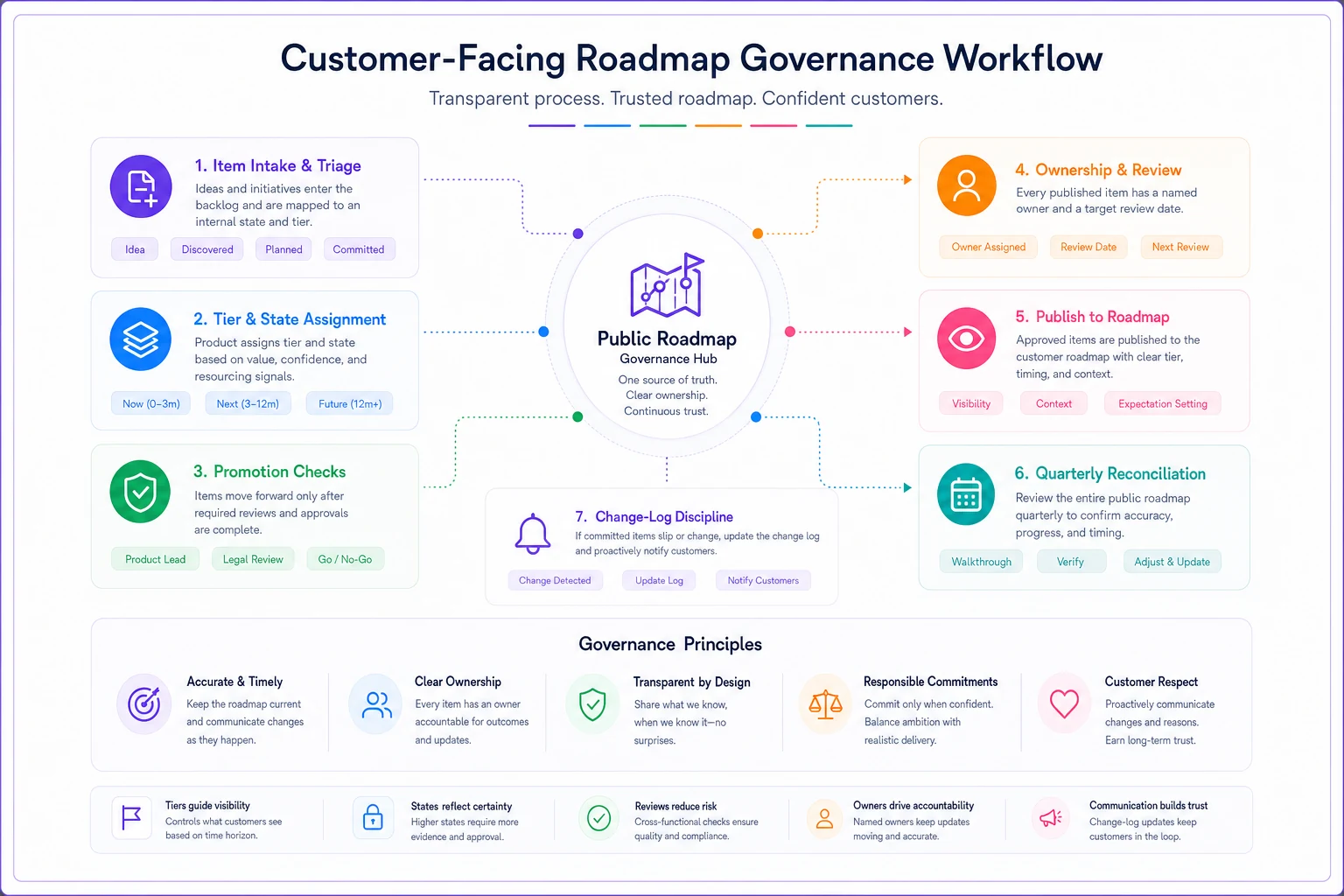
A policy that lives in a Google Doc nobody follows is worse than no policy, because it gives false comfort. Here's the workflow that keeps the tiers meaningful over time.
-
Item enters the roadmap at a tier tied to its internal state. No item skips straight to "Committed" without funding and a delivery band. The tier is set by the owning PM based on defined criteria, not vibes.
-
Promotion between tiers requires a check. Moving an item from "Planned" to "Committed" triggers a lightweight review—product lead confirms funding and forecast, legal confirms the public language matches. This is the single highest-leverage gate in the whole system.
-
Every published item has a named owner and a review date. Un-owned items are how stale commitments live on your public page for months. If an item has no owner, it comes down.
-
Quarterly roadmap reconciliation. Someone walks the entire public roadmap and asks, per item: is this still true, is the tier still right, is the owner still here, has this quietly died? Killed items get an explicit "no longer planned" treatment, not silent deletion—silent deletion is what makes customers feel deceived.
-
Change-log discipline for anything customer-facing. When a committed item slips or changes, you communicate the change proactively. The same coordination discipline that keeps you from breaking clients during API change management and versioning applies to roadmap commitments customers are building plans around.
The reconciliation step is the one teams skip, and it's the one that prevents the slow rot. A roadmap that's reviewed quarterly stays defensible. A roadmap that's published once and forgotten becomes a graveyard of implied promises.
Here's a simple visual of that governance workflow.
Make the promotion gate a calendar event or mandatory ticket update so it can't be bypassed.
The reconciliation step is the one teams skip, and it's the one that prevents the slow rot. A roadmap that's reviewed quarterly stays defensible. A roadmap that's published once and forgotten becomes a graveyard of implied promises.
A quick governance checklist before you publish
Run through this before any public roadmap goes live or gets a major update:
-
Every item is assigned to a tier, and the tier matches its real internal state
-
No hard dates appear on "Exploring" or "Planned" items
-
"Committed" dates trace back to an actual delivery forecast, not a hope
-
Each item has a named owner and a next-review date
-
The global disclaimer is present and legally reviewed
-
Tier-appropriate language is used verbatim, not freehanded
-
Sales enablement has the internal "how to talk about this" note
-
Legal has reviewed at least the "Committed" tier language and the global disclaimer
-
There's a documented process for how killed items are communicated, not just deleted
-
The roadmap links to, and is consistent with, your actual contract terms
If you can't check most of these, you don't have a roadmap policy—you have a public wishlist with legal exposure attached.
A realistic scenario
Consider a mid-market B2B SaaS company, maybe 40 people, selling into finance and operations teams. They ran a public roadmap as a single Trello-style board with three columns: "Now," "Next," "Later." Clean, popular internally, linked heavily by sales.
The problem showed up during a renewal with one of their larger accounts—roughly $90k ARR. A feature that had sat in "Next" for two quarters slipped. The customer's ops lead had built a rollout plan around it and, during the renewal, pushed for a discount citing the roadmap. Their procurement team had also, months earlier, attached a screenshot of the "Next" column to an internal expectations doc. Nothing was contractual, but the negotiation got ugly and cost the account team weeks plus a low-four-figure credit to keep things civil.
They restructured into a tiered model over about a month. Not complicated—they mapped their existing "Now/Next/Later" to "Committed/Planned/Exploring," stripped dates off everything except a small set of genuinely funded items, added the standard disclaimers and the sales-facing internal note, and started a monthly reconciliation.
The changes were undramatic but real. Roadmap-related "when is this coming" tickets dropped noticeably because customers could now tell what was actually near-term versus speculative. Sales stopped quoting soft dates because the enablement note gave them a script for handling those requests. And during the next contentious renewal, the account team could point to clearly-labeled tiers and a disclaimer that had been consistent for months—the conversation stayed about value, not broken promises. No dramatic revenue jump. Just materially less friction and a lot less exposure.
When tiered transparency makes sense—and when it doesn't
When this is worth the effort:
-
You sell to businesses, especially mid-market and enterprise, where procurement and legal scrutinize forward-looking statements
-
Your sales team actively uses the roadmap in deals
-
You've had at least one uncomfortable "but you promised" conversation
-
Your roadmap is public or shared broadly with customers
When this is probably overkill:
-
You're a small consumer product with no contracts and no procurement involvement
-
Your "roadmap" is genuinely just a public voting board with no dates or implied timelines
-
You have fewer than a handful of customers and every commitment is already handled in direct conversation
Who should be careful before adopting this:
Very early-stage teams sometimes over-govern too soon. If you're pre-product-market-fit and shipping weekly, a heavy tiered policy can slow you down without protecting against risk you don't yet have. Start with just two tiers—"Exploring" and "Committed"—and a single disclaimer. Add the middle tiers and reconciliation cadence as your customer base and contract complexity grow.
Keeping the roadmap consistent with the story you tell leadership
One last thread that's easy to miss: your public roadmap has to stay consistent with the internal narratives you're telling executives and the deals your sales team is closing. When the story leadership hears diverges from what's published for customers, the gaps become obvious fast—usually at the worst moment, in a customer meeting.
The same rigor you'd put into an internal executive roadmap narrative should inform the public tiers. If leadership is being told an item is "committed for Q3," the public roadmap shouldn't call it "exploring," and vice versa. Alignment across these surfaces is what makes the whole system trustworthy—internally and externally.
A customer-facing roadmap policy isn't about lawyering up or going vague. It's about matching the level of promise you make to the level of certainty you actually have, saying it in consistent language, and governing it so the tiers stay true over time. Do that, and the roadmap goes back to doing what you wanted it to do in the first place—building trust—without quietly writing checks your delivery team never agreed to cash.
Ready to elevate your product management?
Join 2,000+ product teams using Itemyly to accelerate delivery, improve alignment, and build better products.