


Most compliance checklists fail for the opposite reason people think. They don't fail because they're too loose. They fail because they treat a copy change to a marketing page and a change to how you store payment tokens with the exact same 40-item checklist. So the team learns to rubber-stamp it. By month three, everyone clicks "yes, reviewed" on all 40 items in under two minutes, and the whole thing becomes theater. The fix isn't more rigor everywhere. It's putting rigor where the risk actually lives. That's what a risk-tiered compliance launch checklist does — it sorts releases into tiers, attaches a specific set of required artifacts to each tier, and defines what happens when something doesn't fit the mold.
Why one-size-fits-all compliance gates rot
The pattern is predictable. Legal or security ships a launch checklist. It's thorough because it has to cover the scariest possible release. Every launch inherits it.
Then a PM tries to ship a button color change and gets asked to attach a Data Protection Impact Assessment. They laugh, skip it, and ship anyway. Now the checklist has been broken once, informally, and everyone knows it. The next skip is easier. Within a quarter the checklist is something people work around rather than through.
What happens on teams that ship frequently: the checklist that covers everything ends up enforcing nothing. The signal drowns. When a genuinely risky change comes along — say, a new third-party data processor — it moves through the same numb, auto-approved pipeline as everything else.
Risk tiering solves this by making the checklist proportional. A low-risk change should feel almost frictionless. A high-risk change should feel appropriately slow. The friction is the feature, but only where it belongs.
The three-tier model that holds up
You don't need seven tiers. Three works for almost every product org, and adding more just recreates the rubber-stamp problem in a new form. Here's the breakdown worth starting with.
Eliminate product chaos and align your team.
Itemyly helps you plan, prioritize, and track every product milestone seamlessly.
- Centralized roadmap management
- Stakeholder collaboration
- Release tracking & analytics
No credit card required
| Tier | What triggers it | Approval needed | Timeline before launch |
|---|---|---|---|
| Tier 1 – Low | UI/copy changes, internal tooling, non-user-facing refactors, config with no data impact | PM self-certify | Same day |
| Tier 2 – Medium | New user data fields, changes to existing data flows, new feature touching PII, new external API consumed | PM + one reviewer (security or legal) | 3–5 business days |
| Tier 3 – High | New data processor/subprocessor, payment/PCI scope changes, changes to consent, health/financial data, anything regulated (GDPR, HIPAA, SOC 2 controls) | PM + security + legal + sign-off from a named accountable exec | 10–15 business days |
The trigger column is the part most teams get wrong. They define tiers by vague severity ("high impact"), which means every PM classifies their own launch as low because nobody thinks their work is risky. Define tiers by concrete triggers — specific data types, specific integrations, specific regulatory categories. If a change touches any Tier 3 trigger, it's Tier 3 even if everything else about it feels small.
A quick example of how this plays out in practice. A team classified a "small" feature — letting users export their activity to CSV — as Tier 1 because it was "just an export button." But the export pulled fields that included email and rough location. That's a data flow change touching PII. It was Tier 2 minimum, arguably Tier 3 depending on jurisdiction. Concrete triggers would have caught it. Vague severity didn't.
Artifact lists: what each tier actually has to produce
A gate is only real if it requires evidence. Otherwise it's a checkbox. Each tier should map to a fixed artifact list — the documents or records that must exist before the gate opens. Keep the lists short enough that people can actually produce them.
Tier 1 artifacts:
-
One-line change description in the release record
-
PM self-certification that no data flows changed
That's it. Do not add more. The whole point of Tier 1 is that it moves fast.
Tier 2 artifacts:
-
Data flow summary (what data, where it goes, who can see it)
-
Reviewer sign-off (security or legal, one of them)
-
Rollback note — how you undo this if something's wrong
Tier 3 artifacts:
-
Full data flow diagram or DPIA
-
Subprocessor/vendor assessment (if a new processor is involved)
-
Legal review sign-off with date
-
Security review sign-off with date
-
Named exec accountability record
-
Incident/rollback runbook, not just a note
The mistake here is asking for artifacts nobody can produce in the required window. If your Tier 3 asks for a full DPIA but nobody on the team has ever written one and legal takes three weeks to review, your 10–15 day timeline is fiction. Either train someone to draft the DPIA in advance or lengthen the timeline. Don't publish a timeline you can't hit — that's how teams start gaming the dates.
Timeline templates that account for review, not just work
The number one reason launches blow through compliance timelines isn't the compliance work itself. It's that PMs schedule the gate as if review is instant. They finish the feature, kick off the Tier 3 process, then find out legal has a two-week queue.
Build the timeline backwards from launch date and treat reviewer availability as a real dependency — the same way you'd treat any cross-team dependency in a launch. If you want the deeper version of that thinking, our PM orchestration playbook for cross-team launches covers how to sequence dependencies so nobody's blocking the critical path at the last minute.
Here's a Tier 3 timeline template working backward from a target launch:
-
Launch date minus 15 days — Classify the release, confirm Tier 3, open the gate record.
-
Minus 14 days — Submit data flow diagram and vendor assessment to security and legal simultaneously (parallel, not sequential — this is where most teams lose a week).
-
Minus 10 days — Reviews come back with questions; PM resolves them.
-
Minus 6 days — Both sign-offs recorded. Exec accountability confirmed.
-
Minus 3 days — Rollback runbook finalized and tested in staging.
-
Minus 1 day — Final gate check; all artifacts present and dated.
-
Launch day — Ship, with rollback ready.
Visualize this timeline workflow:
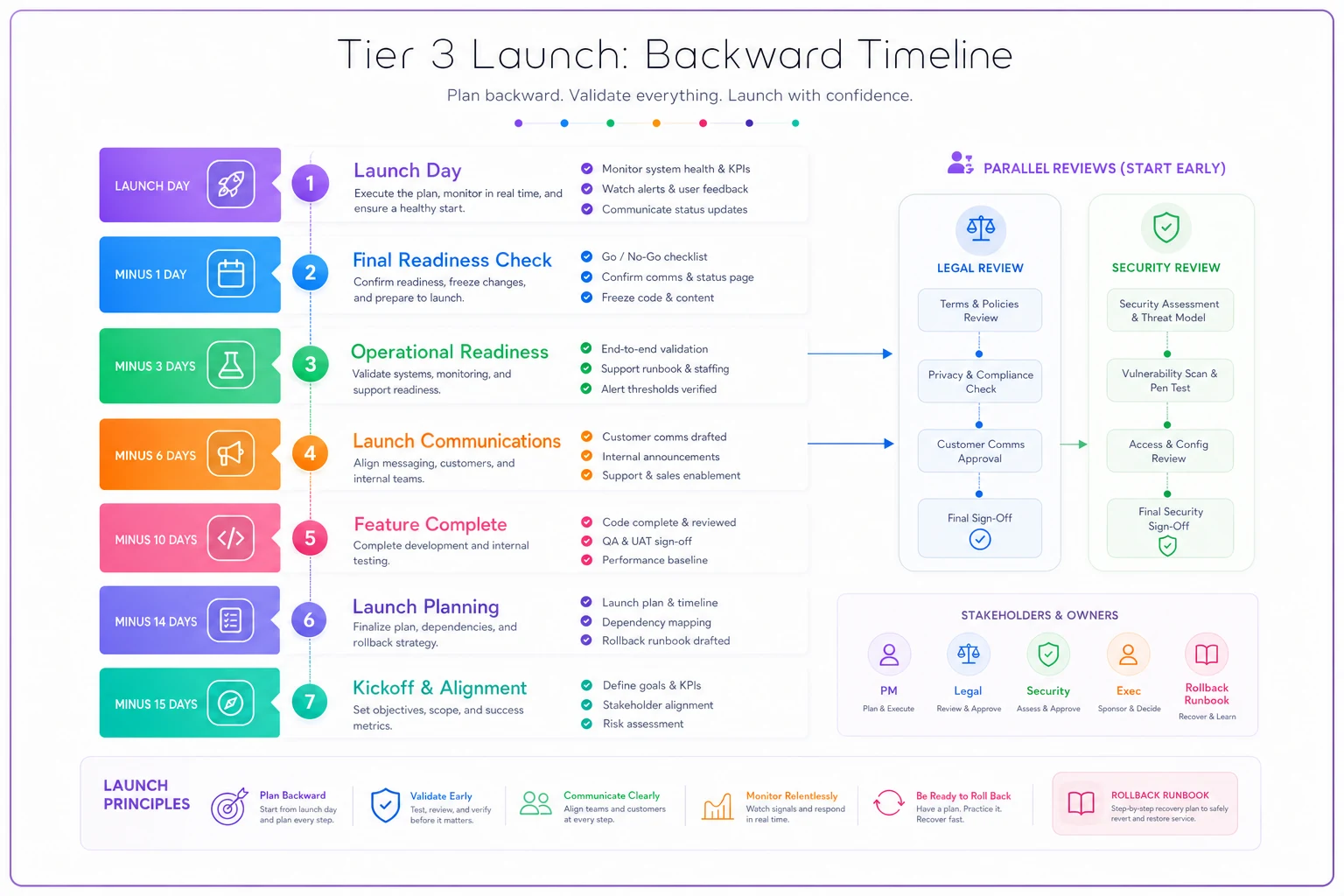
The single highest-leverage change in that whole sequence: run security and legal reviews in parallel. Teams instinctively do them sequentially because it feels more controlled, and it quietly adds a week to every high-risk launch. Stop doing that.
Exception workflows and escalation paths
Exceptions are where compliance checklists live or die. Something will always not fit — a hotfix that has to ship today but technically touches a data flow, or a launch where legal is out and the queue is stalled. If there's no defined path, people just skip the gate. Now you have an undocumented exception and no record of who decided the risk was acceptable.
The exception request should capture:
-
What gate is being bypassed or fast-tracked
-
Why (business reason, with the actual urgency stated)
-
What the residual risk is if you ship without the full process
-
Compensating control — what you're doing instead to reduce risk
-
Who is approving the exception, by name
-
Expiry — when the full compliance work must be completed retroactively
That last one matters more than people expect. An exception should almost never be permanent. It's a "we'll ship now and finish the DPIA within 10 days" deal, with the expiry tracked. Otherwise exceptions pile up into a shadow backlog of half-compliant launches nobody revisits.
Escalation path when a gate is stuck:
-
Reviewer hasn't responded in 2 business days → PM pings reviewer's manager.
-
Still stuck at 4 days → escalate to the accountable exec for that tier.
-
Business-critical and can't wait → file an exception request, get exec sign-off, ship with compensating controls and an expiry date.
Escalation needs time triggers, not judgment calls. "Escalate if it's taking too long" means nobody escalates until it's already a crisis. "Escalate at 2 days" gives a concrete cue that removes the awkwardness of deciding whether to nudge someone senior.
Cadence rules that keep the system honest
A launch checklist isn't a document you write once. Without cadence, tiers drift, artifacts go stale, and exceptions never close.
A few rules that keep it alive:
-
Weekly Review open exceptions. Any past their expiry date get escalated. This is the most important cadence — it stops exceptions from becoming permanent.
-
Monthly Audit a random sample of the past month's Tier 1 self-certifications. You're checking whether things got misclassified as low-risk. If more than a couple should have been Tier 2, your triggers aren't clear enough.
-
Quarterly Review the tier triggers themselves against any new regulations or new data types the product started handling.
The audit of Tier 1 self-certs is the piece teams skip, and it's the one that catches the CSV-export mistake before it ships. Self-certification only works if people know there's a chance of being audited. Without that, "self-certify" becomes "always pick low."
Audit Tier 1 self-certifications monthly to catch misclassifications early.
Changes to APIs and versioning often carry their own compliance weight when external clients depend on them — if your launch touches published interfaces, the API change management rules on versioning and client coordination pair naturally with these gates.
When tiering makes sense — and when it doesn't
This makes sense when you ship frequently enough that a universal checklist is slowing you down, and you handle enough varied data that risk genuinely differs launch to launch. If you're shipping weekly and half your releases are UI polish, tiering pays for itself fast.
This is a bad idea when you're a very small team shipping monthly in a lightly-regulated space. Three tiers and cadence audits are overhead you don't need yet. A single lightweight checklist is fine until volume forces the issue.
Who should not do this: teams that will build the tiers but never run the cadence audits. A tiered system with no auditing is worse than a simple checklist — it creates false confidence. Everyone assumes the gates are working when in reality every launch is being self-classified as Tier 1 and waved through.
Real scenario: a fintech-adjacent SaaS
A mid-sized product team shipping features for a lending platform was running a single 30-item compliance checklist on every release. Engineers averaged around 25 releases a month. The checklist was being completed in under three minutes on most of them — obvious rubber-stamping.
They split into three tiers. Roughly 70% of releases dropped to Tier 1 (same-day, self-certify). About 20% landed in Tier 2, and around 10% were genuine Tier 3 changes involving credit data or payment flows.
The change wasn't that compliance got faster overall — Tier 3 launches actually got slower, deliberately, because they now got real review. What changed was where the attention went. In the first two months, the monthly audit caught two Tier 1 self-certs that should've been Tier 2 — both touched a new data field. Those would've shipped unreviewed under the old system. Meanwhile low-risk launches stopped waiting on reviews they never needed.
The team's own summary was pretty blunt: the old checklist protected nothing because it protected everything equally. Tiering meant the risky 10% finally got the scrutiny that the whole system had been faking on all 100%.
Getting started without over-engineering it
Don't try to build the perfect version first. Start with three tiers, write the concrete triggers, keep the artifact lists short. The hard part isn't the structure — it's the discipline of the weekly exception review and the monthly self-cert audit. Those two cadences are what separate a real compliance gate from a document that decorates a wiki.
Get the triggers concrete, run the audits honestly, and let low-risk work move fast. The whole point is to spend compliance attention where the actual risk lives — and stop spending it everywhere else.
Get the triggers concrete, run the audits honestly, and let low-risk work move fast. The whole point is to spend compliance attention where the actual risk lives — and stop spending it everywhere else.
Ready to elevate your product management?
Join 2,000+ product teams using Itemyly to accelerate delivery, improve alignment, and build better products.