



Rates going up isn't abstract macro noise for product teams. It shows up about six weeks later as a Slack message from finance asking why your staging environment is running three idle GPU nodes over the weekend.
Chair Warsh's Jackson Hole speech on August 28 rattled the usual assumptions. In his keynote remarks at the symposium, he was blunt that inflation remains "too high" and that rates may need to stay elevated or climb further. Bond yields moved within days, and as Reuters noted in its coverage, markets quickly repriced how long tight conditions might last. For anyone running a roadmap, the translation is simple: money got more expensive, and the people who fund your infra now feel it.
This post isn't about the Fed. It's about what happens to your cloud costs and product roadmap when the CFO suddenly cares about every line item in the AWS bill, and how to reprioritize without torching your launches.
The real problem isn't budget cuts. It's that nobody knows what anything costs.
The uncomfortable pattern that surfaces the moment budgets tighten: most product teams genuinely cannot tell you the marginal cost of a feature they shipped.
They can tell you the story points. They can tell you the launch date, the adoption curve, maybe even the retention lift. But ask "what does this feature cost us to run per month at current usage," and you get silence, or a guess that's off by an order of magnitude.
This is fine when capital is cheap. Nobody audits the difference between a $40k and a $60k monthly cloud bill when growth is the only metric that matters. But when rates rise and finance starts scrutinizing spend, the teams that never built cost visibility get caught flat. They end up making cuts blind — killing a cheap high-value feature while an expensive experiment nobody uses keeps humming along in production.
The deeper issue is organizational. Cost lives with platform or finance. Value lives with product. Those two numbers almost never sit in the same view, so nobody's ever forced to divide one by the other. That gap is exactly what a rate shock exposes.
What actually happens to a SaaS budget when capital tightens
When cost-of-capital rises, the pressure doesn't hit evenly. It concentrates in a few predictable places, and knowing where it lands helps you get ahead of it.
Eliminate product chaos and align your team.
Itemyly helps you plan, prioritize, and track every product milestone seamlessly.
- Centralized roadmap management
- Stakeholder collaboration
- Release tracking & analytics
No credit card required
| Area | What changes under higher rates | Roadmap consequence |
|---|---|---|
| Cloud/compute spend | Finance scrutinizes monthly burn line-by-line | Infra-heavy features get delayed or de-scoped |
| Headcount | Open reqs freeze or slow | Capacity forecasts break, delivery bands widen |
| Expensive experiments | Longer payback periods become unacceptable | Higher bar to justify each test |
| Third-party tools | Every SaaS subscription gets re-justified | Tool consolidation, contract renegotiation |
| New borrowing | More costly to finance big infra bets | Large platform investments pushed out |
The mistake teams make is treating this as a one-time cut. They shave 15% off the cloud bill, tell finance it's handled, and move on. Then usage grows back into the savings within two quarters and they're right back where they started. Rate environments that stay tight — which is what Warsh signaled — reward teams that build ongoing cost discipline, not one-off panic trims.
Start with the features you can't cost — that's your list
Before you cut anything, run a fast inventory. Not a full FinOps audit. A one-week pass to answer a single question per feature: do we know what this costs to run?
-
Known and cheap — leave them alone, they're not the problem
-
Known and expensive — these need an ROI check, do the math
-
Unknown cost — this is where the waste hides, investigate first
That third bucket is almost always bigger than teams expect. It's where you find the abandoned batch job still processing full datasets nightly, the search feature quietly hitting a premium API on every keystroke, or the analytics pipeline duplicating storage across three regions because someone set it up during a growth sprint and nobody revisited it.
You don't need perfect numbers. You need to stop flying blind. Even rough per-feature cost estimates change prioritization conversations completely, because now you're comparing value against cost instead of value against nothing.
A tactical reprioritization sequence
Once you've got even a rough cost picture, work through this order. Don't skip to the fun part (killing features) before you've done the boring part (measuring).
-
Tag spend to features. Get cloud costs allocated by feature or service, even if it's approximate. Without this, every later step is a guess.
-
Compute cost-to-value ratio per feature. Monthly run cost divided by whatever value proxy you trust — revenue attribution, active usage, retention contribution.
-
Freeze new infra-heavy commitments. Anything requiring a big new compute footprint gets a hold and a fresh ROI review before it moves.
-
De-scope, don't delete, the borderline items. Can that expensive feature run on cheaper infra? Batch instead of real-time? Cached instead of live? Downgrade before you kill.
-
Raise the release gate for experiments. Expensive tests now need a defined payback window and a kill date, not an open-ended "let's see."
-
Re-forecast capacity and SLAs. If headcount froze, your delivery bands and commitments need to reflect that honestly, not aspirationally.
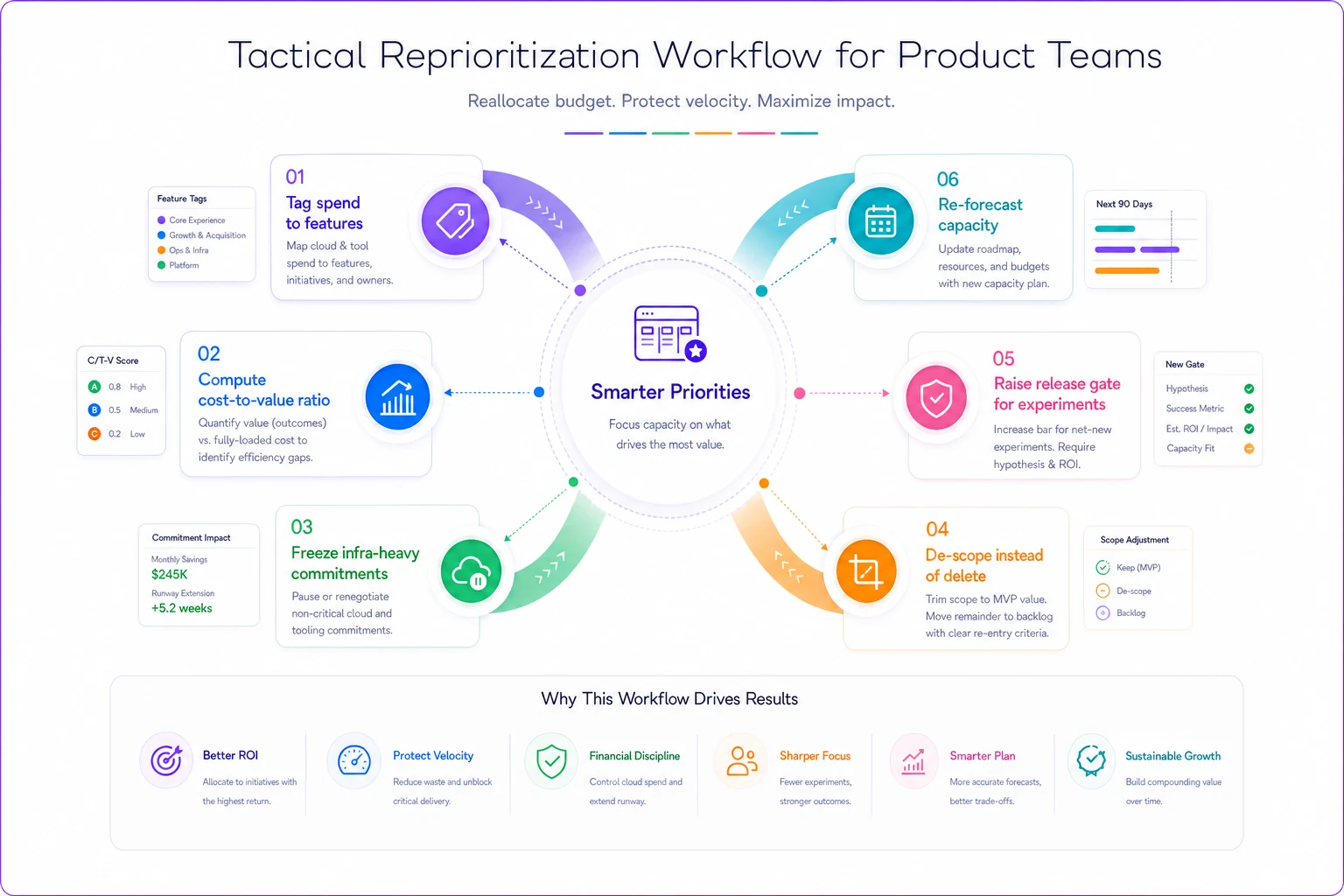
Use this workflow as a checklist during your next prioritization session.
The teams that survive tight budgets well tend to treat step 4 as their main lever. Deletion is dramatic and political. Quietly moving a feature from real-time to a 15-minute batch cycle can cut its cost by more than half while almost no user notices. That's where the real savings live, not in the headline cuts.
A real scenario: the mid-size SaaS caught with an idle-cost problem
Consider a B2B analytics SaaS, roughly 40 people, spending somewhere around $85k–$95k a month on cloud. When their board pushed for tighter margins after rates moved, finance handed product a mandate to cut infra by 20% without hurting launches.
Their first instinct was to delay the next big feature — the expensive one everyone assumed was the cost driver. But when they finally tagged spend by service, the picture flipped. That flagship feature was reasonably efficient. The real bleed was a set of non-production environments running near production-scale around the clock, plus a data pipeline reprocessing historical records in full every night when a delta-only run would've done the job.
They didn't cut a single roadmap item. They right-sized the dev environments, switched the pipeline to incremental processing, and put auto-shutdown on anything non-prod over weekends. The bill dropped by close to the full 20% target within two billing cycles. Zero launches slipped.
The lesson wasn't "cut features." It was that the assumed cost driver and the actual cost driver were completely different things — and the only reason they figured it out was forcing themselves to look at spend at the feature level for the first time.
When aggressive cost-cutting is a bad idea
Tight capital creates pressure to cut everything, and that overcorrection does real damage. A few situations where you should hold the line:
When the feature is cheap but strategic. Killing a low-cost feature to look responsive is theater. If it's not moving the bill, leave it.
When cutting infra degrades reliability during a sensitive period. Downsizing right before your biggest customer's renewal or a major launch trades a small saving for a large risk. Sequence matters.
When the "savings" just shifts cost elsewhere. Cutting managed services to save on subscriptions but adding engineering hours to self-host is often a worse deal once you count the loaded cost of that time.
When you're cutting the observability that tells you what to cut. Teams sometimes trim monitoring and cost-visibility tooling first because it looks like overhead. That's like removing the dashboard to save on fuel.
The judgment call is separating cost that's genuinely wasteful from cost that's doing quiet work. Higher rates don't change which features matter — they just raise the bar for justifying the expensive ones.
Making cost visibility a permanent part of the roadmap
The teams that get through tight cycles cleanly aren't the ones who cut hardest. They're the ones who make cost a standing input to prioritization instead of an emergency the finance team drops on them.
Practically, that means cost-per-feature shows up in the same review where you discuss value and effort. Every new infra-heavy proposal carries a rough monthly run-cost estimate before it enters the backlog. Expensive experiments ship with a kill date attached. None of this is exotic — it's the same discipline you already apply to scope and timelines, just extended to spend.
Surface run-cost alongside usage and value in your roadmap reviews so prioritization happens with cost in view, not after the fact.
This is where modern operational tooling earns its place. When your roadmap platform can surface run-cost alongside usage and value in one view, cost stops being a separate spreadsheet finance maintains in the dark. Some teams use automation to flag features whose spend is drifting up faster than their usage, or to catch idle environments before the monthly bill does. The point isn't the tooling itself — it's closing the gap between the people who see cost and the people who set priorities, so a rate shock doesn't catch you blind again.
For the deeper mechanics of restructuring a roadmap around infrastructure economics, the earlier breakdown on reprioritizing roadmaps for rising infrastructure costs covers the longer-term version of this. Warsh's signal just moved the timeline up.
The takeaway
Higher rates for longer means the cheap-capital era of ignoring cloud spend is over, at least for a while. That's not a crisis if you've done the boring work of knowing what your features cost. It's a scramble if you haven't. Start with visibility, not cuts. Find the unknown-cost features first. De-scope before you delete. Protect the cheap-but-valuable stuff, and put a real bar on the expensive experiments. Do that, and a tightening budget becomes a forcing function that sharpens your roadmap — instead of a panic that guts your best launches to satisfy a spreadsheet.
Ready to elevate your product management?
Join 2,000+ product teams using Itemyly to accelerate delivery, improve alignment, and build better products.