

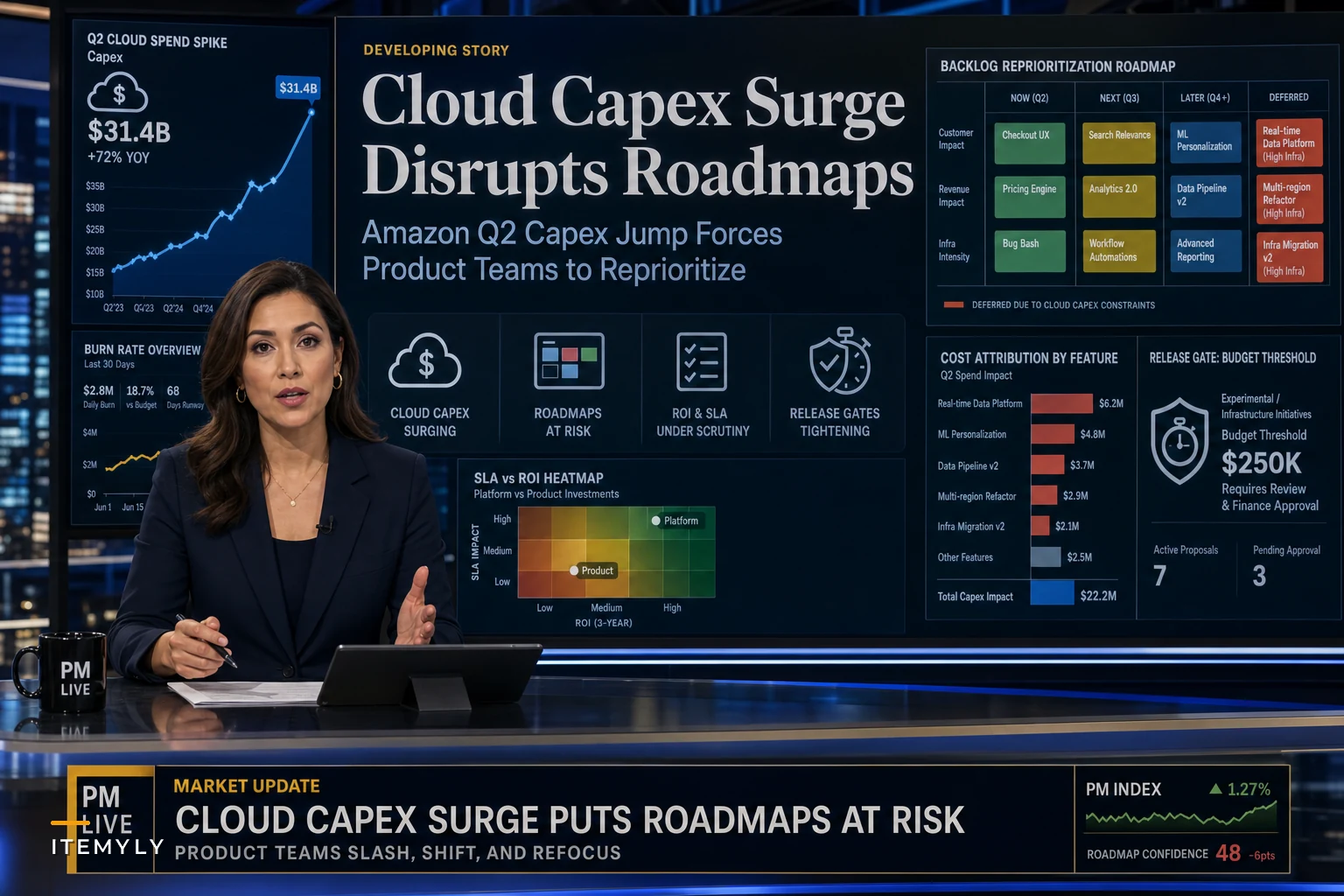

Amazon just dropped a number that should make every product manager stop and think: $220 billion in planned capital expenditures for 2026. According to CNBC's earnings coverage, they're citing higher memory and component costs alongside surging AI demand. AWS revenue jumped 37% year-over-year in Q2.
For product teams, the implication is pretty direct: the infrastructure you've been treating as infinitely scalable just got finite. And expensive.
Three different B2B SaaS companies dealt with this exact scenario last quarter. One team's monthly AWS bill jumped from $47k to $71k after launching their AI-powered analytics feature. They hadn't changed their usage patterns — the underlying costs had shifted. Their CFO walked into the product standup with a simple message: fix this or kill features.
This isn't just an AWS story. Every major cloud provider is seeing similar pressures. Component shortages, AI compute demand, and infrastructure buildout costs are converging at exactly the moment most product teams are trying to scale AI capabilities.
The brutal math of cloud costs roadmap prioritization
When infrastructure costs spike mid-roadmap, unit economics break first. That feature you shipped six months ago that was profitable at $0.12 per user per month? Now it's costing $0.19. Multiply that across 50,000 users and you're burning an extra $3,500 monthly on a feature that hasn't changed at all.
The painful part is how this compounds. Every feature with heavy compute requirements — ML models, real-time analytics, data pipelines — suddenly needs re-evaluation. Most product teams don't have a framework to make these calls systematically, though.
Teams that handle this reactively follow a familiar pattern: kill experiments first, freeze new AI features, then scramble to optimize existing infrastructure. It rarely works because they're optimizing the wrong things in the wrong order.
Building a cost-aware prioritization matrix
The teams that navigate this well build what I'd call a cost-aware prioritization matrix. It's not complicated, but most teams skip it because they've convinced themselves infrastructure costs are purely an engineering concern.
Eliminate product chaos and align your team.
Itemyly helps you plan, prioritize, and track every product milestone seamlessly.
- Centralized roadmap management
- Stakeholder collaboration
- Release tracking & analytics
No credit card required
Map every roadmap item against three dimensions:
Infrastructure intensity: How much compute, storage, and bandwidth does this feature require per user? Don't guess — pull actual metrics from your staging environments.
Revenue attribution: What's the direct revenue impact? If you can't tie a feature to retention, expansion, or new sales, it goes in the "nice to have" bucket.
Optimization potential: Can you meaningfully reduce costs through architecture changes, or is this just fundamentally expensive to run?
A fintech startup used this framework when their inference costs tripled. They discovered their customer segmentation model was burning $14k monthly but only improving conversion by 0.3%. Meanwhile, their fraud detection system cost $8k monthly but saved $45k in chargebacks. The prioritization became obvious once they laid it out that way.
The matrix isn't magic — it just forces conversations that product teams normally avoid. Cost vs. value tradeoffs feel uncomfortable, but they're a lot less uncomfortable than an emergency feature kill in month three.
The hidden infrastructure tax on experimentation
Most product teams don't realize how much they're spending on dead experiments until costs spike.
Every A/B test with an AI component, every feature flag routing to expensive compute paths, every abandoned proof-of-concept still running in staging — these create what I think of as infrastructure debt. Invisible when costs are stable. Devastating when they jump.
One e-commerce platform found they were spending $6,200 monthly on experiments that had been "conclusive" for over 90 days. Their experimentation platform kept variants running because nobody explicitly killed them. Their feature flag system had 47 flags older than six months, half routing to computationally expensive code paths.
The fix isn't to stop experimenting. It's to build cost gates into your experimentation workflow:
-
Set infrastructure budgets per experiment upfront. If a test will cost more than $500/week to run, it needs director approval.
-
Implement automatic experiment sunset rules. After statistical significance or 30 days (whichever comes first), variants shut down unless explicitly extended.
-
Add cost tracking to your feature flag lifecycle. Every flag needs an owner and an expiration date.
Require an estimated weekly cost and an explicit owner before experiments go live so someone is accountable for sunsetting them.
One e-commerce platform found they were spending $6,200 monthly on experiments that had been "conclusive" for over 90 days. Their experimentation platform kept variants running because nobody explicitly killed them. Their feature flag system had 47 flags older than six months, half routing to computationally expensive code paths.
Rearchitecting roadmaps for the new cost reality
Traditional roadmap planning assumes infrastructure scales linearly with usage. That assumption got complicated fast when AI workloads met component shortages.
Smart product teams are restructuring roadmaps around what I'd call "cost cohorts" — grouping features by infrastructure profile and scheduling them to avoid cost spikes. The logic is simple: if you know three AI features are each going to spike your monthly bill, launching them simultaneously is just asking for a CFO intervention.
| Cohort | Infrastructure Profile | Scheduling Strategy | Example Features |
|---|---|---|---|
| Baseline | Low compute, predictable costs | Continuous delivery | UI updates, simple CRUD operations |
| Burst | High compute, short duration | Batched releases | Report generation, data exports |
| Persistent | High compute, always-on | Quarterly gates | Real-time analytics, ML inference |
| Experimental | Unknown costs | Isolated sprints | AI features, new architectures |
A B2B logistics platform restructured their entire Q3 roadmap using this model. Instead of launching three AI features simultaneously — projected $28k monthly increase — they staggered them across quarters. The first feature's actual costs came in around 40% lower than projected after optimization, which created budget room for the others. That's the kind of breathing room you can't manufacture when you've already committed to everything at once.
The platform investment calculation changes
When infrastructure costs rise, the ROI math on platform investments shifts. That service mesh you've been debating? The observability upgrade? The move to serverless? These aren't just engineering decisions anymore.
This connects directly to how teams should evaluate platform vs product roadmap decisions. The framework gets more critical when every platform choice has immediate cost implications.
There's a new variable now: cost efficiency multiplier. How much will this platform investment reduce the marginal cost of future features?
A marketplace startup learned this the hard way. They postponed a caching layer upgrade for two quarters to ship more features. When infrastructure costs spiked, those features became roughly 3x more expensive to run. The caching layer would have reduced costs by around 60%. They ended up killing two features to fund the platform work they should've done earlier — not a great way to spend a quarter.
Setting up cost observability before you need it
Most product teams find out about infrastructure cost problems through their CFO. By then, you're in crisis mode, not strategy mode.
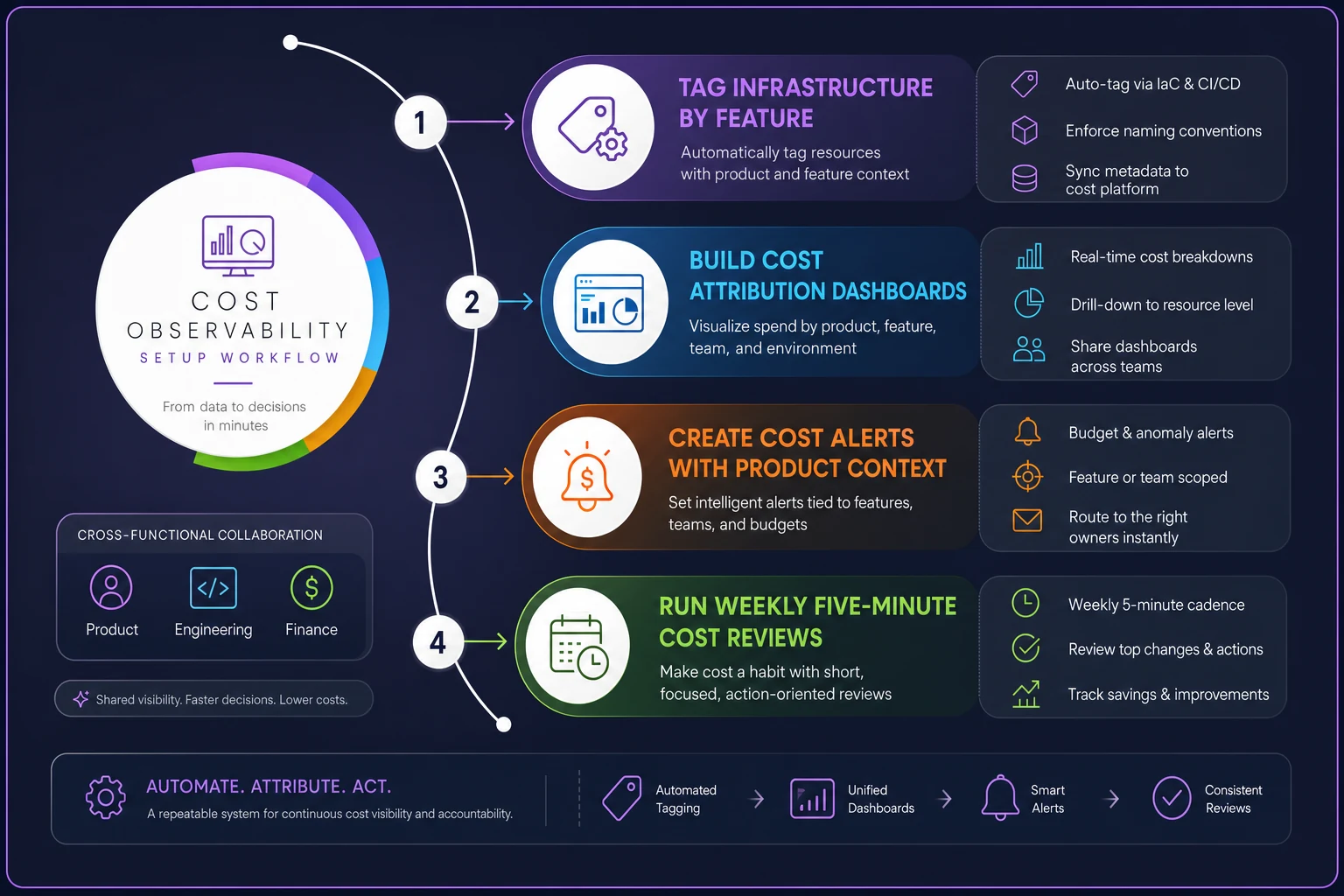
The teams that handle cost volatility well have already instrumented cost observability into their product operations — not just AWS Cost Explorer dashboards nobody looks at, but actual cost-per-feature tracking that shows up in sprint reviews.
-
Tag every piece of infrastructure with feature ownership. Your backend team probably already knows how — make it a launch requirement.
-
Build cost attribution into your product analytics. If you track feature usage, track feature cost in the same dashboard.
-
Create cost alerts with product context. "Infrastructure costs increased 20%" is useless. "The recommendation engine costs increased 20% while usage remained flat" is actionable.
-
Run a five-minute cost review in your weekly product sync. Flag any features with anomalies.
A simple workflow for cost observability looks like this.
None of this is technically difficult. The barrier is organizational — getting people to treat cost visibility as a product responsibility rather than a finance or engineering one.
The AI feature trap
Every product team wants AI features right now. What often gets missed is that AI workloads are the most exposed to infrastructure cost volatility.
Traditional features have predictable cost curves. More users mean more database queries, more API calls, more storage. Mostly linear. AI features break that model. Inference costs can vary 10x depending on model size. GPU availability fluctuates. Memory requirements spike unexpectedly. And because every competitor is building similar things, you're all competing for the same constrained resources.
A SaaS company in the customer success space ran into this. They launched an AI-powered sentiment analysis feature in January costing roughly $4,100 monthly for 10,000 users. By March, the same workload cost $7,800. Nothing changed on their end — the underlying infrastructure costs had shifted.
The answer isn't to avoid AI features. It's to build them with cost volatility in mind:
-
Use model versioning strategies that let you downgrade to smaller models when costs spike. Users won't notice if response quality drops from 95% to 92% accuracy, but you'll notice the 50% cost reduction.
-
Implement request batching and async processing for non-real-time AI features. That "AI-powered insight" doesn't need to generate instantly.
-
Build fallback paths for when AI inference gets too expensive. Cached results, rule-based approximations, off-peak processing — know your options before you need them.
The answer isn't to avoid AI features. It's to build them with cost volatility in mind:
The new release gate: cost projection
Release gates used to be about quality, security, and performance. Now they need to include cost projection.
Before any feature hits production, you need three numbers:
-
Cost per 1,000 users at current infrastructure prices
-
Cost sensitivity to a 20% infrastructure price increase
-
Break-even point considering revenue impact
A collaboration platform made this a hard requirement after a video transcription feature nearly killed their margins. The feature worked perfectly in testing but cost $0.43 per minute to run in production. With average users uploading around 20 minutes of video monthly, they were losing money on every customer.
Forcing cost projection before release surfaces these problems early. That impressive AI feature might not be viable at current infrastructure prices. Better to know that before you've promised it to customers and built marketing campaigns around it.
Managing stakeholder expectations
The hardest part about cloud costs roadmap prioritization isn't the technical analysis — it's telling stakeholders their favorite features aren't happening.
Sales promised a customer that new AI feature. Marketing already announced the Q3 roadmap. The CEO wants to match competitor capabilities. But the math doesn't work.
The teams that handle this well build what I'd call a "cost reality dashboard" — a simple view showing current monthly infrastructure spend, projected spend with committed roadmap, cost per feature in production, and infrastructure cost trends.
Share it broadly. Update it weekly. When stakeholders see that a pet feature would increase costs 30% while generating 5% revenue lift, the conversation changes on its own.
One approach that actually works: create infrastructure budgets per quarter. Every team gets an allocation for new features. Want to launch something expensive? Optimize something else or negotiate with another team. It's a bit like a resource constraint that makes tradeoffs explicit rather than political.
The operational automation opportunity
When infrastructure costs spike, the knee-jerk reaction is to cut features. But there's often a better path: automate the expensive operations.
Most infrastructure costs hide operational inefficiencies. The batch job that runs every hour regardless of whether it needs to. The development environments running hot 24/7. The data pipelines reprocessing everything instead of doing incremental updates.
AI-powered operational software can identify and address these patterns automatically — continuously detecting inefficient queries instead of someone manually digging through CloudWatch logs, tracking cost attribution in real-time instead of guessing which features are burning budget.
The key is setting up the operational foundation before costs spiral. Tag your infrastructure, instrument your code, establish cost baselines. When prices spike, you'll have the data to make smart tradeoffs instead of panic cuts. The teams I've seen handle this well aren't necessarily the ones with better engineers — they're just better organized.
Making strategic bets when others retreat
Infrastructure cost spikes create competitive opportunities for prepared teams.
While competitors freeze roadmaps and kill features, disciplined teams can actually accelerate. Not by spending more — by being more efficient than everyone else.
A travel tech startup used the recent cost spike to their advantage. While competitors pulled back on AI features, they negotiated committed use discounts with AWS, shifted to spot instances for non-critical workloads, optimized their model serving infrastructure, and launched three AI features while competitors froze development.
Their infrastructure costs increased around 18%, but conversion rate jumped 24%. Net result: better margins than before the cost increase.
The teams that win in high-cost environments aren't the ones with the biggest budgets. They're the ones with the best operational discipline — and that's something you can actually build.
Your next three moves
Rising infrastructure costs aren't going away. Bloomberg reports this is the fifth straight quarter of cloud growth acceleration. Demand isn't slowing, and neither are the costs.
If you're a product manager reading this, the path forward is concrete:
The product teams that thrive in this environment won't be the ones who ship the most features. They'll be the ones who ship the right features at sustainable costs — and that requires treating cloud costs roadmap prioritization as a strategic capability, not just an operational constraint.
First, audit your current infrastructure spend by feature. You probably don't know which features are costing you the most. That's the first thing to fix.
Second, build cost gates into your release process. No feature ships without understanding its infrastructure impact.
Third, start treating infrastructure optimization as product work, not engineering overhead. Put it on your roadmap. Track its impact like any other feature.
Ready to elevate your product management?
Join 2,000+ product teams using Itemyly to accelerate delivery, improve alignment, and build better products.