

Product managers document too much or nothing at all. The 15-page strategy decks collecting dust in Google Drive, the endless PRDs nobody reads after launch, the decision rationale buried in Slack threads from eight months ago—none of it helps when engineering asks "why did we pick this approach over that one?" during sprint planning.
What actually works is dead simple: one-page decision records you can paste directly into Jira, Notion, Linear, whatever your team uses. No special tooling, no elaborate processes. Just structured text that captures the trade-off, the choice, and the reasoning in under 500 words.
The format matters less than the discipline. Most PMs start with complex templates and gradually strip them down to bare essentials. A decision record that takes 20 minutes to write gets written. One that needs an hour of formatting dies in drafts.
The core template that covers 90% of decisions
Below is the baseline template that handles scope changes, market pivots, and product trade-offs equally well:
DECISION: [One-line summary] DATE: [YYYY-MM-DD] STATUS: Active | Superseded | Under Review CONTEXT What triggered this decision and what constraints exist
-
1. [Option A] - [2-3 line description]
-
2. [Option B] - [2-3 line description]
-
3. [Option C] - [2-3 line description]
DECISION RATIONALE Why we chose [selected option] over alternatives
-
What we're giving up
-
What risks we're taking
-
What assumptions we're making
SUCCESS METRICS How we'll know if this was the right call REVIEW TRIGGER When/what would make us revisit this
No stakeholder alignment matrices, no RACI charts. Just the minimum viable documentation that answers "what did we decide and why" six months from now.
Three real examples from different decision types
Scope trade-off example
Eliminate product chaos and align your team.
Itemyly helps you plan, prioritize, and track every product milestone seamlessly.
- Centralized roadmap management
- Stakeholder collaboration
- Release tracking & analytics
No credit card required
DECISION: Cut real-time sync for mobile MVP, ship with manual refresh DATE: 2024-10-15 STATUS: Active CONTEXT Mobile beta launches in 4 weeks. Real-time sync adds 3 weeks development. Key enterprise client needs mobile by Q4 close.
-
1. Delay launch 3 weeks for real-time - Full feature parity
-
2. Ship manual refresh now, add real-time in v1.1 - Meet deadline
-
3. Web-only for enterprise, no mobile - Avoid technical debt
DECISION RATIONALE Chose option 2. Enterprise client uses mobile for field audits 2-3x daily, not constant monitoring. Manual refresh covers use case.
-
15-20 support tickets expected first month
-
Competitors have real-time (but worse offline mode)
-
Engineering carries sync work into next quarter
SUCCESS METRICS <5% of mobile sessions attempt refresh more than 10x Enterprise client renews Q1 contract REVIEW TRIGGER If support tickets exceed 50/month or enterprise escalates
Market positioning example
DECISION: Target vertical SaaS over horizontal platform play DATE: 2024-09-22 STATUS: Active CONTEXT Series A conversations revealing investor concern about TAM. Current ARR concentrated in logistics (72% of revenue).
-
1. Double down on logistics, own the vertical - Deep specialization
-
2. Abstract features for horizontal platform - Larger TAM
-
3. Multi-vertical with industry templates - Middle path
DECISION RATIONALE Chose option 1. Our logistics features (dock scheduling, carrier portal) create moat. Horizontal means competing with Monday/Asana on features we'll never match.
-
Cap TAM at $2.3B vs $45B horizontal market
-
Need logistics-specific sales team
-
Harder to hire PMs without domain expertise
SUCCESS METRICS Hit 20% market share in mid-market logistics (currently 4%) Sales cycle drops below 45 days average REVIEW TRIGGER If we saturate mid-market (<10% pipeline growth) by Q3 2025
Technical architecture example
DECISION: Build on existing monolith vs microservices for payments DATE: 2024-11-01 STATUS: Under Review CONTEXT Adding payment processing. Current monolith handles 50K daily transactions. Payment processing estimated at 500K additional events daily.
-
1. Extend monolith with payment module - 6 week build
-
2. Separate payments microservice - 10 week build
-
3. Third-party payment service wrapper - 3 week integration
DECISION RATIONALE Chose option 1. Team knows monolith codebase. Can optimize performance after launch based on real load. Microservice adds complexity before we know if payments feature gets adoption.
-
Potential scaling issues if payments exceed 30% of transactions
-
Harder to iterate payments without affecting core system
-
Technical debt if we need to extract later
SUCCESS METRICS Payment processing stays under 200ms P95 latency Zero downtime events affecting core product from payment code REVIEW TRIGGER If payment transactions exceed 150K daily or latency degrades
Storage patterns that prevent decision archaeology
The worst place for decision records is scattered across tools. The second worst is a dedicated "decision log" nobody remembers exists.
For feature work: Paste the record directly in the epic or main story. In Jira, use a custom field called "Decision Record" or drop it in the description. In Linear, pin it as a comment at the top. The record lives with the work it affects.
For strategy decisions: Create a decisions folder in your team's main documentation space. In Notion, make it a database with views by quarter and status. In Confluence, use a template and tag pages with "decision-record." The key is making them searchable by date, status, and keyword.
For technical decisions: Put them in the codebase. A decisions/ folder in your repo with markdown files named YYYY-MM-DD-short-description.md. They version with the code, show up in pull requests, and developers actually find them.
Name decision files
YYYY-MM-DD-short-description.mdso they sort chronologically and are easy to scan in PRs.
The anti-pattern to avoid: dedicated decision management tools that require separate logins, unique formats, or manual syncing. Every layer of friction kills usage.
Below is a quick reference for where different decision types belong:
| Decision Type | Recommended Location | Format |
|---|---|---|
| Feature scope | Epic or main story (Jira/Linear) | Inline paste |
| Strategy/market | Team docs folder (Notion/Confluence) | Tagged database entry |
| Technical architecture | Codebase decisions/ folder | Dated markdown file |
| Cross-team dependencies | Shared wiki, linked from relevant epics | Linked page |
Whichever storage approach you pick, the rule is the same: if finding the record requires more than two clicks or a single search, it won't get found.
Search and discovery practices
A decision record nobody can find might as well not exist. Three practices keep them discoverable:
-
1. Consistent naming Every record title starts with "DECISION:" followed by a clear, searchable description. Not "Mobile Strategy" but "DECISION: Cut real-time sync from mobile MVP." Instantly recognizable in search results.
-
2. Quarterly indexes Every three months, build a simple index page listing all decisions with one-line summaries and links. Takes maybe 30 minutes and saves hours of digging. PMs rotating onto the team start here.
-
3. Status tracking That STATUS field isn't decoration. "Superseded" decisions link to what replaced them. "Under Review" triggers discussion in planning. Active decisions get referenced in related work. A clear status stops people from following outdated choices.
Some teams tag decisions with themes like "scope," "architecture," or "market"—but honestly this rarely helps in practice. Good titles and full-text search do more than maintaining a taxonomy nobody keeps clean.
The review cadence that keeps decisions fresh
Most decision records die peacefully, never reviewed after creation. The ones that actually matter need deliberate revisitation.
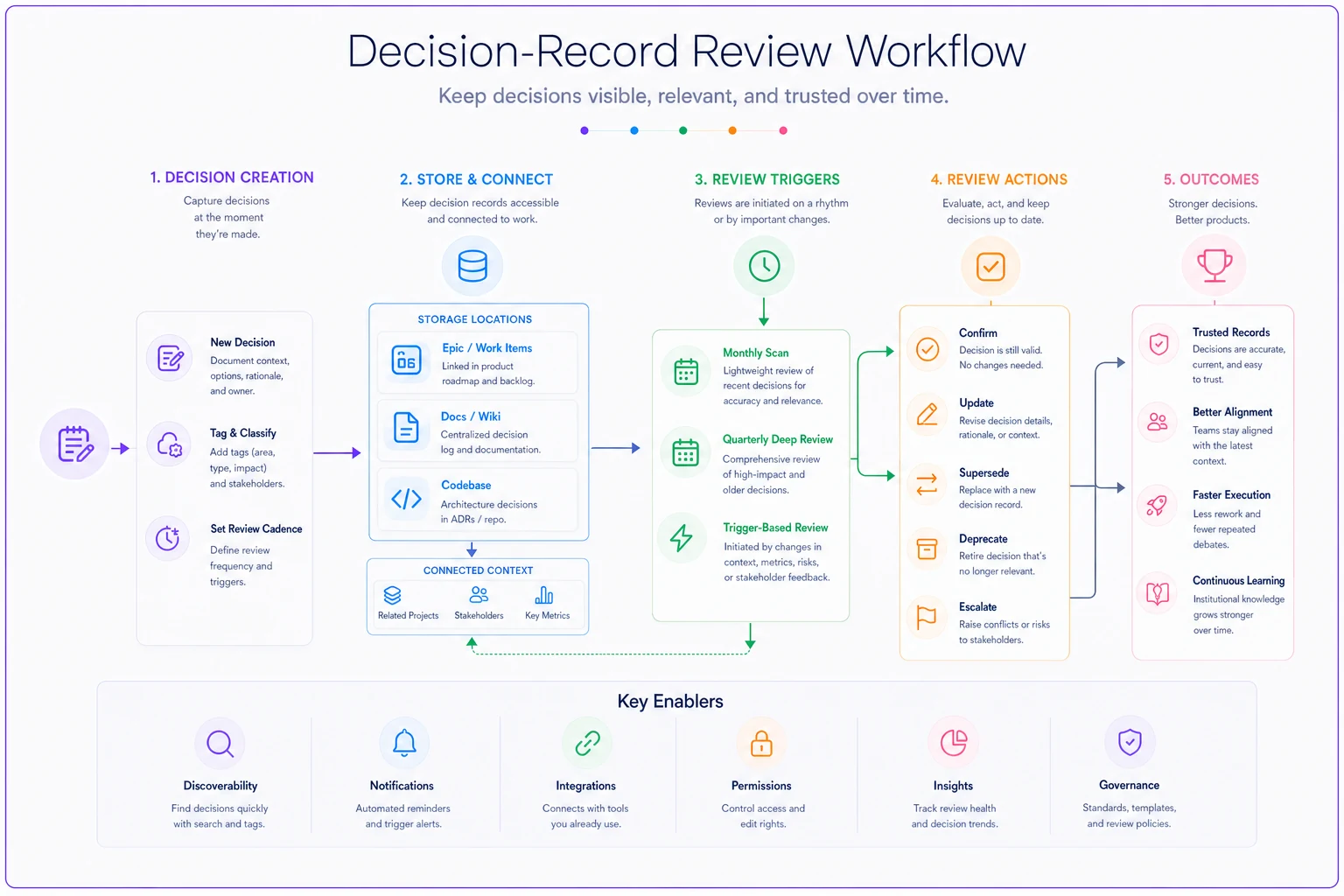
Monthly scan: During monthly planning, spend 10 minutes scanning "Under Review" decisions. Faster than a standup, and it catches decisions needing attention before they cause problems.
Quarterly deep review: Pick the two or three highest-impact decisions from last quarter. Did the success metrics hit? Should anything change? This isn't about being right—it's about learning which kinds of decisions age well versus which ones rot fast.
Trigger-based reviews: The "Review Trigger" section isn't hypothetical. When triggers hit, the decision goes back to "Under Review." The enterprise client escalates about manual refresh? That mobile sync decision gets reopened immediately.
A quick visual of this review workflow:
The review doesn't need to be formal. Drop a comment in the original record: "Reviewed 2024-12-01: Metrics hit, decision holds" or "Reviewed 2024-12-01: Moving to Superseded, see [new decision link]." The point is showing the decision got attention, not creating more documentation around the review itself.
Common mistakes that kill adoption
Over-engineering the template. A PM once showed me their decision template with 14 sections including "stakeholder impact matrix" and "alternative mitigation strategies." They'd documented exactly three decisions in six months. Your template should take 15 to 20 minutes to complete, not an hour.
Retroactive documentation. "Let's go back and document our past decisions" sounds responsible but mostly wastes time. Start with the next decision. Past decisions only get documented when someone asks "why did we do this?"—then you write just that one.
Consensus theater. Decision records document decisions, they don't create them. If you're spending meetings wordsmithing the rationale section to make everyone comfortable, you're missing the point. The decider writes the record, others can comment, but it's not a group editing exercise.
Perfect information paralysis. Every decision record includes assumptions and unknowns. That's the point. You're capturing what you knew when you decided, not waiting for certainty that never arrives.
When lightweight breaks down
This one-page approach handles most product decisions but starts breaking at the extremes. Major platform migrations, complete pivots, or bet-the-company features need more documentation. When legal gets involved, when board members start asking questions, when decisions ripple across multiple teams for multiple quarters—that's when you expand beyond one page.
Even then, start with the one-pager. It forces clarity on the core decision. The appendices, analyses, and supporting documents can follow. If you can't write a clear one-page summary, you probably haven't actually made a decision yet.
Making decision records standard practice
The hardest part isn't the template or the storage system. It's making decision documentation a reflex instead of an afterthought.
Start small. Next sprint planning, when you make a scope cut, take 15 minutes to document it. Paste it right in the story. Don't announce a "new decision record process"—just do it. When someone asks "why did we cut that feature?" point them to the record. When it saves a 20-minute discussion, people notice.
After a few sprints, you'll have somewhere between five and ten decision records. That's when you create the quarterly index. Still no process announcement, just a simple page listing decisions with links. Send it to your engineering lead as context.
By month three, engineers start asking "is there a decision record for this?" during planning. That's the signal it's working. The template becomes muscle memory, the storage pattern becomes obvious, and the review triggers actually trigger reviews.
For teams running operational software where product decisions directly affect workflows, this kind of lightweight documentation becomes especially useful. When customer operations shift based on product choices—like adjusting technical debt priorities that affect system reliability—clear decision records reduce confusion between product, engineering, and operations teams considerably.
The compound value of documented decisions
Six months in, you'll have somewhere around 20 to 30 decision records. Not comprehensive documentation of everything, just the choices that actually mattered. New PMs read through them in an afternoon and understand why the product works the way it does. Engineers stop relitigating old decisions because the rationale is written down. You stop explaining the same context repeatedly.
The real value isn't in any single record. It's in the pattern of thinking they reveal over time. Which assumptions keep appearing? Which trade-offs do you consistently accept? Which success metrics actually predict outcomes? The documentation becomes a learning system, not just a historical archive.
Most product teams never get there because they start too heavy. They build elaborate decision frameworks that collapse under their own weight. The one-page template, pasted where work happens, reviewed when triggers hit—that's the practice that actually sticks.
Try it with your next decision. Set a timer for 20 minutes. Use the template above. Paste it in whatever tool you're working in right now. Don't overthink it. Just document what you decided and why. That single record won't change much, but the habit compounds into something genuinely useful over time.
Ready to elevate your product management?
Join 2,000+ product teams using Itemyly to accelerate delivery, improve alignment, and build better products.