

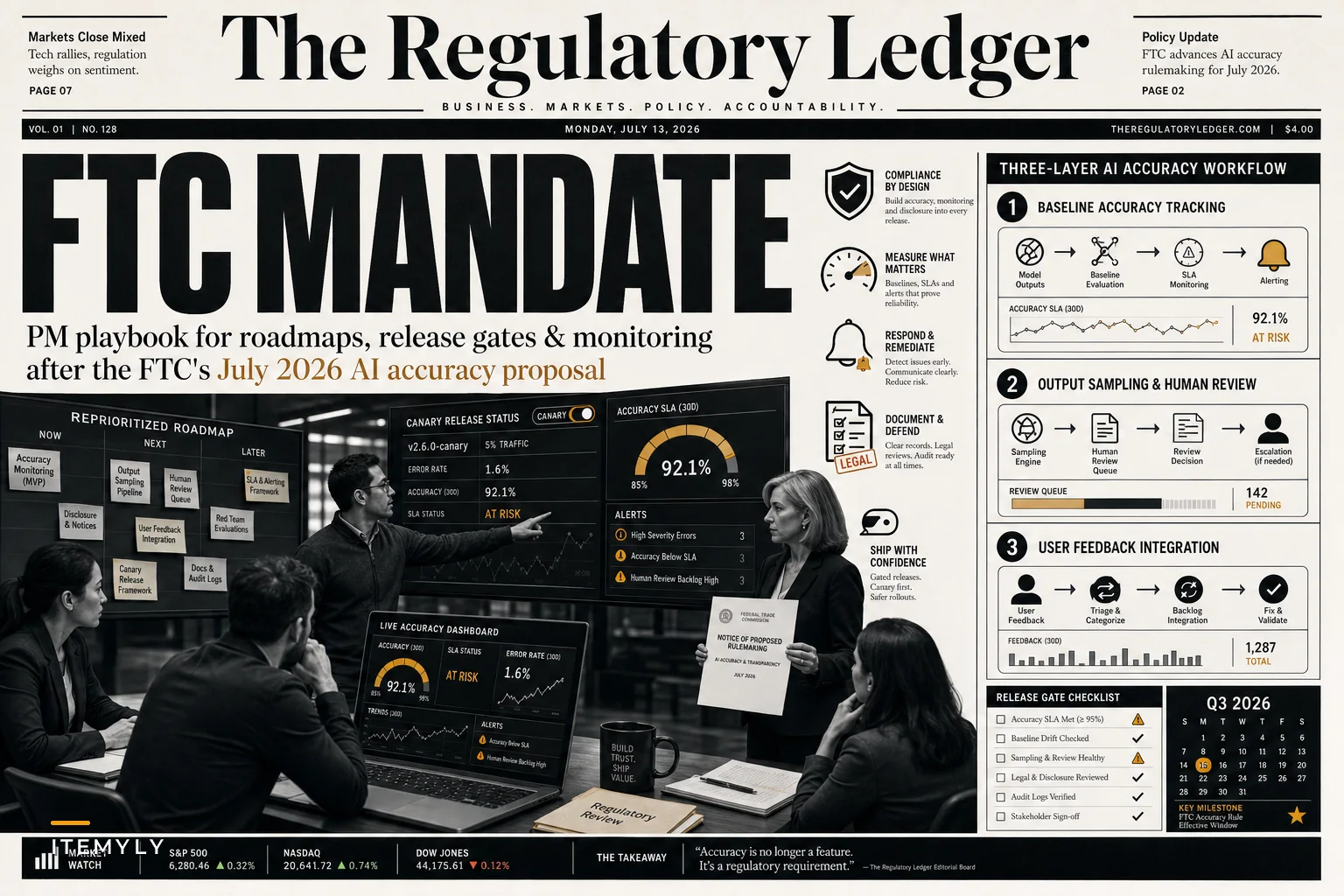

You're three sprints away from shipping that AI-powered recommendation engine when the FTC drops a bombshell. Their July 1st proposed policy statement on AI accuracy basically says: if your AI misleads users or you hide accuracy problems, you could face consumer protection violations.
Great timing, right?
The proposal specifically targets companies that might "steer" AI outputs or suppress accuracy information in ways that mislead consumers. The public comment period runs through September, and smart product teams are already trying to figure out what this means for features in flight and roadmaps heading into Q4.
What makes this particularly awkward for product organizations is that you're not dealing with a single compliance checkbox. AI accuracy compliance cuts across your entire product lifecycle—from initial feature design through monitoring production outputs. It touches release criteria, QA processes, user-facing copy, monitoring dashboards, incident response, and probably half your backlog.
The Hidden Compliance Debt Already in Your Codebase
Most product teams shipping AI features have been moving fast, focused on user value and competitive positioning. That speed creates what I'd call compliance debt—all those accuracy metrics, audit logs, and explainability features that got pushed to "later."
Later just became now.
Think about your current AI features. Can you actually answer these questions with data, not gut feel:
-
What's the baseline accuracy for each model-driven feature?
-
How often does your AI produce factually incorrect outputs?
-
When accuracy drops, how long until someone notices?
-
Which user segments see lower accuracy rates?
-
What disclosures exist around potential inaccuracies?
Most teams can answer one or two of these with confidence. The rest are sitting in a backlog column nobody prioritizes.
The FTC's stance essentially says that burying accuracy issues or failing to disclose them could constitute deceptive practice. Reuters coverage notes that even well-intentioned bias mitigation could run into trouble if it compromises accuracy without proper disclosure. So even the teams trying to do the right thing have exposure they may not realize.
Why Standard Release Gates Won't Cut It
Your existing QA process probably looks something like: unit tests pass, integration tests pass, user acceptance testing complete, security review done, ship it. Maybe some performance benchmarks or error rate thresholds thrown in.
Eliminate product chaos and align your team.
Itemyly helps you plan, prioritize, and track every product milestone seamlessly.
- Centralized roadmap management
- Stakeholder collaboration
- Release tracking & analytics
No credit card required
AI accuracy compliance demands something fundamentally different. You're not just checking if the feature works—you're validating that it works accurately enough, consistently enough, and transparently enough to hold up under regulatory scrutiny.
Traditional release gates assume deterministic outputs. Input X produces output Y, every time. AI features are probabilistic. The same input might produce slightly different outputs, and that variance itself becomes a compliance consideration.
A product team tried to retrofit accuracy checks into their standard release process by adding a "model performance review" checkbox to their release checklist. The problem was immediate: nobody knew what threshold constituted acceptable accuracy. Is 85% good enough? 92%? It entirely depends on the feature, the user impact, and what you've communicated to users about how it works.
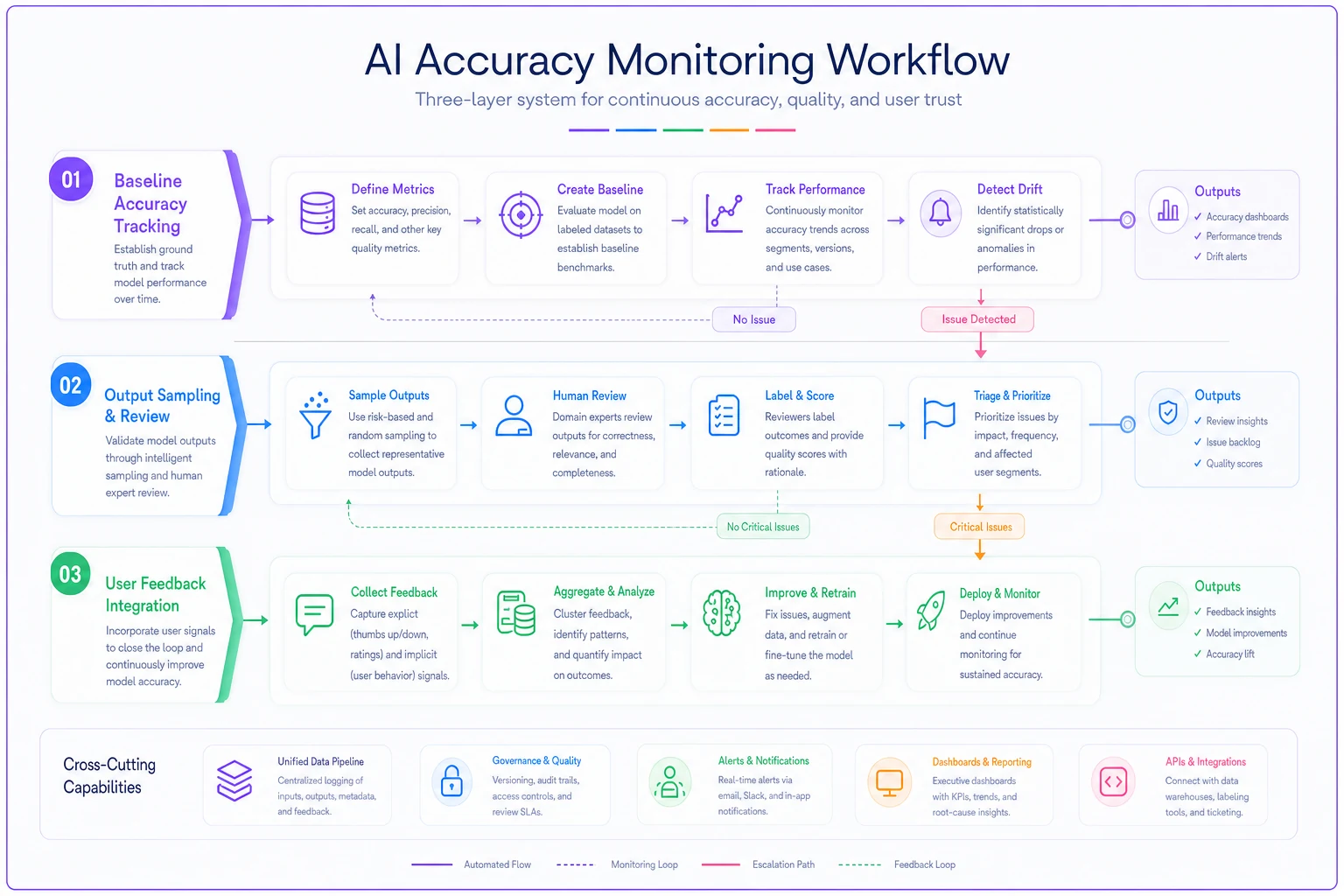
The Accuracy Monitoring Stack You Actually Need
Skip the vendor pitches about comprehensive AI observability platforms. Most teams need something more practical and immediate. Here's the minimal viable monitoring setup based on what actually works:
Layer 1: Baseline Accuracy Tracking
-
Establish accuracy baselines for each AI-powered feature
-
Track accuracy by user segment, not just in aggregate
-
Monitor accuracy drift over time
-
Set thresholds for automatic alerts
Layer 2: Output Sampling & Review
-
Randomly sample 1-3% of AI outputs for human review
-
Flag outputs with low confidence scores for priority review
-
Track patterns in incorrect outputs
-
Document edge cases and failure modes
Layer 3: User Feedback Integration
-
Add lightweight feedback mechanisms (was this helpful? yes/no)
-
Track user-reported inaccuracies
-
Correlate feedback with model confidence scores
-
Create feedback-to-fix SLAs
Prioritize sampling outputs that affect critical user decisions first to maximize early detection value.
Visual of the monitoring workflow.
The goal isn't perfection—it's demonstrable diligence. You need to show you're actively monitoring, measuring, and addressing accuracy issues. Not that you assumed it would be fine.
Rewriting Your Definition of Done
Your team's definition of done probably includes code reviewed, tests written, documentation updated. For AI features under this regulatory lens, you need more:
| Traditional Definition | AI Accuracy Addition |
|---|---|
| Feature works as designed | Accuracy baseline established and documented |
| Tests pass | Accuracy thresholds defined with rationale |
| Documentation complete | User-facing accuracy disclosures written |
| Monitoring configured | Accuracy drift alerts configured |
| Security reviewed | Bias and fairness metrics evaluated |
One team added what they call "accuracy acceptance criteria" to every AI-related user story. Before anything ships, they document: expected accuracy range, how accuracy is measured, what happens when accuracy drops, and what users are told about potential inaccuracies. It's a bit more overhead upfront, but it surfaces problems before they become production incidents.
The Disclosure Dilemma
This is where product teams struggle most. How do you communicate AI limitations without scaring users off or making the product feel perpetually beta?
Most teams end up at one extreme or the other. Either they bury a generic "AI may make mistakes" disclaimer in terms of service nobody reads, or they plaster warnings everywhere until the experience feels paranoid.
The middle path requires precision. Match disclosure prominence to risk level. A movie recommendation? A subtle note about personalization is probably fine. Medical symptom analysis? Clear, prominent accuracy limitations. Financial guidance? Multiple touchpoints about verification needs.
What tends to work: contextual disclosures that surface where users actually make decisions based on AI output. Not buried in onboarding. Not tucked in settings. Right there, inline, at the moment it matters.
Sprint Planning in the Compliance Era
Sprint planning used to follow a familiar rhythm: prioritize features, estimate effort, assign work, build. Now add this wrinkle: every AI feature needs compliance review before it enters a sprint.
This isn't a one-time legal sign-off at launch. It's ongoing as features evolve. That prompt engineering tweak you snuck in? Could change accuracy profiles. That model update? Might shift bias patterns. That new data source? Could introduce exposure you didn't anticipate.
Some teams are creating "compliance stories" for each AI feature—separate backlog items for accuracy benchmarking, monitoring setup, disclosure drafting, and bias testing. These run parallel to feature development rather than getting bolted on at the end.
The overhead is real. Teams typically report somewhere around 20-30% more effort for AI features once they factor in accuracy compliance work. But the alternative—retrofitting compliance after shipping—costs considerably more, in time and in risk.
When Features Fail the Accuracy Bar
Not every AI feature will hit acceptable accuracy thresholds. Some won't come close. The decision becomes: do you ship with limitations, delay for improvement, or kill it?
One team's AI-powered pricing recommendation engine hit 72% accuracy in testing. Not terrible, but not great for something touching pricing decisions. The product manager wanted to ship with disclaimers. Engineering wanted more time. Legal wanted to pull it.
They landed on a fourth path: progressive disclosure with human oversight. The AI suggests prices, but requires human confirmation for variations above 10%. As the model improves, they gradually reduce the oversight threshold. Users get value immediately, risk stays controlled, and the team has time to actually fix the model.
That pattern—AI assists, humans decide—may become the default for a lot of features while accuracy standards continue to develop.
Cross-Functional Coordination Complexity
AI accuracy compliance can't live in one team. Product defines requirements, engineering implements monitoring, legal reviews disclosures, support handles complaints, data science improves models. Without clear ownership, you get gaps everywhere.
Teams that handle this well create explicit RACI matrices for AI features:
-
Responsible
Who ensures accuracy standards are met?
-
Accountable
Who makes the ship/no-ship call?
-
Consulted
Who provides accuracy requirements?
-
Informed
Who needs accuracy updates?
This connects directly to the challenges of coordinating cross-team launches, but with extra complexity around compliance gates and accuracy validation layered on top.
Building Your Incident Response Playbook
When your AI produces problematic outputs at scale—and eventually it will—you need a response plan that goes beyond standard incident management. Accuracy incidents require specific decisions:
Detection & Triage
-
How do you identify accuracy degradation?
-
What's the threshold for declaring an incident?
-
Who makes the call to intervene?
Immediate Response
-
Do you throttle the feature?
-
Switch to fallback logic?
-
Increase human oversight?
-
Update user communications?
Resolution & Follow-up
-
How do you determine root cause?
-
What's the process for model retraining?
-
How do you validate fixes?
-
What documentation is required?
One team implemented "accuracy circuit breakers"—automatic throttling when accuracy metrics drop below predetermined thresholds. The feature doesn't fail completely; it just serves fewer users while the team investigates. Simple idea, but it buys time without a full outage.
The Roadmap Reshuffling Reality
Your Q3/Q4 roadmap probably didn't account for AI accuracy compliance work. Now you're weighing whether to delay features, reduce scope, or add resources.
Most teams end up with something like a three-phase approach:
Phase 1: Stop the Bleeding (Sprint 1-2)
-
Add basic accuracy monitoring to production features
-
Draft initial user disclosures
-
Document current accuracy baselines
-
Create incident response procedures
Phase 2: Systematic Improvement (Sprint 3-6)
-
Implement comprehensive monitoring
-
Establish accuracy acceptance criteria
-
Add automated accuracy testing
-
Refine disclosure language
Phase 3: Operational Excellence (Sprint 7+)
-
Build accuracy dashboards
-
Automate compliance reporting
-
Implement continuous model evaluation
-
Create accuracy improvement pipelines
Teams that do this well stop treating it as compliance overhead and start treating it as product work. When accuracy monitoring makes the product better—not just legally defensible—the overhead stops feeling like a tax.
The Competitive Angle Nobody's Talking About
Everyone's focused on the compliance burden. The flip side doesn't get much attention. If the FTC enforces strict accuracy standards, teams that invested in monitoring and transparency early are in a genuinely better position.
If your competitor ships a flashy AI feature with 60% accuracy and no disclosure while you ship something similar with 85% accuracy and clear transparency, who's in better shape when enforcement ramps up?
Teams building accuracy infrastructure now aren't just managing risk—they're building a process advantage. When accuracy becomes table stakes, the teams with mature monitoring and improvement pipelines will iterate faster and ship with more confidence than teams starting from scratch.
Making Accuracy Compliance Operational
The gap between policy proposals and operational reality is where most teams get stuck. You can't just add "be accurate" to your acceptance criteria and move on. You need systematic approaches that actually integrate into existing workflows.
Start with measurement standardization. Every AI feature needs consistent accuracy metrics tied to user impact. A chatbot giving wrong restaurant hours has different accuracy requirements than an AI analyzing medical images—treat them accordingly.
Automate what you can. Manual accuracy reviews don't scale. Build automated testing pipelines that continuously evaluate model outputs against known good examples, flag anomalies for human review, and let machines handle routine validation.
Make accuracy visible across the organization—not just to compliance teams or lawyers. When engineers see accuracy metrics alongside latency and error rates, when product managers track accuracy trends the same way they track engagement, when support can pull accuracy stats before responding to a complaint, that's when compliance actually becomes part of how you operate.
The FTC's focus on AI accuracy isn't going away. The public comment period might reshape some details, but the direction is clear. Product teams that adjust their roadmaps, release processes, and monitoring infrastructure now will be in a much better spot than those who wait to see how enforcement shakes out.
Your next sprint planning session needs a new question on the table: not just "can we build it?" but "can we build it accurately enough, monitor it thoroughly enough, and communicate about it transparently enough?" Teams that can answer yes to all three are in a good position. The rest have some work to do.
Ready to elevate your product management?
Join 2,000+ product teams using Itemyly to accelerate delivery, improve alignment, and build better products.