

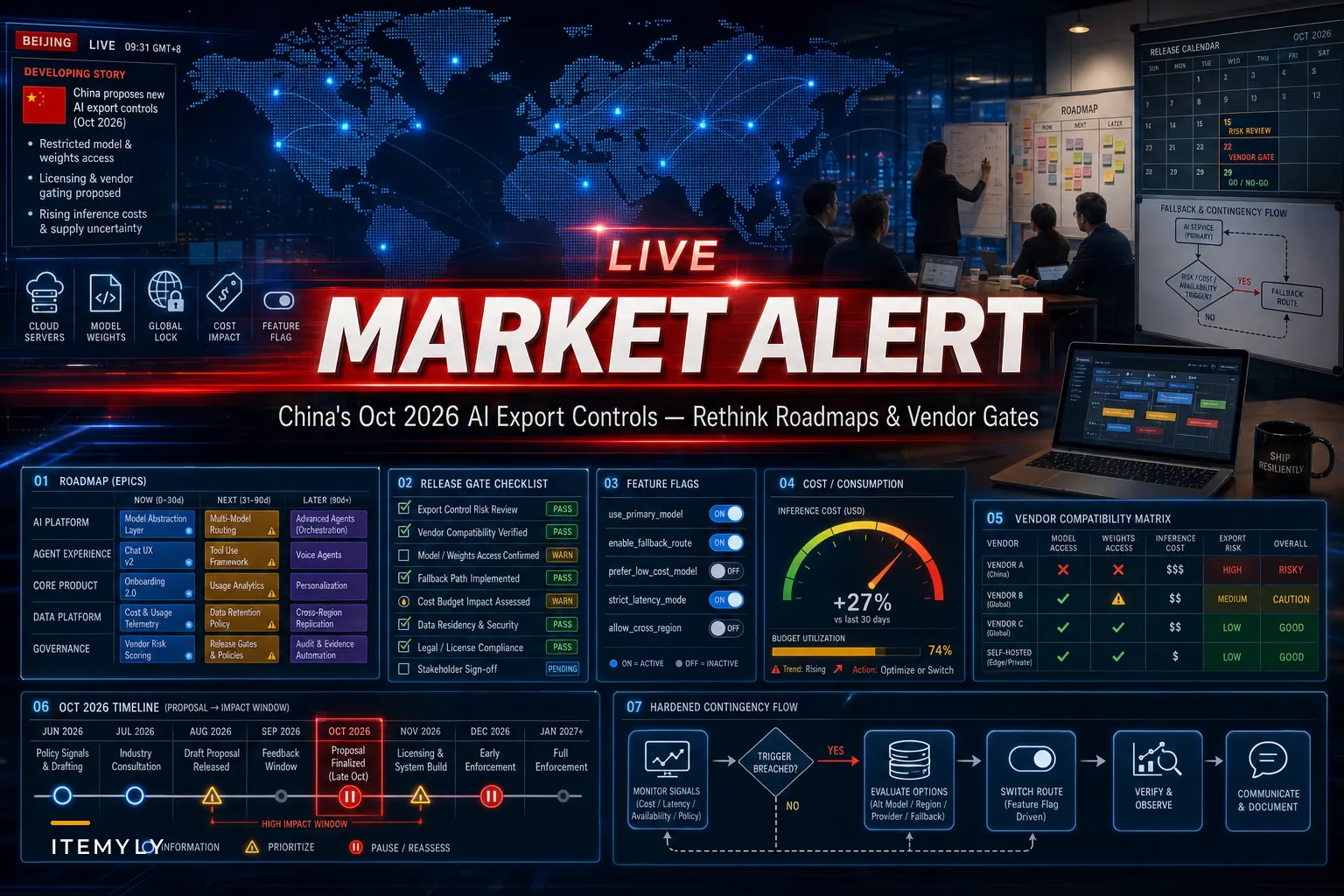

Most roadmaps built in the last 18 months quietly assumed one thing: that model access, GPU capacity, and agent tooling would stay cheap, abundant, and easy to swap. That assumption is shakier than it was a month ago.
China's commerce ministry proposed adding roughly 23 AI-related technologies — advanced models, model weights, multi-agent capabilities, and associated chip and software items — to its restricted-export list. Reuters described the move as drawing a line around the country's "AI crown jewels", and Bloomberg had earlier reported the draft was aimed at exerting control over models, chips, and agents.
Whether or not these specific rules land in their current form, they expose something product teams tend to ignore until it hurts: your AI features sit on top of a supply chain you don't control, and that supply chain has geopolitical seams running through it. This post isn't about trade policy. It's about what you do on Monday when your roadmap has three agent-driven features in flight and your CFO starts asking whether your model vendor has a single point of failure buried somewhere in a chip fab or a weights license you've never actually read.
Why this hits product roadmaps harder than most macro news
Interest rate changes and cloud price hikes move your costs. Export controls can move your access. That's a different category of risk, and most prioritization frameworks don't handle it well.
When you score a feature with RICE or weighted effort models, you're implicitly assuming the thing you're building will be buildable and shippable on roughly the timeline you estimated. Export controls introduce a failure mode that sits outside your effort estimate entirely. The feature could be fully built, tested, and ready to ship — and then stuck because a dependency three layers down becomes restricted, repriced, or legally murky.
Teams with the most aggressive AI roadmaps usually have the least visibility into where their capabilities actually come from. They know they're calling an API. They often don't know which underlying model, which hardware, or which jurisdiction is involved. That gap is fine when supply is abundant. It becomes a real problem the moment any part of the chain gets constrained.
The deeper issue isn't China specifically. It's that AI features created a new class of vendor dependency that moves faster and is harder to inspect than anything product teams dealt with in the SaaS-integration era. A payment API changing its terms gives you months of warning. Model access and compute availability can shift on a policy announcement.
The dependency you can't see on your roadmap
Most roadmaps track features. A few track vendor dependencies. Almost none track the stack beneath their vendor dependency.
Eliminate product chaos and align your team.
Itemyly helps you plan, prioritize, and track every product milestone seamlessly.
- Centralized roadmap management
- Stakeholder collaboration
- Release tracking & analytics
No credit card required
Think about a typical agent feature. You call a provider's API. That provider runs inference on GPUs. Those GPUs came from a specific manufacturer. The model weights were trained under a license. There may be fine-tuning tooling or a secondary model from a different region somewhere in the pipeline. Each of those layers is a potential chokepoint, and your roadmap probably represents all of it as a single line item: "integrate agent orchestration."
A common scenario looks something like this. A mid-market SaaS team ships a document-summarization agent built on a provider they picked mostly on price. Nine months later, that provider raises per-token costs by 40% because their own GPU supply tightened. The team never built the feature to be portable, so switching providers means rewriting prompt chains, re-tuning outputs, and re-running their entire eval suite. What looked like a two-week vendor swap becomes a six-week project nobody budgeted for.
The export-control news just makes this concrete. The question to ask your team isn't "are we affected by these rules." It's "if any single layer under our AI features became 30% more expensive or temporarily unavailable, how long until we'd feel it, and how long to recover?"
Most teams can't answer that. That's the actual problem.
Adding vendor and export-risk gates to prioritization
You don't need a new scoring framework. You need two or three extra questions in the one you already use, applied specifically to AI and agent bets.
| Gate question | Red flag answer | What it changes |
|---|---|---|
| Can we name every layer this feature depends on? | "Not really, it's just the API" | Feature can't pass until mapped |
| How many providers could deliver this capability? | One, with no realistic substitute | Portability work becomes part of the estimate |
| What's our exposure if unit costs double? | Margin goes negative at current pricing | Needs a cost gate before launch |
| Is any dependency subject to export or licensing restrictions? | Unknown | Legal/procurement review required |
| How fast could we ship a degraded fallback? | We can't, it breaks entirely | Build a non-AI path first |
The point of these gates isn't to kill AI features. It's to stop you from making irreversible commitments on top of dependencies you haven't inspected. A feature that scores high on RICE but can't answer the top two rows is carrying hidden risk that will surface at the worst possible time.
Run the gate again before launch and whenever a dependency's pricing or availability shifts materially.
One thing worth flagging: teams often treat these gates as a one-time check at kickoff. Supply conditions change mid-build. The gate should run again before launch and get revisited any time a dependency's pricing or availability shifts materially.
Cost observability as an acceptance criterion
Consumption-based AI pricing already made costs variable in a way most product teams weren't structured for. Supply constraints make that variability sharper and harder to predict.
-
What does this cost per action, per user, per session?
-
What's the cost at 10x current volume?
-
Where's the alert threshold if per-unit cost suddenly climbs?
-
Who owns the response when it does?
This sounds obvious written down. In reality, a large share of AI features ship with no per-feature cost telemetry at all. The costs land in one blended cloud bill, and nobody can tell you which feature is responsible for the spike. When pricing moves — whether from supply constraints, provider changes, or demand — you're flying blind.
We walked through the mechanics of consumption-based AI costs and agent-feature reprioritization in more depth in our breakdown after DevDay, and the same discipline applies doubly here. The moment your input costs can move on external policy, per-feature cost observability stops being nice-to-have and becomes the thing that keeps your margins from quietly eroding.
A fallback-first release strategy for AI features
The single most useful shift: stop designing AI features as all-or-nothing, and start designing them with a degraded mode from day one.
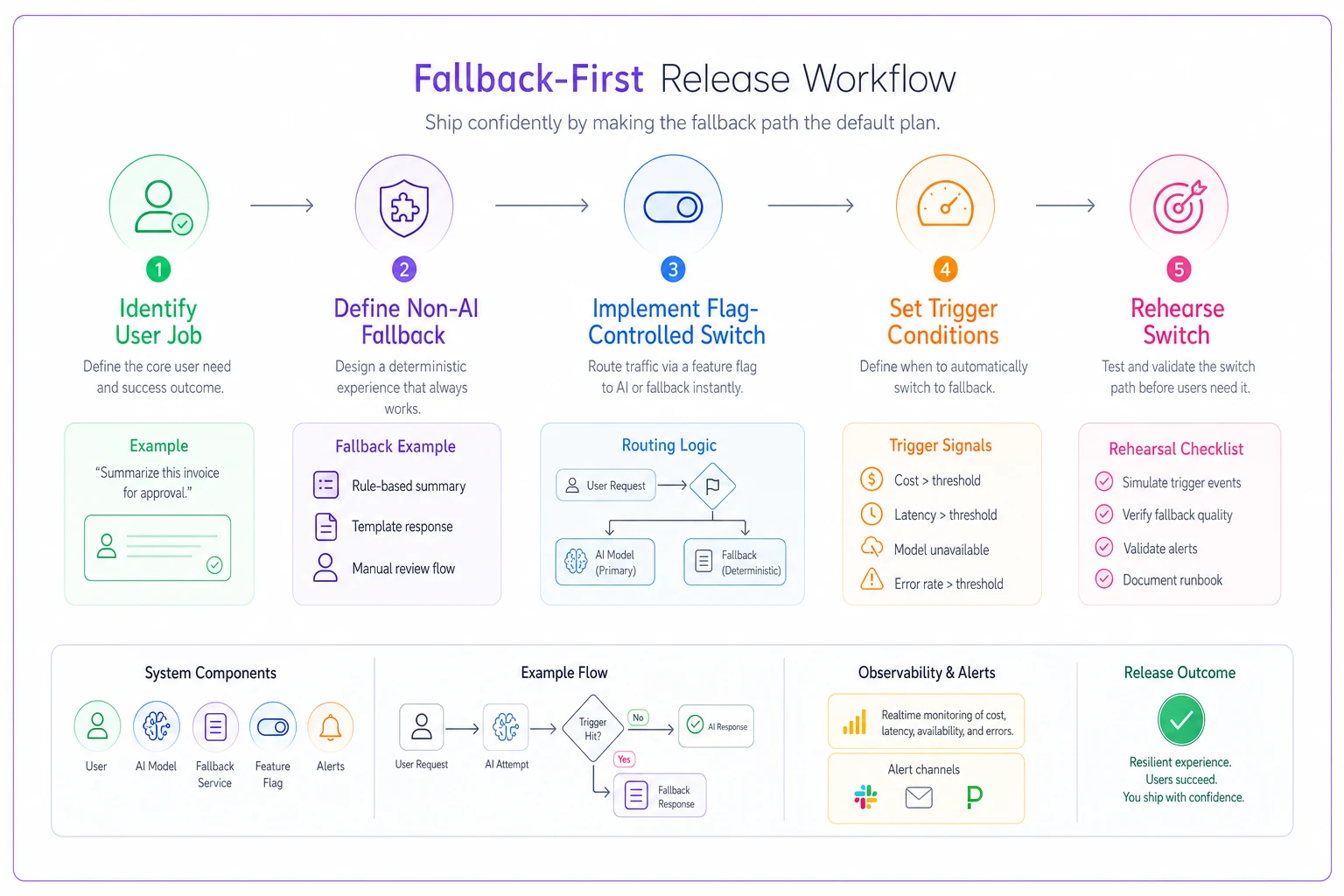
A practical process for retrofitting this into your roadmap:
-
Identify the user job, not the AI feature. A user doesn't want "an AI agent." They want their invoices categorized, their tickets routed, their draft written. Separate the job from the method.
-
Define a non-AI or lighter-AI path that still does the job — slower, more manual, or less polished, but functional. Rules-based routing instead of a model. A template instead of generation. Human-in-the-loop instead of full automation.
-
Build a switch between them at the feature level, ideally flag-controlled, so you can degrade gracefully without a deploy.
-
Set the trigger conditions explicitly
cost per action exceeds X, provider latency exceeds Y, availability drops below Z.
-
Rehearse the switch at least once before you need it. A fallback you've never tested is a theory, not a plan.
A realistic example: a team running an AI-powered support triage feature sets a rule that if their model provider's cost-per-ticket crosses a defined ceiling, the system falls back to keyword-based routing plus a flag for human review. Triage gets slightly worse. Nobody's workflow breaks. Costs stay bounded. The feature survives a supply shock that would have otherwise forced an emergency scramble.
Here's a simple workflow for implementing a fallback-first release.
This is the part teams skip because it feels like building the feature twice. You're not. You're building the feature once and the safety valve once. The safety valve is cheap compared to the cost of a core feature going dark with no plan.
When to actually slow down your AI roadmap
This matters most if you've built core, revenue-tied functionality on a single AI provider with no substitute, your margins are thin enough that a cost spike hurts, or you've committed AI capabilities to customers in contracts or public roadmaps. In those cases, dependency mapping and fallback planning should move up your priority list now, not next quarter.
This matters less if your AI features are additive conveniences rather than core workflows, your volumes are low enough that even a large cost increase is a rounding error, or you've already built provider-agnostic abstractions. Don't manufacture an emergency where there isn't one.
What you probably shouldn't do is freeze all AI work or rip out every dependency. That's the overcorrection. The goal is visibility and optionality, not retreat. A team that panics and reverts to pre-AI workflows usually loses more to lost capability than they ever would have lost to a supply disruption.
The judgment call comes down to: how central is the capability, how substitutable is the dependency, and how exposed are your margins. High on all three means act now. Low on all three means note it and move on.
The underlying problem this exposes
Strip away the specifics and what's left is this: product teams got comfortable treating AI capability as infrastructure — always on, always cheap, always swappable — before it earned that status. Real infrastructure, the boring kind, took decades to become reliable enough to ignore. AI dependencies aren't there yet.
The teams that come out of this period in good shape won't be the ones who predicted the policy correctly. They'll be the ones who built roadmaps that assume inputs can change, who know exactly what sits under each feature, who can tell you the cost per action, and who have a tested fallback for anything core.
That's not a reaction to one country's export list. It's mature dependency management applied to a layer of the stack that moved so fast most teams never applied it. The export-control news is a useful prompt to finally do the unglamorous work: map what you depend on, gate your AI bets on real risk questions, make costs observable per feature, and never ship a core capability without a way to degrade it gracefully.
Do that, and the next supply shock — whatever its source — becomes a planning conversation instead of a fire drill.
Ready to elevate your product management?
Join 2,000+ product teams using Itemyly to accelerate delivery, improve alignment, and build better products.