

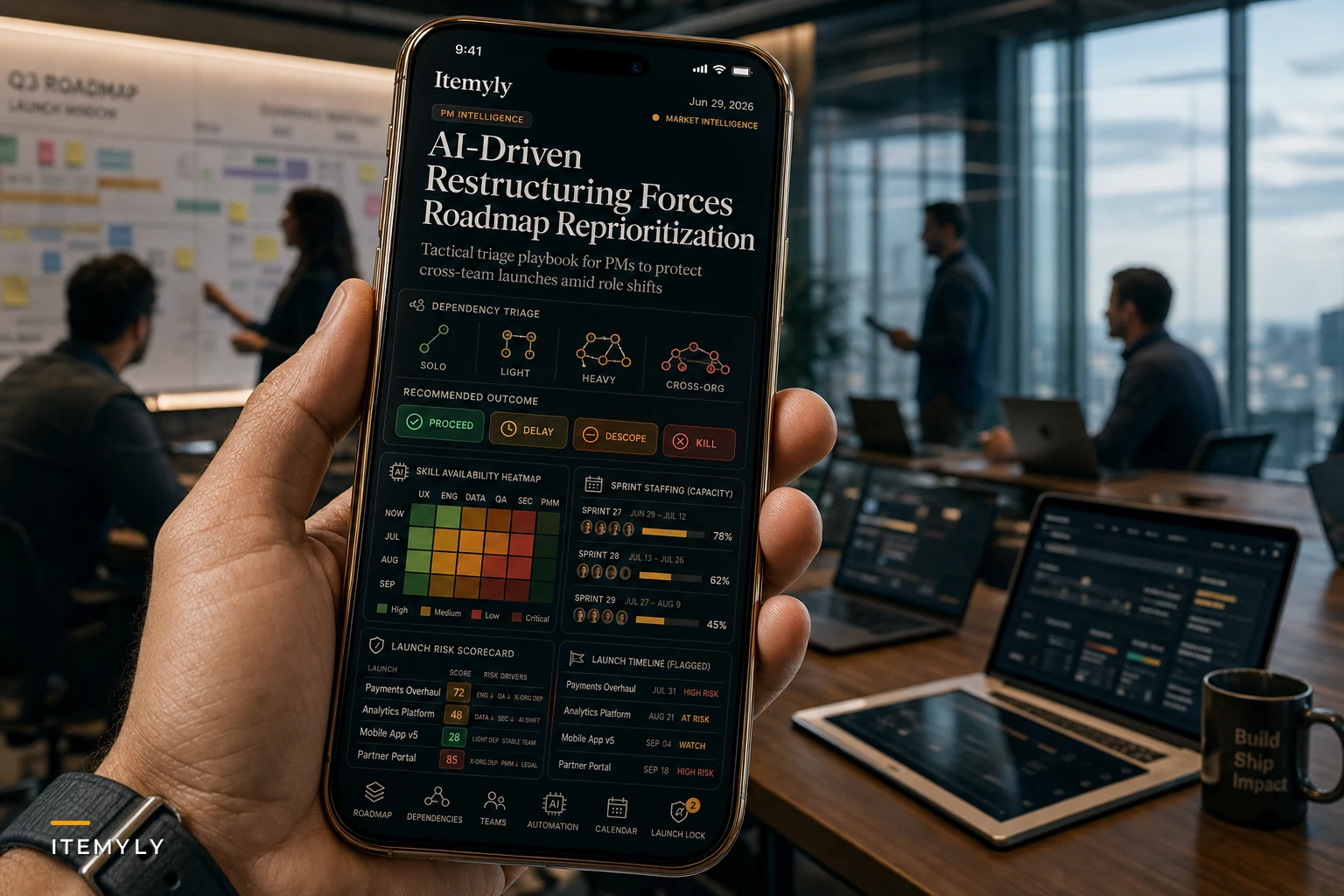

The Gallup workplace research from last week dropped a reality check product managers can't ignore: tech workers who don't regularly use AI face significantly higher layoff risk. Then TechCrunch's reporting documented the actual restructuring wave hitting major firms, with entire product teams getting consolidated or eliminated based on their AI adoption levels.
This isn't theoretical anymore. Product organizations are waking up to find their mobile team merged with web, their QA engineers reassigned to AI training projects, and their carefully planned Q3 launches suddenly missing half their dependencies. The roadmaps we spent weeks negotiating in January? Obsolete.
The restructuring patterns breaking traditional roadmap planning
What makes AI-driven restructuring particularly brutal for roadmap prioritization is how it hits multiple dimensions at once. Traditional layoffs usually targeted specific products or regions. These reorganizations cut across teams based on skillsets and automation potential, which creates dependency chain chaos that's genuinely hard to untangle.
A fintech PM I worked with last month discovered their payments team lost three engineers to an "AI efficiency initiative" while simultaneously being asked to accelerate their checkout redesign by six weeks. The kicker? The remaining engineers had to spend 30% of their time training the new AI coding assistants that management insisted would "make up for the headcount reduction."
The dependency mapping they'd done in Q1 became useless almost overnight. Features relying on the payments team's API updates suddenly had no owner. The mobile team waiting on those APIs still had their full headcount but nothing to build against. Meanwhile, the data team got doubled in size to support new AI initiatives, creating a bottleneck where none had existed before.
Your roadmap assumptions about team velocity, skill availability, and cross-team coordination all break at once. The careful balance between feature development and technical debt collapses when you lose the engineers who actually understood the legacy systems.
Why standard reprioritization frameworks fail during AI transitions
Most product teams reach for their standard frameworks when restructuring hits—RICE scores, value vs. effort matrices, customer impact assessments. These tools assume stable team composition and predictable velocity.
Eliminate product chaos and align your team.
Itemyly helps you plan, prioritize, and track every product milestone seamlessly.
- Centralized roadmap management
- Stakeholder collaboration
- Release tracking & analytics
No credit card required
During AI-driven reorganizations, those assumptions don't hold. That high-value feature requiring frontend and backend coordination? Your frontend team just got merged with another product line and is now supporting two separate codebases. The effort estimate goes from 3 sprints to "unknown."
The technical debt you'd scheduled for Q4? Half the engineers who understood that code are gone, and the new AI tools can't parse a custom framework from 2019. What was a 2-week refactor becomes a 3-month rewrite.
What tends to happen next is product managers start making panic decisions—pivoting to whatever can ship with existing resources regardless of strategic value, cutting scope so aggressively that launches become empty shells, pushing everything to "next quarter" hoping things stabilize. And then doing the same thing again the quarter after that.
Building an AI-transition roadmap triage system
The teams that successfully navigate these transitions treat the reorganization as a hard constraint rather than a temporary disruption. They build explicit triage criteria for their existing roadmap rather than starting from scratch.
First, they categorize every roadmap item by its dependency footprint:
Solo-team features: Can be completed by a single team without external dependencies
Light coordination: Requires input or review from one other team
Heavy coordination: Needs active development from multiple teams
Cross-org initiatives: Involves teams across different reporting structures
During restructuring, solo-team features become your lifeline—they're the only items where you maintain real control over delivery. A messaging platform shifted roughly 70% of their Q3 capacity to solo-team work when their org restructured, which let them maintain release momentum while larger initiatives got replanned.
Next, they assess skill requirements against their post-restructuring reality:
| Feature Type | Pre-Restructure Team | Post-Restructure Reality | Viability |
|---|---|---|---|
| API modernization | 4 backend engineers with system knowledge | 2 engineers remain, 1 new AI assistant | Delay - knowledge gap too large |
| Dashboard redesign | 3 frontend, 1 designer | Full team intact, designer moved to AI products | Proceed with contractor designer |
| ML recommendation engine | 2 ML engineers planned hire | ML team expanded to 5 | Accelerate - new opportunity |
| Mobile performance | 3 mobile engineers | Team merged with web, competing priorities | Descope to critical fixes only |
The assessment gets brutal, but it gets clear fast. Features requiring specialized knowledge from departed team members get delayed. Work that aligns with new AI priorities gets accelerated. Everything else gets descoped to minimum viable versions.
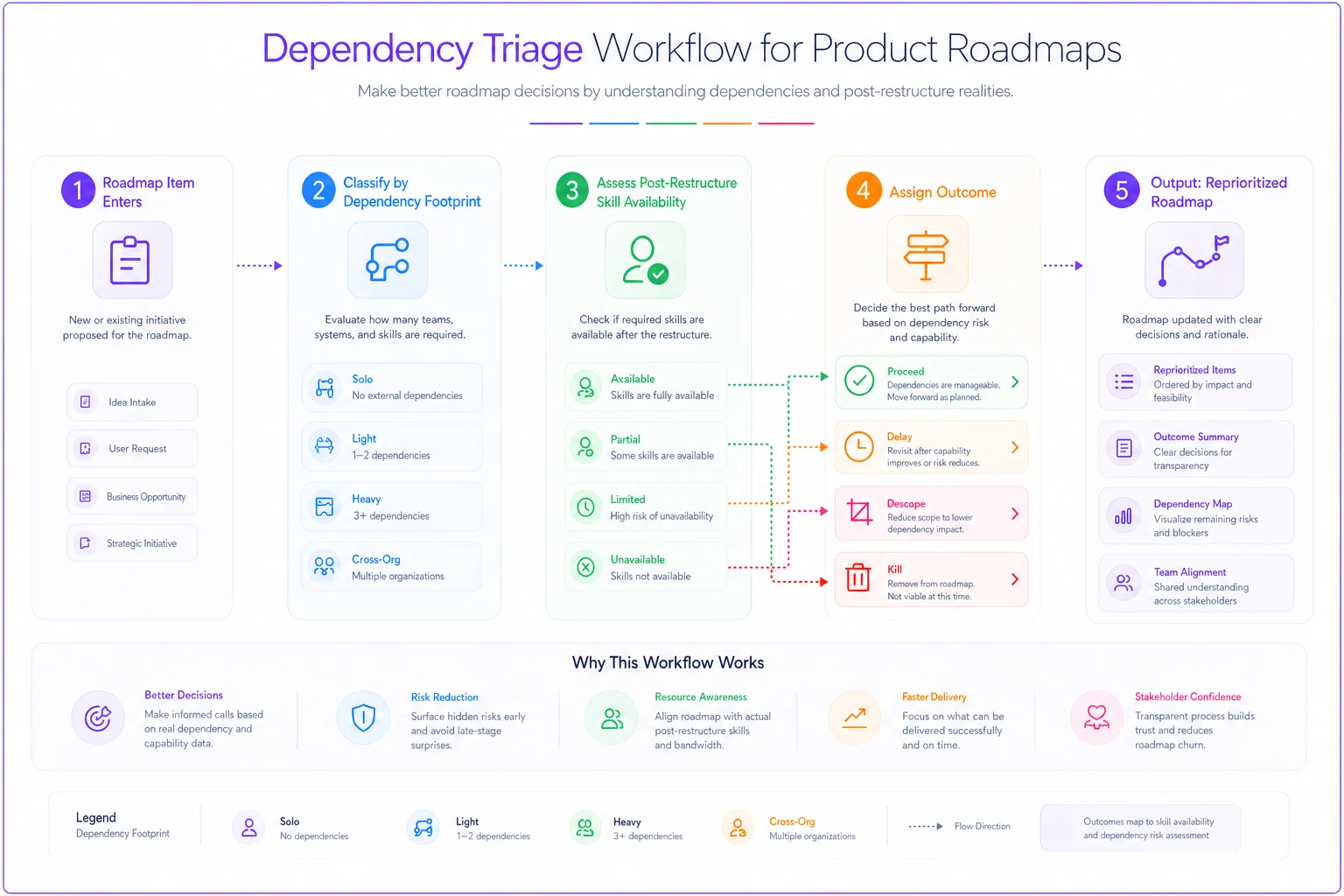
Run this triage in a single 90-minute working session per roadmap area to get quick alignment before stakeholders demand answers.
The teams that do this exercise early—before stakeholders start asking questions—are the ones who avoid the panic spiral entirely.
Securing cross-team launches when reporting structures shift
The hardest challenge during all of this isn't individual features—it's the cross-team launches that define your competitive position. When engineering teams get shuffled based on AI capabilities rather than product alignment, carefully orchestrated release plans fall apart fast.
A marketplace platform learned this the hard way when their seller tools team got split between "AI-enhanced" and "traditional" development groups mid-launch. The two halves now reported to different VPs with different OKRs. The unified seller dashboard they'd been building became two separate initiatives with incompatible timelines.
Successful teams create explicit launch contracts that survive reporting changes. Instead of relying on informal agreements and shared Slack channels, they document specific deliverables with acceptance criteria, handoff dates with buffer time built in, escalation paths that don't depend on previous reporting structures, and fallback plans if dependencies fail.
They also identify launch champions in each affected team—usually senior engineers who survived the restructuring and understand both the technical requirements and the political dynamics. These people become the connective tissue when management structures shift.
One pattern that consistently works: breaking large launches into smaller, independent releases. Instead of a single Q3 launch requiring coordination across five teams, you ship five smaller features that each provide standalone value. When two of those five teams get reorganized, you still deliver three features instead of nothing.
Managing technical debt when institutional knowledge evaporates
AI-driven restructurings create a hidden crisis that doesn't show up until something breaks: the engineers who understood your technical debt often leave or get reassigned. That authentication system everyone complained about but nobody wanted to touch? The only person who knew how it worked just got moved to the AI platform team.
Traditional technical debt approaches assume knowledge continuity. You could defer fixing that legacy payment processor because Sandra knew all its quirks. When Sandra's role gets eliminated, that debt becomes a ticking time bomb.
Systems with lost institutional knowledge need immediate documentation or replacement—you can't defer them anymore. A logistics platform discovered this when their warehouse integration started failing after their restructuring. The engineer who'd built it was gone, the documentation was three years out of date, and the AI coding assistant couldn't parse the custom protocol they'd implemented. What should've been a routine maintenance window turned into a two-week emergency.
Smart teams create "knowledge insurance" before restructurings hit:
Code archaeology sprints: Dedicated time to document critical but obscure systems
Rotation requirements: Multiple engineers must touch critical systems quarterly
Simplification mandates: Complex systems get simplified before the knowledge holder leaves
AI-readable documentation: Systems documented in ways AI assistants can actually parse and understand
Converting disruption into competitive advantage
While most teams scramble to maintain their existing roadmaps during restructuring, the sharper product organizations use the chaos as cover for strategic pivots they couldn't otherwise justify.
An ecommerce platform used their AI restructuring to finally kill their legacy mobile app. They'd wanted to move to a progressive web app for two years but couldn't get buy-in. When the mobile team got dissolved and redistributed, they positioned the PWA as the "AI-efficient solution" that required fewer specialized resources. The restructuring gave them political cover to make a change that would've taken six months of stakeholder management otherwise.
The key is identifying which sacred cows become vulnerable during reorganization: legacy products with dedicated teams that no longer exist, complex integrations that required specialized knowledge, feature parity requirements that assumed stable team structures, technical debt that only affected now-departed stakeholders.
You frame these changes as responses to the new organizational reality rather than strategic choices. "We can't maintain the legacy API without the original team" carries more weight than "We should sunset the legacy API."
Creating operational stability through platform consolidation
The most successful responses to AI restructuring involve reducing operational complexity rather than trying to maintain it with fewer resources. Most product teams do the opposite—they try to preserve every feature and commitment with half the people, which just spreads the damage around.
A productivity software company audited their entire product surface area immediately after their restructuring hit. They found 14 different admin interfaces across products, 8 authentication systems from various acquisitions, 23 different notification mechanisms, and 6 separate billing implementations. Pre-restructuring, each had a dedicated team or owner. Post-restructuring, they had roughly 60% of their original engineering capacity.
Instead of maintaining everything with skeleton crews, they made a strategic call: consolidate aggressively. They picked the best-in-class solution for each category and migrated everything else. Some products lost unique features. But their remaining teams could actually deliver instead of drowning in maintenance.
The consolidation roadmap became their North Star through the chaos. Every sprint, teams migrated one system to the consolidated platform. By month four, they were shipping faster than before the restructuring, despite having fewer engineers. Not every team will get that outcome, but the direction of the bet was right.
Building AI-augmented workflows without losing launch velocity
The pressure to incorporate AI during restructuring creates another problem: you're supposed to ship AI features while your team is learning AI tools while your org structure is in flux. Most teams handle this poorly, creating parallel work streams that never converge.
A legal tech platform tried to maintain their existing roadmap while adding an "AI layer" on top. Neither shipped on time. Core features got delayed because engineers were in AI training. The AI features were shallow because the team didn't understand the underlying workflows deeply enough.
The teams that succeed integrate AI augmentation into their existing roadmap rather than treating it as a separate initiative. They find specific workflow bottlenecks that AI can address without requiring architectural overhauls:
Documentation generation: AI creates first drafts of technical docs from code
Test case generation: AI suggests test scenarios based on code changes
Code review assistance: AI flags potential issues before human review
Deployment validation: AI monitors for anomalies post-deployment
These augmentations improve existing processes without requiring new features or user-facing changes. A project management platform implemented AI-assisted code reviews during their restructuring—no product changes required, but it reduced review time by roughly 35%, enough to meaningfully offset their reduced headcount.
The trick is choosing AI augmentations that provide immediate operational value rather than speculative future benefits. Every AI investment should make your current roadmap more achievable, not add to it.
When to abandon ship versus when to double down
Not every roadmap item survives restructuring, and trying to save everything guarantees you'll deliver nothing. Knowing what to kill completely versus what to protect is genuinely the hardest part of navigating this.
Features worth abandoning during restructuring:
-
High-maintenance items with declining usage
-
Experimental initiatives without proven value
-
Geographic expansions requiring local expertise that no longer exists on the team
-
Platform migrations with unclear ROI
-
Nice-to-have improvements to otherwise stable features
Features worth protecting despite restructuring:
-
Revenue-generating core functionality
-
Regulatory compliance requirements
-
Key customer commitments with penalties
-
Competitive differentiators under active threat
-
Technical foundations for future products
A social media management platform made this calculation when their restructuring eliminated their analytics team. Two major initiatives were in flight: a new analytics dashboard and improvements to their core scheduling engine. The analytics dashboard had executive support and looked impressive in demos. The scheduling engine drove 80% of revenue. They killed the dashboard completely, reassigned those resources to scheduling, and ended up with a better core product despite losing roughly 40% of their engineers. Not an easy call, but the right one.
Renegotiating stakeholder expectations without losing credibility
The political dimension of AI restructuring often hurts more than the operational challenges. You made commitments based on resources you no longer have. Stakeholders expect deliveries you can't make. The temptation is to promise you'll somehow figure it out.
This is where most product managers destroy their credibility. They agree to unrealistic timelines hoping things improve, commit to scope they can't deliver, promise AI will magically solve resource constraints.
-
Immediate transparency
Communicate changes within 48 hours of understanding the impact
-
Specific tradeoffs
Present exact options, not vague promises
-
Protected commitments
Identify non-negotiable deliveries and protect them fiercely
-
Regular updates
Over-communicate progress, especially on stretched timelines
A financial services platform demonstrated this when their restructuring killed their new onboarding flow. Instead of promising they'd "figure it out," the PM immediately presented three options: delay launch by 3 months to rebuild with the new team, ship a minimal version in 6 weeks with reduced functionality, or redirect resources from another project to maintain the original timeline. Each option included specific feature lists, resource requirements, and business impact. Stakeholders chose option two, understanding exactly what they were trading. The PM's credibility actually went up because they navigated the crisis without sugarcoating it.
Creating sustainable velocity with restructured teams
After the initial chaos settles, teams face a longer-term challenge: establishing sustainable velocity with their new structure. The temptation is to immediately push for pre-restructuring productivity levels. This burns out remaining team members and creates quality problems that compound over time.
An enterprise software company pushed their reduced team to maintain the same release cadence after their AI restructuring. Production incidents tripled. The time saved by shipping faster got consumed by emergency fixes and customer escalations.
Sustainable velocity requires accepting a temporary slowdown while teams rebuild muscle memory—longer sprint cycles initially (3 weeks instead of 2), reduced commitment per sprint (around 60% of previous velocity), additional time for knowledge transfer and documentation, and real investment in tooling and automation to offset headcount losses.
Most importantly, it means resetting baselines rather than comparing to pre-restructuring metrics. Your new normal might be 70% of previous velocity, but with better quality and fewer fires. That's a trade worth making.
The path forward: building antifragile product organizations
The current wave of AI restructuring won't be the last disruption product teams face. The organizations that thrive are building systems that get stronger under stress rather than just surviving it.
This means real changes to how roadmaps and teams are structured: smaller, independent units that can deliver value without complex dependencies, shorter planning horizons with quarterly roadmaps instead of annual plans, redundant capabilities so multiple team members can cover critical functions, and automated operations that reduce manual coordination overhead.
The operational patterns that help navigate AI restructuring—ruthless prioritization, explicit dependency management, platform consolidation—aren't temporary fixes. They're the foundation of resilient product organizations.
Some teams will try to wait out the disruption, hoping things return to normal. They won't find what they're looking for. The smartest product organizations recognize that constant adaptation is the new normal, and they're using this restructuring as practice for the next one, building operational muscles that make them stronger regardless of what changes come.
For teams looking to systematize cross-team coordination during these transitions, our PM orchestration playbook covers battle-tested patterns for maintaining release predictability even as team structures shift. The frameworks there become especially critical when you're coordinating across newly formed teams with different tools, processes, and priorities.
The restructuring will end. The operational capabilities you build while navigating it will define your competitive position long after.
Ready to elevate your product management?
Join 2,000+ product teams using Itemyly to accelerate delivery, improve alignment, and build better products.